
Early Music A Cappella Recordings
Much of the earliest music was composed for the unaccompanied voice reaching a peak during the Renaissance when there was flowering of talented European composers. Many of these composers were true musical geniuses and whose work is still vibrant and relevant today. We offer here a far ranging collection of these works performed by the top vocal ensembles from both Europe and the US.
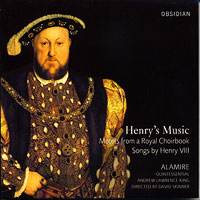 |
O Christe Jesu, pastor bone - Taverner King's Pavan - Anonymous England Be Glad - Anonymous Consort XII - Henry VIII Madame d'amours - Anonymous Tandernaken - Henry VIII Salve radix - Sampson Psallite felices - Sampson Sub tuum presidium - Benedictus de Opitiis Quam pulcra est - Sampson Hec est preclarum - Anonymous Beati omnes - Jacotin Consort XIII - Henry VIII O my heart - Henry VIII Helas madame - Henry VIII Though some saith - Henry VIII Nil majus superi vident - Philippe Verdelot Consort VIII - Henry VIII Adieu madame - Henry VIII En vray amoure - Henry VIII Lauda vivi alpha et oo - Robert Fayrfax |
Alamire won the British Library contract to record the soundtrack for their 2009 exhibition celebrating 500 years since the coronation of Henry VIII. 'Henry's Music' includes a world premiere recording of the contents of MS Royal 11.e.xi (a royal choirbook gifted to King Henry in around 1518), which is to produced in full-colour facsimile by the Folio Society, and tribute motets by Robert Fayrfax, Philippe Verdelot, and John Taverner. Alamire is joined by the cornet and sackbutt ensemble QuintEssential and gothic harpist Andrew Lawerence-King.
Listen to "England Be Glad" in Real Audio.
| 9010 CD $17.95 |
 |
The political intrigue of the early 17th century culminated with the execution of Charles I in 1649 and the beginning of the Commonwealth led by the Lord Protector Oliver Cromwell. Thomas Tomkins, the greatest composer of that age, wrote a pavan for ‘these distracted times’ shortly after the King’s execution. This CD provides a mixture of Tomkin’s church and chamber music that soothed troubled souls during these turbulent years. The recording was made in the chapel of Sidney Sussex College, Cambridge, where Cromwell was a student and where his severed head remains.
|
 |
Philippe Verdelot was the most important composer of Italian madrigals in the early 16th century and recognized as the greatest innovator of the genre. A Frenchman, he occupied several important musical posts in Italy, including the Florentine posts of maestro di cappella at the Baptistry of S. Maria del Fiore and the great Duomo itself. In the mid 1520s, during his time in Florence, a set of part-books were assembled, probably under Verdelot's supervision, for the court of Henry VIII. Most, if not all, of the works were composed by Verdelot. This is the first recording of the complete madrigals in the collection, which stands not only as the most exceptional of diplomatic musical gifts but is also an important source for the history of the early madrigal. Listen to "Afflicti spirti mei" in Real Audio.
|
 |
Josquin Desprez is widely recognized as the greatest of the Renaissance master musicians. He set the standard for the various compositional techniques borrowed and utilized by most composers of his generation and beyond, and became an iconic figure whose art captivated musicians and scholars for centuries. This recording centres around some of Josquin’s earliest works, and, in particular, his fascination with the D’ung aultre amer rondeau composed by his teacher Johannes Ockeghem. Also included are some of his most popular motets and chansons performed here by a solo voice (Clare Wilkinson) with renaissance harp (Andrew Lawrence-King).
|
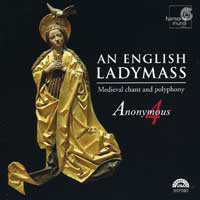 |
Prosa: Gaude virgo salutata (chant) Polyphonic song: Edi beo thu hevene quene Introit: Salve mater redemptoris/ Salve lux langentium/ Salve sine spina/ Salve sancta parens Motet: Lux polis refulgens/ Lux et gloria Kyrie: Kyria christifera Gloria Motet: Spiritus et alme/ Gaude virgo salutata Song: Miro genere Gradual: Benedicta et venerabilis Alleluia: Alme iam ad gaudia/ Alme matris dei/ Alleluya per te dei Sequence: Missus Gabriel de celis Prosa: Gaude virgo gratiosa (chant) Polyphonic song: Salve virgo virginum Offertory: Felix namque (chant) Sanctus and Benedictus Sequence/Song: Jesu Cristes milde moder Agnus dei: Virtute numinis Communion: Beata viscera (chant and song) Rondellus: Flos regalis Chant setting: Ite missa est Hymn: Ave maria stella |
Here is a record to dispel the old myth that chant and early polyphony are really uniquely the province of male voices, men and boys. It is often forgotten that communities of nuns, within the walls of their enclosure, sang exactly the same liturgical repertoire as the monks, their male counterparts. Individual names of female singers do, in fact, emerge from time to time: the noble Blesilla in the fourth century, for example, commended by St Jerome for her excellent singing of the Alleluia, or Abbess Hildegard in the twelfth century, who composed ravishingly beautiful hymns and sequences. In our own century we have some good recordings of nuns' choirs, Argentan in Normandy is one, and St Cecilia's, on the Isle of Wight, another. But this disc represents something quite new: here is a professional all-female vocal quartet uniquely devoted to the performance of chant and early polyphony. Anonymous 4, whose very title recalls the authorship of a famous medieval music treatise, have brought to the early-music scene a new approach and a refreshingly new sound. They sing with clean, unpretentious voices a programme of music that follows the basic structure of the Lady Mass, once so popular in England. They fill it out with a well-chosen selection of thirteenth- and fourteenth-century pieces in honour of the Blessed Virgin Mary: chants and polyphonic items, mainly in Latin, but including two items in the vernacular, namely the charming early strophic song Edi beo thu and the gentle sequence Jesu Christes milde moder. There is a captivating simplicity and directness about their performance, which naturally avoids many of the pitfalls of an overstretched attempt at reconstruction.
| 6200 CD $15.98 |
 |
"Origin" is the 16th recording by the four angel-voiced women of Anonymous 4, of music by 12th century German abbess and mystic Hildegard of Bingen. Hildegard's intensely emotional chants and visions (including the monumental hymn "O ignee spiritus" and some of her finest antiphons) are performed here framed by hymns and sequences that she and her convent sisters would have heard and sung every day. 17 songs, the hymns "Veni creator spiritus" and "Beata nobis gaudia," " the antiphon "O quam mirabilis est," the vision "The fire of creation," the sequences "Veni spiritus eternorum" and "Oignis spiritus paracliti," and the responsory "O felix anima" are particularly wonderful, but we are deeply touched throughout this recording by the spirit and power of this music, hauntingly and perfectly performed by the stunningly talented Anonymous 4.
|
 |
The unique mystical music of Hildegard von Bingen has captivated all who listen. The German nun, who was barely educated, put forth an enormous body of work as a result of visions. At the age of 43 she had a vision of tongues of flame which compelled her to write down her spiritual experiences. She wrote several liturgical works for the feast of St. Ursula and the Eleven Thousand Virgins, which was probably an important date at her convent. Anonymous 4 has chosen some of these pieces for this recording of Hildegard's music. The framework of the album consists of portions of Vigil, Lauds and Vespers. They have included other liturgical chants and psalms in addition to Hildegard's works to recreate the powerful impression they first made. With their vocal clarity and passionate singing, Anonymous 4 has been lauded for their brilliant interpretation of the music of Hildegard
|
 |
The four beautiful, talented women who call themselves Anonymous 4 stun usonce again with a soaring collection of a cappella choral music from the early Christian church. One of the most respected and prolific choral groups(we like to think of them as an institution) performing today, Anon 4 discovers the timeless choral works that otherwise might never be heard, or heard by only a few, and brings them to us in perfect, bell-like tones and harmonies--an unexpected gift from centuries past. There are 17 songs here, all in Latin, and an amazing, comprehensive set of illustrated liner notes that tell us everything we want to know about the music. Put this CD on a really good music system, sit back and let the music of the angels wash over you.
|
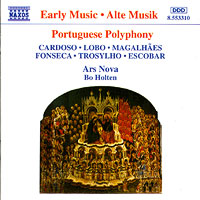 |
Lamentatio Manuel Cardoso (1566-1650) Magnificat secundi toni Manuel Cardoso (1566-1650) Audivi vocem de caelo Duarte Lobo (1565-1646) Pater peccavi Duarte Lobo (1565-1646) Vidi aquam Filipe Magalhaes(1571-1652) Kyrie Filipe Magalhaes(1571-1652) Gloria Filipe Magalhaes(1571-1652) Credo Filipe Magalhaes(1571-1652) Sanctus Filipe Magalhaes(1571-1652) Benedictus Filipe Magalhaes(1571-1652) Agnus Dei Filipe Magalhaes(1571-1652) Commissa mea pavesco Filipe Magalhaes(1571-1652) Beata viscera Manuel da Fonseca (fl. 1540) Circumdederunt me Bartolomeo Trosylho (1500-1567) Clamabat autem mulier Pedro de Escobar (1465-1535) |
Portugal was historically by no means isolated from the mainstream of European culture, although the earlier periods of Portuguese polyphony may be relatively little known. There were, nevertheless, monastic and ecclesiastical connections with other parts of Europe, and, of course, with Rome, while the proximity of Spain, most evident in the golden age of Portuguese polyphony, ensured that Portugal was part of the wider European tradition of polyphony. The vocal group Ars Nova is one of the most distinguished chamber choirs in Scandinavia in the field of early and new music. The twelve singers of the choir and the director Bo Holten have produced a series of internationally acclaimed compact discs and have given more than 650 concerts and broadcasts in Scandinavia, the rest of Europe, Israel and Japan. .
| 8998 CD $9.95 |
 |
'Delectable though this music is, it needs performers who can do it justice, and James O’Donnell and his choir do that and then some. Whether depicting a soul thirsting for the Lord’s rest, or giving thanks for salvation, the smooth trebles soar into the rafters of Westminster. This is a CD that brings the listener one step closer to heaven' (BBC Online)
|
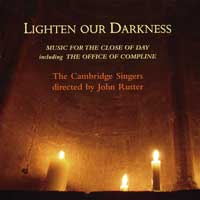 |
In Pace - Sheppard Libera Nos, Salva Nos - Sheppard Justorum Animae - Lassus Pastor Noster - Handl` O Lord, The Maker Of All Thing - Mundy Visita, Quaesumus Domine - Byrd Abendlied - Rheinberger O Christ Who Art The Light And Day - Byrd O Gladsome Light - Bourgeois Te Lucis Ante Terminum - Tallis Alma Redemptoris Mater - Victoria Ave Regina Caelorum - Victoria Regina Caeli Laetare - Victoria Ave Maria - Guerrero Bogoroditsye Dyevo - Rachmaninov In Manus Tuas - Byrd In Manus Tuas - Sheppard |
The service of Compline is the last of the seven daily services observed in monastic communities, taking place immediately before bedtime. This CD gathers together 18 of the many lovely a cappella choral motets, mainly from the Renaissance period, which were written to adorn the evening worship of the church. Composers featured include William Byrd, Orlando de Lassus, John Sheppard and others. In some traditions it became the custom to include a Motet of the Virgin Mary within Compline. Here we have four examples by de Victoria and a beautiful Ave Maria by Rachmaninov. The Cambridge Singers, directed by John Rutter, sing as well as ever and the clear and cool acoustic of the Lady Chapel at Ely Cathedral make it the perfect setting for Compline. In addition there is a 22 minute bonus disc in which the Office of Compline, sung in English with its traditional chants, is given in its entirety with John Harte as Reader and Simon Wall as Precentor.
Listen to "O Gladsome Light" in RealAudio.
| 8399 2CDs $15.95 |
 |
This recording presents a selection of fifteen of the 150 or so Latin motets and three of the dozens of English anthems that, between them, form the greater part of the life’s work of William Byrd (1543-1623), the greatest English composer of his era. The chosen motets and anthems represent just some of the many facets of Byrd’s sacred music, now recognized after three centuries of neglect as among the most glorious every written for choir.
|
 |
Directed by the renowned John Rutter, the 29-strong, angel-voiced Cambridge Singers bring us a collection of 29 motets issued by Palestrina in 1584, at the height of his powers as a composer and revered throughout Europe. The subject of these motets is a combination of the sacred and madrigals that celebrated dance and erotic love, which Palestrina seems to have considered sacred also. In any case, the motets are in latin and the music is as if sung by a choir of angels. The liner notes are extensive and give us the words, translations and history of Palestrina and his music. Lovely!
|
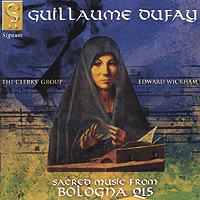 |
Vasilissa, ergo gaude Kyrie Fons bonitatis O beate Sebastiane Gloria (Bol. Q15 no. 107) O gemma, lux et speculum Credo (Bol. Q15 no. 108) Supremum est mortalibus Sanctus & Benedictus (Bol. Q15 no. 104) Inclita stella maris Agnus Dei (Bol. Q15 no. 105) Gloria "Spiritus et alme" O sancte Sebastiane |
This is the third disc recorded by The Clerks' Group for their Signum Records trilogy. The series explores repertoire in the medieval period and culminates with a selection of works by Guillaume Dufay, found in one of the great anthologies of 15th century music: the manuscript Bologna, Civico Museo Bibliografico Musicale, MS Q15 (or "Q15" as it is known by its friends).The Q15 manuscript contains examples of almost every conceivable musical genre of the period by a vast array of composers. The Clerks' Group has chosen to perform works by a single composer, but still the variety of forms and styles on offer is bewildering. Guillaume Dufay was a composer who witnessed and contributed to most of the revolutionary changes to occur in music composition in the 15th century. The album includes some of the earlier works so often neglected from Dufay's repertoire, and goes on to explore compositions that demonstrate this revolutionary genius. Some compositional techniques celebrated by The Clerks' Group's performance include the playful exchange of Dufay's song-like melodies between the vocal lines; and the use of mensural canon, where the same melody is sung by all voices but at slightly different speeds. These are just a few examples of the radical nature of Dufay's music as demonstrated on this recording. The Clerks' Group brings immense diversity to the music and its performance. Their refreshing approach displays sincere empathy and passion for this astonishing repertory.
| 7033 CD $15.98 |
 |
This new Hyperion recording celebrates the 500th anniversary of the birth of England’s first superstar composer, Thomas Tallis, and welcomes the signing to the label of The Cardinall’s Musick and Andrew Carwood. Over the group’s fifteen-year history, The Cardinall’s Musick has built an enviable reputation for excellence. Some twenty recordings on the ASV Gaudeamus label have seen accolades from around the world, including a Gramophone Award and a Diapason d’Or, while in the concert hall and workshop the group has consistently displayed innovation and a freshness of approach, whether tackling contemporary works (many of them commissions) or sharing the fruits of years of research into the music of the English Renaissance. On their debut recording for Hyperion, The Cardinall’s Musick turns to the period of its namesake, Cardinal Wolsey, and specifi cally to the music of Thomas Tallis. Gaude gloriosa takes center stage. One of a series of monumental and extended motets (each lasting getting on for twenty minutes), this should be regarded as the summation of the genre - whereas Tallis’s earlier attempts such as Salve intemerata or Ave Dei Patris fi lia can seem to ramble somewhat, in Gaude gloriosa we find a sure-footed and eloquent response to an unusual text in honor of the Virgin Mary, and a work which takes singer and listener alike into a world of unremitting fervor. Other works on this recording include the famous Loquebantur variis linguis and O nata lux settings, the five-voice Latin Magnificat and Nunc dimittis. Of special note is the Suscipe quaeso Domine - where a particularly gloomy text (thought to have been written to mark England’s reconciliation with Rome on the accession of Mary Tudor) elicits from Tallis some truly extraordinary and rhetorical effects including harmonic shifts which are every bit as shocking today as they must have been at the work’s first performance in 1554. Future plans for The Cardinall’s Musick on Hyperion include the completion of their on-going series encompassing the complete Latin church music of William Byrd.
|
 |
The Byrd Edition is a long-term project that is one of the most comprehensive ever undertaken in the early music field: some 20 CDs that will cover the complete works of William Byrd. The music will be freshly edited and sources re-examined by David Skinner. The Cardinall's Musick under Andrew Carwood has gained a formidable reputation in bringing the neglected masterworks of the English Renaissance to a wider public. These have included the festal Masses of Ludford and the complete works of Fayrfax, the excellence of which was recognized by the winning of a prestigious Gramophone Award. The whole project is divided between the Latin Church Music, the Secular Songs and Consort Music, and the English Church Music. Volume 1 is the first of the Latin Church Music discs, which provides a chronological survey of Byrd's surviving Latin motets to the Cantiones Sacrae of 1591, interspersed with a liturgical survey of the Gradualia. Thus this first CD includes the Gradualia propers for Lady Mass in Advent, the Lamentations, the exquisite penitential motet Peccavi super numerum and the great 9-part psalm setting for men's voices Domine quis habitabit.
|
 |
Since 1989 The Cardinall's Musick, directed by Andrew Carwood, has gained a reputation in bringing neglected English Renaissance masterworks to a wider public, and they have recorded a number of CDs to critical acclaim. "Propers" is the work of William Byrd (1535 to 1623), early Latin Christmas sacred music. There are 15 movements here, with names like "Ave regina caelorum," "O saluteris hostia," "Alleluya, Confitemini Domino" and "O admirabile commertium." "Propers for the Nativity" is a series designed for a Christmas church service, with music for the Offertory, Communion, etc. These are powerful, calming, soaring chants that could be easily mistaken for the songs of angels, back in 1607 or 2003!
|
 |
The Clerks' Group is a highly sophisticated ensemble of young singers whose immaculately polished performances show Machaut's extraordinary lyrical gift - even in the genre of the motet, so often thought of as abstract and unapproachable. Edward Wickham clearly views Machaut as a medieval romantic, drawing out the finely wrought lines and wallowing in the luscious sonorities of his music; and the effect is enhanced by a resonant acoustic, though the recorded sound is somewhat over-glossy. Each singer has a naturally light, straight-toned voice and can effortlessly flat over the vocal lines like 'a feather on the breath of God'. The highlights of this disc are three motets by Machaut based on love songs in performances which sound every bit as poetic and expressive as 18th-century Lieder; and the rapturous Marian motet Felix virgo / Inviolata genitrix, in which the group's intimately veiled sound is especially apt. Alongside the Machaut works are a handful of anonymous motets from the Ivrea Codex, a major 14th-century source containing some fine compositions, if never quite matching Machaut's genius. With the caveat that a few motets go a long way, this is a truly haunting collection.
|
 |
Here is the climactic fourth release in the Ockeghem series of which two volumes have been final Gramophone Award Nominations. The Requiem is specially released to commemorate the 500th anniversary of Ockeghem's death. This extraordinarily moving work is coupled with the first CD recording of the beautiful Missa Fors Seulement, reflecting the fluid and diverse style of his late masterpieces.
|
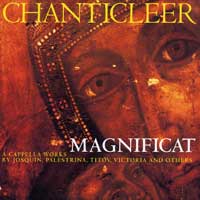 |
Ave Maria - Gregorain Chant Ave Maria, Mater Dei - William Cornysh Magnificat - John Tavener Stabat Virgo Maria - Claudio Monteverdi Maria, Quid Ploras - Aquilino Coppini The Angel Cried Out - Vasily Titov Regina Caeli Laetare - -Tomas Luis de Victoria Alma Redemptoris Mater Tomas Luis de Victoria Ave Maria Stella - Gregorian Chant O Thou Joy Of All The Sorrowful - Titov Ave Regina Caelorium - Palestrina Ave Maria - Josquin Salve Regina - Josquin |
The now Grammy-winning, San Francisco-based Chanticleer was originally devoted to the Renaissance vocal repertory; their focus has broadened since to include other genres as well as commissioned works. "Magnificat," however, featuring settings by de Victoria, Palestrina, Monteverdi and Taverner (as well as the less ubiquitous Russian Orthodox Vasily Titov), returns to liturgical chant. These twelve male voices, under the musical direction of Joseph Jennings and performing arrangements encompassing the full vocal range, bring a seemingly effortless grandeur to these homages to the Blessed Virgin. This tapestry of sound is a gentle whisper of comfort and reprieve.
| 6491 CD $15.98 |
|
|
William Byrd and his teacher, Thomas Tallis, were inarguably the greatest composers of Elizabethan England. The primary vehicle for royally-sanctioned musicians of the court was liturgical, and in the court of Elizabeth that would mean settings for Anglican services. However, Byrd was a committed Catholic who nonetheless wrote these masses, motets and antiphons for published volumes titled "Gradualia," volumes I and II. This insurgent act apparently went uncensured, and it is these a cappella works that Chanticleer has recorded here. Given that they would not be performed publicly in a church setting by a large choir, the arrangements are intimate. They are each in the same mode and clef, which therefore creates a mood unbroken, a continuity of feeling that is quietly moving.
|
|
|
Gregorian chant is the archetypical song for the Roman Catholic Church. There are three separate distinct periods, all of which are represented on this recording. The first era, called Gregorian, was roughly 700-850 AD. This is the time of Pope Gregory's school which rigidly codified the music allowed to be sung in churches, and the beginning of the written score for transmission to posterity rather than relying on strictly oral traditions. The Carolingian period is considered from 850-1,000 AD and began to add new styles to the more rigid structure. The medieval period was from 1,000-1,300 AD the styles proliferated immensely. That led the way to modification into secular song. In understanding Gregorian chant, the meaning of one word is particularly important. Melisma means that a number of notes are sung over the duration of a single syllable. The most joyous of the music which Chanticleer performs on this disc is very melismatic. Enjoy!
|
|
|
Chanticleer is an all-male, all-adult choir (of 12 singers in the present recording), which means that Palestrina's soprano lines as well as the alto ones are taken by countertenors. The sound is on the whole warm rather than brilliant, at times rather dark, with an impressively firm bass. It is noticeable that in Chanticleer's selection from the Canticis Canticorum motets they choose none of those with divided soprano lines, only those with two alto or two tenor parts. Without female or boys' voices the sound is uncommonly unified. Tempos are quite fast, but the voices never seem taxed by passages of florid singing. Pitch is commendably precise most of the time. The acoustic is pleasing and the recording clean, but the words are not always easy to pick out. While this is the only recording currently available of Palestrina's masterly Requiem, it is not do justice to Chanticleer's typical vocal repertoire.
|
|
|
Who better than Chanticleer to interpret the chants of Josquin De Prez and Alexander Agricola, two High Rennaissance composers who, though not Italian born, came to prominence while in service of the Italian nobility and papacy. De Prez, the more famous of the two, served to advance the development of both homophonic and polyphonic textures and was prescient in his use of both. Agricola also utilized the motet and various liturgical forms as was standard at the time. The exhaustive liner notes that complement this recording provide formal analysis and historical background. The sound? While the nuances of each composition may be appreciated fully by those with a dedicated propensity, anyone can be calmed by the ethereal voices and elegant organum of these simple settings.
|
|
|
The distinguished Chanticleer bestows their attentions on the works of the cosmopolitan composer Brumel, who, though probably French, was an advocate of a developing international style that included Italian and Flemish influences. Though these works were to be sung in the context of the Mass, Brumel also incorporated elements from popular folk songs, such as melody and rhythm, that gave his arrangements a distinct flavor; in fact, these elements may have even been directly borrowed, as was commonplace at the time. For example, De Prez' "Berzerette Savoyenne" was adapted for Brumel's version; both are included here. Likewise, the melody of "Lauda Sion" is familiar to most, but Brumel's contrapuntal melange obscures it, as clouds behind the sun; it is rarely conspicuous. These settings glorify the purity of the voices, and as such, are a perfect comportment for the men of Chanticleer.
|
|
|
Cristóbal de Morales is usually mentioned along with Francisco Guerrero and Tomás Luis de Victoria as the trio of Spanish composers who typified 16th-century Spanish church polyphony. The Missa Mille regretz is based on the famous chanson of the same name by Josquin des Prez, and proved to be a favorite work of Charles V. This recording conveys the deep spiritual feeling behind these liturgical settings - another bull's-eye for this splendid ensemble.
|
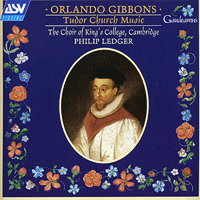 |
Almighty and Everlasting God Magnificat Voluntary Nunc Dimittis Magnificat Now Shall the Praises of the Lord be Sung Nunc Dimittis This Is The Record of John O Lord of Hosts O Thou, The Central Orb A Song of Joy Unto the Lord We Sing See, see, The Word is Incarnate Come Kiss Me With Those Lips of Thine Lift Up Your Heads Fantasia Hosanna To The Son of David |
Orlando Gibbons began his association with Kings College, Cambridge as a chorister under the direction of his eldest brother from 1596 to 1598. His talent was such that by the age of 21 he was sharing the duties as an organist. In 1623 he accepted the additional appointment as organist at Westminster Abbey; but he died suddenly just 2 years later. He was not a prolific composer, but his works include many masterpieces some of which are on this disc. One of his most outstanding verse anthems is: "This is the record of John". It is recorded on this disc by the Kings College Choir featuring Michael Chance as the countertenor soloist; and few have ever performed this as well as Chance. His tone quality, his diction, his emotional investment in the music goes way beyond other renditions. Another bright spot in this group of pieces is the verse anthem: "See, see, the word is incarnate" featuring the choir with a group of outstanding soloists: Paul Smy (boy soprano); Chance, Jones (altos); Daniels, Rivers (tenors);Finley (bass).Some of the other selections are: anthems: "A Mighty and Everlasting God"; "Lift up your heads". The London Early Music group does much of the accompanying. The Choir with its boy sopranos and male altos are dictionally perfect and so enjoyable to hear.
| 8686 CD $15.95 |
|
|
The listener trying to get a basic grip on what medieval plainchant was all about could not ask for a better introduction than this release. The Choir of King's College, Cambridge gets back to its roots, so to speak, performing chants that could have been heard at the college's chapel half a millennium ago. With the chapel's magnificent acoustics as a backdrop, the album takes listeners through the series of decisions choristers would have made concerning what to sing. Those decisions began with the liturgical year, which called for specific chants corresponding to specific days in the cycle. "In this recording," writes John Milsom in his admirably clear and informative liner notes, "the annual cycle has been stopped at two points," both of them days connected with the birth of the Virgin Mary. A mass from one day and a Vespers service from the other are included. Some of the chants contain tropes that place them in their specific time and place. Both are presented more or less complete, with the connective tissue of text-bearing chants retained along with the big ornate pieces; Milsom compares focusing exclusively on the latter to cutting the illuminated initial letters out of a medieval manuscript. For most listeners, he points out, the experience of hearing chant is akin to that of strolling into a museum and looking at an illuminated manuscript; one experiences a richly colored, ornate thing that carries mystery associated with extreme age and remoteness in each case. But we get to the real mystery by trying to penetrate it a bit, and this recording is an ideal aid. Those who experience chant in a more mystical way will likewise benefit from this album; director Stephen Cleobury's tempos are deliberate, and he pulls back from time to time to let the sound of the choristers reverberate around the chapel.
|
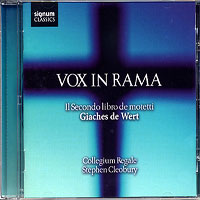 |
Lo Crux Ave Spes Unica |
The Flemish-born Giaches de Wert was one of many foreigners to dominate the Italian music scene in the mid to late sixteenth century, therefore to this day his music is largely unknown to many. It is the second of three books of Motets which appears on this disc, written when his skill as a madrigalist had reached its height. As part of the Kings College Choir, the choral scholars of Collegium Regale perform independently of the choir, singing a repertoire that encompasses 15th Century sacred music, jazz, folksongs and pop. Directed by Kings College's and the BBC Singer‚s renowned director Stephen Cleobury.
| 8974 CD $15.95 |
 |
Exsultate justi - Viadana Mirabile Mysterium - Vinci Adormus te, Christe - Nanino Voce Mea - Porta Requiem Aeternam - Anerio Kyrie - Lassus Gloria - Lassus Credo - Lassus Sanctus - Lassus Benedictus - Lassus Angus Dei - Lassus Ave Maria - Clemens Jubilate Deo - Rore Improperium - Lassus Peccavi Super Numerum - Wert Eripe me de inimicis - Raselius Rorate Caeli - Handl Dixit Maria - Hassler Verbum caro factum est - Hassler Duo seraphim - Esquivel Ecce sic benedicertur - Morales O Domine Jesu Christe - Victoria Ego sum panis vivus - Esquivel O vos omnes - Victoria Rorate Caeli - Guerrero O magnum mysterium - Byrd Terra tremuit - Byrd Laboravi in gemitu - Morley Tibi Laus - Philips |
A most sensitive and attractive recording. The American Repertory Singers achieve choral artistry with consistently lovely tonal quality and astounding rhythmic control and flexibility. Sara Stern and Dotian Levalier participate with highly pleasing effect and artistry. The first track of the CD is a setting of the Welsh tune ‘Ar hyd y nos’. The combining of the two instrumentalists with the choir provided a captivating and alluring textual attractiveness. …The Seven Words of Christ from the Cross makes most effective use of dissonance. Schuneman’s reading is wondrously apt and his selection of the soloist [David F. Eberhardt] to sing the part of the Evangelist is very admirable.
| 8637 CD $15.95 |
 |
Christ's passion, the ultimate sacrifice, is the subject of the third disc, I Am With You. This release includes one of two recordings of the chanted passion narrative according to the Gospel of John, featuring three cantors who assume the characters in the story of the passion. Part of a new series in Gregorian Chant, "A Celebration of Faith in His Name," this stirring music evokes the passion, mystery, and beauty of the life of Christ.
|
 |
Giovanni Pierluigi da Palestrina, hailed through the centuries as "prince and father of music," wrote music of unsurpassed grace and beauty. Issued at the 400th anniversary of the master's death, this album contains the only existing recording of his Missa Descendit Angelus Domini and the Missa Beatae Mariae Virginis II, and six other motets.
|
 |
Mundus vergens Novus miles sequitur A la doucour de la bele seson Sol sub nube latuit Hac in anni ianua Anglia, planctus itera Etas auri reditur Vetus abit littera In occasu sideris L'amours dont sui espris Purgator criminum Li nouviauz tanz Pange melos lacrimosum Ma joie me semont Ver pacis apperit Latex silice |
This CD commemorates the eight hundreth anniversary of King Richard the First's coronation in Westminster Abbey. Soloists or groups of two to four singers perform each piece a cappella, sometimes overlapping melodies and harmonies with dazzling technicality. Each track glows with vocal virtuosity. The effect heightens with each successive listen.
| 8748 CD $11.95 |
 |
An essential document of 13th-century music and of vocal performance of three- and four-voice motets. 'A wonderful collection. Lusciously sung sensuous music...remarkable addition to the distinguished sereis of records from Gothic Voices' (Gramophone)
|
 |
This Gothic Voices offering covers most of the material found in a songbook (a manuscript collection of favoured songs) dating from around AD 1200. It was only rediscovered by chance, the original manuscript having been disassembled for use as flyleaves for another book. Precious little information is given in the sleeve note about the circumstances of that rediscovery, which is a shame, and we read that it can only be guessed that the songbook had its origins within some kind of religious foundation. Just over half the songs are monophonic and most relate to Christian feasts, especially Christmas. But as in many such collections from across the centuries, the fun comes in discovering the more eclectic choices of music for inclusion. Here, for example, there are songs bewailing the sale of ecclesiastical offices, the need to use flattery to get on in life and the prevalence of greed and disrespect for the law, plus a marvellous love song featuring a young man's agonising choice between the charms of "little Flora" and his studies. The tasteful, sensitive Gothic Voices performances are everything we have come to expect.
|
 |
This is the record that started the Hildegard craze back in 1982--and you need only listen to Emma Kirkby glide and soar through Columba aspexit (the opening hymn) to understand why. Gothic Voices performs the music very simply, either alternating soloists and unison choir over a drone or using a single unaccompanied voice. The singers render Hildegard's extravagant poetic imagery and melody not with the rhythmically fluid, ecstatic approach favoured by Sequentia, but with equalist rhythm and a calm, meditative quality. Gothic Voices' straightforward approach is less likely to send you into a rapturous trance than is Sequentia's, but in the hands of such fine singers as Kirkby, Margaret Philpot, and Emily van Evera, Hildegard's extraordinary texts and melodies are captivating--and clear enough to linger in the memory as melodies rather than just sensations. This record is still a bestselling title - try it and find out why.
|
 |
Nicolas Gombert, active in the first part of the sixteenth century, was of the generation that followed Josquin Desprez and may have been Josquin's student. His a cappella choral music, said one laconic but spot-on contemporary, "avoids rests." In place of the gracefully alternating pairs of voices in Josquin's sacred works the listener hears overlapping imitative voice entrances that feel like waves in an ocean of tones. Some may find his dense, low sound a fascinating and enveloping thing, while others might wish for Josquin's clear text settings, whose meanings in works like Ave Maria...virgo serena almost come across even if you don't consult the Latin translation. It's a matter of personal preference. But if you'd like to investigate Gombert for yourself, this inexpensive reissue disc makes a good place to start for several reasons. The opening Credo in eight parts represents Gombert at his most sonically ambitious; it's a little-known wonder of rich Renaissance part-writing. The all-male vocal ensemble Henry's Eight achieves superb pitch precision in very difficult choral writing. The cutting quality of the male countertenor voice helps clarify Gombert's dense textures, and when the singers pair up on parts in some of the pieces for four or five voices, the vibrations between the paired voices are good ones
|
 |
Salve Virgo Virginum Now Springes The Spray Ah Si Mon Moine Adam Lay Ibounden Foweles In The Frith So Trieben Wir Den Einter Aus The Coventry Carol Gaudete An Adult Lullaby Veni, Yeni Salva Nos Verbum Caro Lo, Here My Heart Binnorie O Binnorie This Ay Night Miri It Is |
Towards the end of the 14th century, England saw the rise of a pleasingly consonant musical style that was admired abroad as the "English manner." Paul Hillier and the Hilliard Ensemble are heard in a selection of the most beautiful polyphonic songs and carols from this rich period. "The performancesÉ match the beauty of the music a sound of remarkable purity. Their ensemble singing is perfection itself, and each part is exquisitely phrased." - Stereo Review
| 6320 CD $11.98 |
 |
This is a 2 CD set, CD #1 has 71 minutes of Italian madrigals, CD #2 has 55 minutes of English madrigals. Perhaps the most important secular musical development of the 16th century, the madrigal had its fullest flowering in Italy, where Franco-Flemish composers Phillippe Verdelot, Adrian Willaert and Jacques Arcadelt, born in northern Europe, spent their working lives. In England Thomas Morley, John Wilbye and Thomas Weelkes succeeded in producing some real masterpieces. There are 26 cuts on disc #1, all in Italian, "Cantiam lieti cantiamo," "Una leggiadra nimpha," "Con l'angelica riso," "Donne, venete al ballo"?all flow like sweet water from this talented, precise British sextet. Disc 2 has 22 cuts, all in English: Morley's "April is in my mistress' face," Wilbye's "Sweet honey sucking bees," Weelkes' "O care thou wilt dispatch me," Orlando Gibbons' "The Silver Swan"?and they are equally fine. Recommended. Listen to "The Silver Swanne" in RealAudio.
|
 |
Whereas most of Hilliard Ensemble's recordings have been designed around a particular composer or collection of music, this disc is content simply to offer The Hilliard Ensemble ‘in recital’, and presents a mixed programme of early vocal music – including many of the group’s favourite pieces.
|
 |
Of all the north European composers who made their careers writing beautiful secular madrigals in sixteenth-century Italy, Josquin Desprez is regarded as the greatest. Fusing learned polyphony with rhythmic gaity, the madrigal was hugely popular in Italy and England. The brilliant British male octet The Hilliard Ensemble, sounding very much like angels, are one of few groups who can do justice to this difficult, soaring material. From the sacred "Ave MariaÉ Virgo serena," "Veni Sancti Spiritus," and "De profundis clamavi" to the secular "Petite camusette," "Je me complains" and "Je ne me puis tenir d'aimer," this is wonderful music. 13 songs. Extensive liner notes give lyrics and translations.
|
 |
Nomen mortis infame - Willem Cuelleers Gloria - Juan Bautista Comes Qui habitat - Josquin Desprez Jesus autem / Credo in Deum - Robert Wylkynson Ecce beatam lucem - Alessandro Striggio, Sr. En venant de Lyon - Pieter Maessins Lauda Jerusalem - Joao Lourenco Rebelo Exaudi me Domine - Giovanni Gabrielli Spem in alium - Thomas Tallis |
While the latter half of the sixteenth century saw the first stirrings of the Baroque, this period also witnessed the creation of the finest cathedrals in sound, with their foundations in the distant Gothic era of music . . . Composers vied with each other in daring and ingenuity, presenting works with twelve, sixteen, twenty-four and even, in the case of Tallis’s famous Spem in alium, forty different voices! The Huelgas Ensemble celebrates its thirty-fifth anniversary with a spectacular selection of these works.
| 8821 SACD $21.95 |
 |
For their latest release, Paul Van Nevel and the Huelgas-Ensemble have distilled the quintessence of vocal polyphony. Their spectacular new recording illustrates the dominant styles of the Renaissance as reflected in the Masses by its three greatest masters. The strict counterpoint of the Roman school is evident in the Missa Ut re mi fa sol la by Palestrina (c. 1525-1594); the ripe perfection of the Franco-Flemish school can be heard in the Missa "Tout les regretz" by Roland de Lassus (1532-1594) and the flamboyance of Late Gothic England shines through in the Missa “Ave Maria” by Thomas Ashewell (c. 1478-c. 1513). An entire world recreated in gorgeously vivid sound
|
 |
In this selection of settings by masters like Willaert and de Rore, among others, of the verse of Virgil, Horace and Catullus, Paul Van Nevel offers us, with the subtlety of perception and the rigorous but flexible attention to detail we have come to expect from him, another dazzling excursion into the rich and fascinating by ways of early Renaissance vocal music.
|
 |
It was in seeking to set to music the emotions they found in literary texts and poems – imitar le parole – that the madrigalists of the early sixteenth century rediscovered the poetry of Francesco Petrarca. The rich imagery of his language provided the springboard for Orlande de Lassus, in particular, to show his mastery over a period of nearly forty years as one of the greatest composers of madrigals.
|
 |
Perhaps Jacobus de Kerle, contemporary and peer of Orlande de Lassus, Clemens non Papa and Philippe De Monte, needed a tireless pioneer of the calibre of Paul Van Nevel to rediscover him for the 21st century. This master of polyphony, who was active in Flanders, Italy and Germany before finally settling in Prague, left works of timeless beauty - as this CD will prove.
|
 |
Alfonso Ferrabosco ‘Il Padre’ has suffered a curious fate: he has long been neglected on record, yet in his own time he was the most eminent representative of a famous Bolognese musical dynasty. After emigrating to England at an early age, he spent most of his life in the service of Elizabeth I, earning the admiration of his peers. Though implicated in some distinctly murky affairs – could he have been a secret agent for the queen? – Ferrabosco was above all a musical genius, capable of equally felicitous expression in the motet, the madrigal or the polyphonic chanson.
|
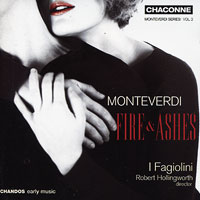 |
Sinfonia from "Ballo Delle Ingrate" Ardo, Avvampo Rimanti in Pace Ogni Amante E guerrier Si Ch'io Vorrei Morire Che Dar Piu Vi Poss'io E Cosi, A Poco A Poco Vorrei Baciarti, O Filli Chiome D'oro Batto, Qui Pianse Ergasto Entrata from "Ballo Delle Ingrate" Lagrime D'amante al Sepolcro Dell'amata Tirsi e Clori |
Monteverdi’s madrigals are a theatre of the senses: touches, glances, scents, the textures of fabrics, of lips and skin, the shining gold of hair, the deep blue of eyes, the sounds and vistas of nature, the coolness of water, the sun’s warmth, the ecstatic agony of fire and ice. The second volume in I Fagiolini’s Monteverdi conspectus allows us to trace this evolution from the early Mantuan a cappella madrigals that made his reputation to the late concerted madrigals of the 1630s written for the Viennese court – styles seemingly worlds apart, yet both forged by the same desire, to confront and master afresh in each new work the ever-present tension between mere art and real life.
Listen to Batto, Qui Pianse Ergasto in RealAudio.
| 8913 CD $18.95 |
 |
Monteverdi: Flaming Heart' offers works from Book IV to VIII, a selection that demonstrates both the extraordinary compass of his art and the unprecedented depth and subtlety of response to a text. In recent years we have settled for a certain lack of danger in our search for an ‘ideal’ Monteverdi. I Fagiolini's ‘The Full Monteverdi’, revealed a new side to this music a Monteverdi of both beauty and horror, colourful, vivid, sometimes chaste, sometimes dirty, and always completely alive.
|
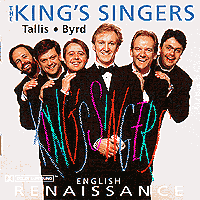 |
Haec Dies - William Byrd Te Lucis Ante Terminum - Th-omas Tallis Beata Viscera Mariae Virginis William Byrd Ave Verum Corpus - William Byrd Vigilate - William Byrd Viri Galilaei - William Byrd Te Lucis Ante Terminum - Thomas Tallis Lamentations Of Jeremiah, First Set - Thomas Tallis Lamentations Of Jeremiah, Second Set - Thomas Tallis If Ye Love Me - Thomas Tallis O Lord, Make Thy Servant Elizabeth, Our Queen - William Byrd Sing Joyfully - William Byrd Laudibus In Sanctis - William Byrd |
Thomas Tallis (1505-1585) was the most influential English composer in his day. He lived at Court from 1543 until his death. He survived the coming into dominance of Protestantism during Edward VI's reign, the restoration of Catholicism under Mary in 1553 and the tumultous tussle leading to the Elizabethan Settlement which devised a new church establishment then dominant for nearly a hundred years. Throughout these changes Tallis continued to write choral liturgical music in both the older Latin motet style and the newer English anthem style. His greatest student was William Byrd (1543-1623) who pushed the authorities with his staunch Catholicism but was such a brilliant composer that he never received more than a heavy fine. Elizabeth awarded them the exclusive rights to publish music in her realm, effectively creating a monopoly. The King's Singers bring us a sampling of the huge output from these two most influential composers, including both motets and anthems. These are performed for the joy of those who love renaissance music, with the musical perfection expected of the best. Songlist
| 6125 CD $16.98 |
 |
"Spem in alium," not just the greatest of Tallis's compositions but one of the greatest of all time, is based on a liturgical text, written for 40 independent voices, and was first performed in England in 1573. A work for 40 voices is not one that would usually be associate with the legendary all male sextet The King's Singers. Through modern recording technology, flexibility and experimentation, the six have become 40, a true harmonic convergence that occurs when the pairs high, sweet voices throw the sound across the space between them until finally all voices join for a full culmination of the work. "Spem" is a stunningly beautiful piece, although very short, eight minutes and 22 seconds to be precise, and we listened to it several times to truly appreciate it. The piece is followed by a 6-minute interview with the Singers, who discuss the experience of recording it. A short sublimely beautiful piece, recorded by one of the world's finest choral ensembles. SACD
|
 |
On November 5, 1605, Guy Fawkes was caught preparing to detonate 36 barrels of gunpowder under the House of Lords, unveiling and act of attempted treason that shocked the whole of Europe.Commemorating the 400th anniversary of the Gunpowder Plot, the King’s Singers and Concordia illuminate the dangers of hearing Mass in secret, of conspiracy and downfall, and the protestant relief and great joy. The music, structured around Byrd’s perfect 4-part Mass, contains motets by catholic composers, protestant anthems celebrating the downfall of the plot, and a commission from the British composer, Francis Pott, Master Tresham: His Ducke. A script, drawing on historic texts and reproduced in the CD booklet, uses the dramatized persona of William Byrd, the most celebrated composer of his age, to recreate the atmosphere of change and hope in the Jacobean court. Listen to "Sanctus/Benedictus from Mass for 4 voices" in RealAudio.
|
 |
If you like The King's Singers, you'll love this CD! Gesualdo: Tenebrae Responsories for Maundy Thursday offers a small slice from the liturgy used for Holy Week. All tracks are superbly performed. The voices weave together to form a solid fabric of stunning polyphony. The responsories, here, are divided into three sets beginning with lessons from the Lamentations of Jeremiah. Gesualdo, an eccentric Italian prince and one of the Renaissance's more innovative composers, is best remembered for killing his wife and her lover while they were in bed together. His guilt over this shocking and passionate act is said to be mirrored in his music with its chromatic and often indulgent lines. The music is liturgical in nature, but this recording can be appreciated inside and out of the sanctuary.
|
 |
The Triumphs of Oriana is an extravagant musical compliment paid to England's Elizabeth I by Thomas Morley, published in 1601. It consists of 25 madrigals by 23 different composers, each madrigal concluding with the refrain, "Then sang the shepherds and nymphs of Diana: Long live fair Oriana." Oriana was a character in a chivalric romance long equated with Elizabeth, and Diana, goddess of chastity, would certainly attend the Virgin Queen. However idealized their pastoral setting, many of the madrigals are excellent, those by Bennet, Weelkes, Cavendish and Morley are well known. As a whole they captured the musical imagination of the time and they continue to intrigueãfor instance, who is the mysterious "Bonny-boots" who appears in two of the songs? The soaring tenor and falsetto voices of King's Singers, England's brilliant, prolific male sextet, were made to perform this difficult, eclectic collection. Picking favorites, beside the four previously mentioned, is not easy: Tomkins' "The fauns and satyrs tripping" is lovely, as is "With wreaths of rose and laurel" by Cobbold and "Fair nymphs I heard one telling" by Farmer. "Triumphs" is a choral joy, an ode to a beautiful fantasy from long agoãsung by six men whose voices and talent are fortunately very real. Extensive, interesting liner notes.
|
 |
Subtitled "the spirit of Renaissance Spain," this recording has our manly British sextet exploring, with aplomb and panache, the marriage of music and drama that was popularized by Catalan musician Mateo Flecha the Elder. The salubrious accompaniment of the Harp Consort, under the direction of Andrew Lawrence King ("consort" is a period term for an ensemble), sets the stage, as it were, for the unfolding of either courtly and elegant polyphony, or a display of rustic and passionate bravura. The latter, typified by the fiery dance rhythms of the villancicos, and the slow sensual breaths of "Zarambeques" (and bass Stephen Connolly's earthy timbre), are in contrast to the "Benedictus (from Mass for the Dead)" and "Por las Sierras de Madrid," (combining no less than four separate tunes with an improvised treble part, using a form known as qoudlibet). This mixture, blended with both scholarly acumen and a generous dose of unmannered showmanship, makes "Fire-water" a new King1⁄4s Singers favorite. Songlist
|
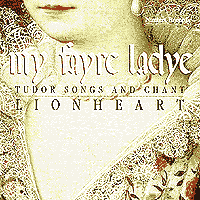 |
*The Beloved* Quam pulcra es - Sarum Chant Quam pulcra es - John Dunstable Ibo michi ad montem mirre - Sarum Chant Who shall have my fayre ladye? - Anon. Salve regina misericordie -Sarum Chant *The Unfathomable* Adew mes amours - William Cornysh A robyn, gentyl robyn - William Cornysh Iff I had wytt for to endyght - Anon. *The Maternal* Quid petis o fili? - Richard Pygott *The Desired* Tota pulcra es - Sarum Chant Up Y Arose - Anon. And I war a maydyn - Anon. Blow thi horne hunter - William Cornysh *The Triumphant* Anima mea liquefacta est - Sarum Chant O regina mundi clara - John Brown Beata Dei genitrix - Sarum Chant |
This musical homage to the fairer sex is performed by the all male sextet "Lionheart," whose member's impeccable credentials include past association with Anonymous 4. The group's foundation, and the cornerstone of it's sound, is Gregorian Chant, a style that is epitomized here. In medieval times, the church was the locus of existence, and expressions of devotion were central in music and art. Therefore, it is understandable that the role of woman in culture would be regarded similarly, and that songs of praise to her would take on a religious connotation, as to the Virgin Mother Mary. Predominant on this recording is the Sarum Chant, a plainsong used in rituals at Salisbury Cathedral in England. The melodies are simple and unembellished, the mood subdued.
| 6398 CD $15.98 |
 |
Great recordings of the Spanish Renaissance composers Francisco Guerrero and Cristobal de Morales are often hard to find. Luckily, Lionheart has simplified the task by taking matters into their own hands - they recorded their own album. Perfectly balanced and blended voices are qualities to which every vocal ensemble aspires, but not everyone acquires. Lionheart does. If you love the Renaissance Period or you're wanting something other than the usual Mozart and Beethoven, Lionheart's El Siglo de Oro is just the album for you.
|
 |
Lionheart combines the best of the familiar with the rarely performed to bring the richly beautiful and often intense and earthy heritage of English Christmas in this excellent collection of yuletide music. Lionheart is one of America's leading ensembles in vocal chamber music. Acclaimed for its "smoothly blended and impeccably balanced sound" (Allan Kozin, The New York Times), Lionheart (Jeffrey Johnson, Lawrence Lipnik, John Olund, Richard Porterfield, Kurt-Owen Richards, and Michael Ryan-Wenger) is best known for its interpretation of medieval and Renaissance a cappella music, with Gregorian Chant as the keystone of its repertoire.
|
 |
This thoughtfully constructed program, beautifully sung by Lion-heart, features music by composers closely connected with the papal choir (hence the word Rome in the title): Costanzo Festa (cl490-1545), Giovanni Pierluigi da Palestrina (c1525-1594), and Tomas Luis de Victoria (1548-1611). This is Lionheart 's first recording in nearly three years and it is worth the wait. The ensemble's tonal quality is sublime, and their voices blend flawlessly. Typically, Lionheart 's articulation is crystalline, and there's an emotional weight behind each note - these guys are paying attention to the words. The sonic quality of the disc is stellar, with a realistic church acoustic that doesn't skimp on clarity or warmth. This is a vital addition to the Palestrina discography and one of the best recordings of Renaissance polyphony in recent (or distant) memory.
|
 |
This is the second recording from the six-member Lionheart, dedicated to the performance of Gregorian chant. The group has appeared at venues such as Carnegie Hall and Lincoln Center, and has been featured in the New York and Los Angeles "Times." "Paris 1200" collects twelfth-century polyphony from France, composed by Perotin and Leonin, both men considered masters of the period; Notre Dame Cathedral, founded in 1163, provided an outlet for these new works. The primary forms used were organum, motet and conductus. Though harmonically fundamental, the beauty of chant lies in its very simplicity, and in the quality of the performance, at which Lionheart excel.
|
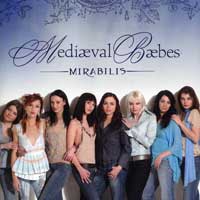 |
Star of the Sea Trovommi Amor Temptasyon San'c Fuy Belha Ni Prezada All For Love of One The Lament Musa Venit Carmine Kilmeny Lhiannan Shee Umlahi Cittern Segue Return of the Birds Tam Lin Scarborough Fayre Come My Sweet Mark Hur Var Skugga The World Fareth As A Fantasye Away |
"Mirabilis" is a Latin word with pre-Christian or pagan origins that was used in the Mediaeval period to describe a supernatural force on the fringes of this world. Eight beautiful women with equally beautiful voices and a fetish for stunning costumes (which they model in the exquisite full-color liner notes and which are now approaching the size and complexity of costumes created for SF's "Beach Blanket Babylon") continue to prove that 13th-15th century English music and poetry are totally hot and sexy. The Baebes, now down to 8 members, bring us another exotic collection of 18 songs largely from early English sources, with music and arrangements by Katherine Blake and other group members. Most songs are lightly accompanied by percussion, dulcimer, zither, saxophone, guitar, keyboards, strings and other instruments. Particularly wonderful are "Musa Venit Carmine," "Lhiannan Shee," "Umlahi" (with words and music by Blake), the haunting "Tam Lin," a sweet and lively cover of "Scarborough Fayre," the folk tune made famous by Simon & Garfunkel, the rhythmic "Come My Sweet," "This World Fareth As A Fantasye," and the ethereal "Away" which features Blake on lead vocal. "Mirabilis" is the 6th recording by the Baebes to grace our PAC catalog, and we have noticed 3 things--each album is excellent, each seems better than the last, and the Baebes are having as much fun dressing up and creating this magical music as we are, seeing and listening to them!
Listen to Away in Real Audio
| 7809 CD $15.98 |
 |
The third compilation of the Liturgical Choir's music, Exultate Deo, features mostly a cappella music, with sets by DuruflŽ, Palestrina, Mendelssohn, and Stanford. Highlights include Faure's tranquil "Cantique de Jean Racine"; Hoiby's contemporary organ exposition, "Let This Mind Be In You"; Palestrina's ageless "Sicut Cervus"; Mendelssohn's eight-voice German Mass segments; and Stanford's jubilant Easter anthem, "Ye Choirs of New Jerusalem."
|
 |
The release, Cantate Domino, is a combined effort of the University of Notre Dame Basilica choirs. It features a few of the contemporary pieces the Liturgical Choir prepared for their summer tour in Paris, including twentieth-century French composers Francis Poulenc and Pierre Villette. The thirteen voiced Basilica Schola sings Renaissance pieces by Hans Leo Hassler, Heinrich Isaac, Thomas Tallis and William Byrd. The Women's Litrugical Choir performs motets by Gabriel Faur?, Franz Schubert and Charles Stanford.
|
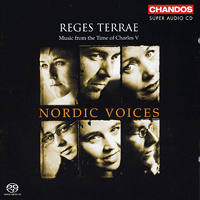 |
Reges terrae - Pierre de Manchicourt Regina caeli - Cristobal de Morales Laudate Dominum - Pierre de Manchicourt O magnum mysterium - Jacobus Clemens 'non Papa' Hei mihi, Domine - Francisco Guerrero Ego sum qui sum - Nicolas Gombert O Virgo virginum - Pierre de Manchicourt Exaltata est sancta Dei Genitrix - Cristobal de Morales Agnus Dei (from Missa 'Reges terrae') - Pierre de Manchicourt |
Nordic Voices have put together a unique collection of pieces by sixteenth-century composers associated with the courts of Emperor Charles V, a great musical enthusiast. Superbly sung by these Norwegians, the works draw attention to a highly varied group of sought-after composers, whose careers often followed a colourful course. During the first half of the sixteenth century, there was no greater a ruler than the Emperor Charles V, whose court was lavishly supplied with music by composers of high talent. Charles had a personal enthusiasm for music, and his chapel was more or less in constant attendance on his travels. It is small wonder, then, that a number of the greatest composers of the age had some connection with him, including the Franco-Flemish composers Manchicourt, Cristóbal de Morales and Nicolas Gombert. Complementing these composers are the perhaps less well-known Guerrero and Jacobus Clemens non Papa. This superb collection confirms these composers as major figures of their era, and will serve as a perfect introduction to the music of the period. Their performance is smart and stylish, employing a playful yet sophisticated approach that enhances their already remarkable singing.
| 8832 SACD $24.95 |
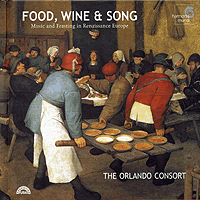 |
In paupertatis predio (anon) Chanconette / Ainc voir / A la cheminee / Par verite (anon) Prenes l'abre / He resveille toi Robin (Adam De La Halle) Nes qu'on porroit (Guillaume de Machaut) Apparuerunt apostolis v. Spiritus Domini (anon) Nowell, nowell: The boares head (Richard Smert) Si quis amat (anon) Cacciano per gustar (Antonio Zachara da Teramo) Canto de' cardoni (anon) Donna di dentro / Dammene un pocho (Heinrich Isaac) Canto di donne maestre di far cacio (anon) Adieu ces bons vins de Lannoys (Guillaume Dufay) Je ne vis onques (Gilles Binchois) Sile fragor (Loyset Compere) La plus grant chiere (anon) La tricotea (anon) Ave color vini clari (Juan Ponce) Oy comamos y bebamos (Juan del Encina) Quem tem farelos (anon) Von Eyren (Matthias Greiter) Von edler Art (Ludwig Senfl) Trinkt und singt (anon) |
In Food, Wine and Song, the Orlando Consort serves up a variety of music from the late Medieval through Renaissance periods, each song featuring texts about food and drink. The CD begins in late medieval France and England and moves chronologically through Italy, Burgundy, Spain, Portugal, ending in late Renaissance Germany. The sound of the quartet is always outstanding and this CD is no exception. The doleful ?Adieu ces bons vins de Lannoys? (track 15), by Guillaume Dufay is particularly beautiful with its sorrowful melody and haunting harmonies. As an added bonus, included with this CD is an accompanying cookbook. Prepared by world renowned chefs, these tasty recipes correspond with ingredients found in the songs. A number even come from medieval sources. For a real treat, try the Orange Omelette for Pimps and Harlots! For a true feast, try Food, Wine and Song. It will surely please the palate.
| 7083 CD $15.98 |
 |
The music of Antoine Busnois has inspired intense interest in recent times. With this survey of the different genres - sacred and secular - in which Busnois excelled, the Orlando Consort demonstrates the composer's supreme technical mastery, his melodic flair, and his rhythmic vitality. A comprehensive portrait of an early-Renaissance genius.
|
 |
The Orlando Consort sings rare and exquisite church music from 15th Century England, including motets, antiphons and psalm settings by Dunstaple, Frye, Plummer and others. This program spans some seventy years of English sacred music, dating from the reigns of Henry V, Henry VI and Edward IV, and the period of unrest known as the Wars of the Roses. It illustrates the rise of the so-called contenance angloise (English manner)Ñvalued especially for its suave melody, fluid rhythms and prevailing consonanceÑfrom its beginnings around 1420 to the repertory of the Eton Choirbook at the end of the 15th century. Sadly only a tiny proportion of the music that must have been written in this period has survived, but the pieces included in this anthology provide vivid testimony to this astonishingly rich and varied repertoire.
|
 |
An encounter between two powerful dynasties. The Orlando Consort revisits a fascinating meeting between two musical cultures. During his 1502 ceremonial visit to Toledo (Spain), Philip the Fair of Burgundy, and his Royal hosts, Ferdinand and Isabella, vied to display the artistic achievements of their respective realms. Music was central to all the festivities: solemn celebrations, worship, courtly banquets, dances and chivalric entertainments. "Immaculate tuning, rhythmic concision and clear articulation of the text." - BBC Music Magazine.
|
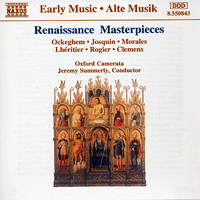 |
Intemerata Dei mater (Johannes Ockeghem) Nunc dimittis (Josquin Desprez) Magnificat (Octavi toni) ( Cristobal de Morales) Surrexit pastor bonus (Jean Lheritier) Laboravi in gemitu meo (Philippe Rogier) Ego flos campi (Jacob Clemens) Si ignoras te (Giovanni Pierluigi da Palestrina) Lauda mater ecclesia (Orlande de Lassus) Vadam et circuibo (Tomas Luis de Victoria) Laudibus in sanctis (William Byrd) Crux fidelis (King Joao IV of Portugal) |
It is doubtful whether any of the composers represented on this recording would have had an understanding of the term 'masterpiece' (let alone the term 'Renaissance') when applied to their own music. Similarly, it is unlikely that any of these composers would have considered themselves composers in the sense in which we now understand the word. The Renaissance musician was regarded as more craftsman than artist. Moreover, all of the music recorded here is entirely functional: it was all designed to be used within a living Latin liturgy; it had no other purpose. Beauty is in the eye of the beholder, but it may also be in the mind of the creator, and when composer and performer seem to perceive beauty within the same gesture (although separated by hundreds of years) we may be tempted to describe a work as masterly. In the Nunc dimiltis, for instance, Josquin's anonymous imitator may lack the technical refinement of his mentor, but the product is sincere and moving. Similarly, Thomas Morley's subsequent adaptation of Rogier's Laboravi in gemitu meo evidently reflects a contemporaneous respect for this beautifully-paced motet. And while King Joao IV may have been a discerning musical patron, he was neither a prolific nor great composer; however, Crux fidelis achieves a depth of emotion that was as recognizable to J. S. Bach as it must have been to King Joao's own subjects. Byrd's Laudibus in sanctis is the only concrete example on this recording of the composer giving a particular work his own seal of approval: its position at the head of the 1591 Cantiones sacrae proves that Byrd himself regarded this motet highly, and the fact that it now enjoys unreserved critical acclaim is comforting.
| 8755 CD $9.95 |
 |
The early 1580s marked an important change in the sacred music of William Byrd, just as they did in the history of Catholicism in England. Many of the Latin motets of the 1580s, collected in two volumes of Cantiones sacrae, set words about the Babylonian Exile, charged with penitential ecstasy. These are non-liturgical works - indeed the text of Infelix ego draws on the Bible only indirectly through the pen of savonarola. The words, written as that Catholic puritan demagogue awaited execution in Florence, reflect on his own personal guilt and the redemptive pity of God. They stimulate Byrd's wide technical resources, from two- and three-part writing to complex six-part polyphony to dramatic homophony, the whole reminiscent of the vast Marian antiphons of Christopher Tye or William Mundy. By contrast, the Mass settings are compact and controlled. They belong to a later period, when Byrd's response to his circumstances had changed from the impassioned to the practical; the Gradualia represent an attempt to set music for the entire Catholic liturgy, and the Masses may have been linked to the same project.
|
 |
If Weelkes stands slightly apart from his contemporaries then it is because he was perhaps the nearest the English got to a 'dare-devil'. The traits of the boldest compositions of his 1600 madrigal collection dig surprisingly deeply into the baroque psyche without ever drawing on specific 'baroque' practices: impetuosity, restlessness, a love of bold and startling symbolism, concentrated gestures, and an ambition for large structural coherence - all characteristics which would have found a natural home fifty years later. But when the madrigal soon, and ironically for Weelkes, became an anachronism he willingly turned his attention to the church, committed as he was to the bastion of counterpoint. However tempting it is to think of an innovator stifled by the conservatism of his age, the relatively experimental devices in the madrigals are surprisingly unintegral to Weelkes's musical style. He was never particularly responsive to words; as Hosanna to the son of David and Alleluia! I heard a voice display, his music is essentially driven by sonorous textures and an engagingly direct desire to set a text with the minimum of fuss.
|
 |
O quam gloriosum and O magnum mysterium are both early motets, published in 1572, and are amongst the best loved in his output. Written for the feasts of All Saints and the Circumcision respectively they both lend themselves well to adaptation into "parody" Masses. Material in O quam gloriosum for instance comes in easily delineated sections which can be lifted entire - Victoria particularly likes the motive on "quocumque ierit" which ends several sections of the Mass; he does however leave the startling first three bars of the motet completely alone. Why Victoria should have been so fond of the parody technique in general (only one of his twenty Masses is free-composed) is difficult to say - a clue may lie in the fact of his republishing many of his old works in new volumes, and he is unusual among contemporaries in having almost all of his output published in his lifetime. He was not altogether the otherworldly innocent he made out. But Victoria was far from just a talented, functional composer. The intensity of works such as Ardens est cor meum has led to frequent comparisons with another child of the Counter-Reformation, El Greco. Adapting the words of Mary Magdalene when she discovers the tomb empty on Easter morning, it translates into a personal plea for spiritual revelation. This passionate style is also evident in Versa est in luctum by Alonso Lobo, a Spanish contemporary and regarded as an equal by Victoria. It was written for the funeral of Phillip II of Spain, and sets a movement from the Requiem Mass.
|
 |
Without doubt the music written by the prince of Verona is some of the most macabre yet outlandishly fantastic music ever written. The famous unprepared chromatic side steps remain decidedly unnerving even to a devoted Second Viennese School. The effect of the chromatic spirals is often vertigo inducing but also deeply moving and ultimately awe-inspiring. This is truly sublime music by a neglected genius. The performances here are amongst the very best available of Gesualdo's music - at any price. This would be a perfect place to start exploring this bizarre but inspired musical universe.
|
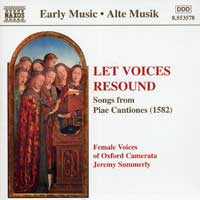 |
Aetas Carmen melodiae Parce Christus spes reorum Tempus adest floridum Resonet in laudibus Cedit hyems eminus Personent hodie Jesu dulcis memoria In dulci jubilo Florens juventus virginis Jermiae prophetae Ave maris stella Puer natus in Bethlehem |
Just the fabulous treble voices of the Oxford Camerata sing the important 16th century collection of Finnish songs known as "The Piae Cantiones". In 1592, exactly three hundred years before the founding of the modern Finnish musical establishment, the headmaster of Turku Cathedral School compiled and edited a collection of 74 songs which he entitled "Piae Cantiones" (Devout Church). As a protestant he was at odds with the catholic publisher and this religious tension is evident throughout. The melodies originated at various times and features songs up to five parts. The song now known as Good King Wenceslasis is most enjoyable and this all a cappella recording is certainly interesting. The beautiful, uniform purity of sound the singers achieve make this recording an essential addition to any collection.
| 7537 CD $15.98 |
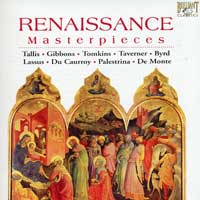 |
Orlande De Lassus -Aurora lucis rutilat -Tristis est anima mea -Missa "Tous les regretz" -Ave Verum -Surgens Jesus -Timor et tremor -Domine convertere -Salve Regina -Veni Creator Eustache Du Caurroy -Veni sancta spirtus -Requiem -Ave Maria -Ave Virgo gloriosa -Salve Regina -Christe, qui lux es -Victimae Paschalis Giovanni Pierluigi Da Palestrina -Victimae Paschalis -Magnificat -Dum complerentur -Stabat Mater -Alma Redemptoris -Recordare -Ad te levavi -Veni sancta spiritus Philippus De Monte -Miserere -Peccavi super numerum -Missa "Si ambulavero" -Super flumina Babylonis -Domine, quid multiplicati sunt -Spes humani generis -Domine Jesu Chirste -Angelus Domini Hodie, dilectissimi, omnium sanctorum |
For such transcendent music to succeed, it has to be performed with sufficient technical prowess. This the Choir commands, and they add to it under Higginbottom's direction, a full realisation of the unparalled range of expression at Pucell's command.
| 7851 5CDs BOX SET $37.98 |
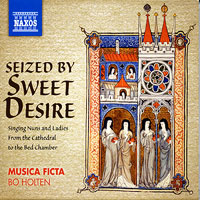 |
Alleluja - Perotin |
Until recently the role of women as composers and performers of both sacred and secular music during the Middle Ages has been seriously underestimated. This disc, sung by the all-female group Musica Ficta, reveals how well suited to women’s voices are music from Notre-Dame in Paris and the songs of many trouvères (the northern counterparts of the troubadours of Languedoc). The latter songs, for instance, often feature female protagonists and present different perspectives on love and life to those by their male counterparts.
| 4224 CD 9.95 |
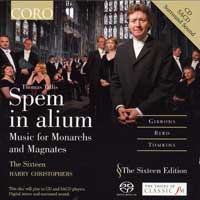 |
Spem in Alium O all true faithful hearts Deus venerunt gentes Know you not Great King of Gods (Lord of Lords) O God, the heathen are come Te Deum Be Strong and of A Good Courage Spem in Alium (also set as "Sing and glorify") |
Newly recorded in the round and in surround sound, Thomas Tallis' 40-part motet, Spem in alium, one of the great landmarks of polyphony, forms the centre-piece of this dazzling CD. Under the theme, Music for Monarchs and Magnates' The Sixteen draws together music by Tallis, Byrd, Gibbons and Thomas Tomkins, some of it never before recorded, some indeed not performed since the time of its writing. It explores the use of music for ceremonial, even propaganda purposes by the state, contrasted with the composers' private use of biblical texts to give public vent to their own sometimes dangerous views in an England torn by political and religious strife. Alongside the usual 40 voice setting of Spem in Alium is an English version of the same work - Sing and Glorify - which was adapted to an English text for King James I to honour his son Henry, the newly-annointed Prince of Wales. With cornetts, sackbuts, dulcians and organs in place of some voices, this is a glorious complement to the usual version.
| 7909 CD $16.98 |
 |
The great Spanish composer and priest, Victoria, devoted his life to writing supremely uplifting and intense music throughout the church calendar. The Call of the Beloved includes some of the earliest triple-choir music ever to be published and is a reminder of Victoria's joyous and passionate music, complementing his more austere Requiem and music for Holy Week. "If one can ever achieve complete emotional expression through the power of music, then here it is." - Harry Christophers. "This is a beautifully prepared and rewarding recording that deepens our appreciation of one of the greatest masters of the renaissance." - Gramophone
|
 |
Music from a turning point in history .... the short-lived marriage between Mary Tudor and Philip II of Spain, although barren and doomed, resulted in a glorious flowering of Anglo-Spanish music which saw the greatest musicians from the two nations meeting and working together. The music for a flamboyant Christmas Day ceremony in St. Paul's Cathedral in 1554 was a celebratory focal point of an extraordinary resurgence of the Catholic faith in England, fuelled by hopes, soon to be dashed, that Mary was pregnant.
|
 |
This new recording features the celebrated Requiem of 1605, Victoria’s final composition, a work of beguiling beauty and sumptuous simplicity. It can be seen as the summation of both his art and the Spanish Renaissance tradition. The beautiful plainsong on which it is structured can be heard arching through the texture, forming a delicate and sinuous line throughout. Subtly accompanied by a chamber organ and bajón, it is recorded here with the same forces as may well have performed it originally in the Monasterio de las Descalzas Reales. The Requiem is preceded by Marian Antiphons interspersed with three motets setting texts from the Song of Songs.
|
 |
The haunting tones of Allegri's Miserere are uniquely and instantly recognizable even to those who know little sacred music. It was only ever sung in the Sistine Chapel, where Allegri himself was a chorister. Palestrina had sung there before Allegri was born and his best-known work is Miss Papae Marcelli. Like his Stabat Mater it combines exquisite poise with a translucent setting of words. Chromaticism and blossoming cadences are employed to heart-rending effect in Lotti's eight-part Crucifixus in a unique blend of 16th and 18th century musical styles.
|
 |
The vast power of the Royal Courts of England and Scotland may be long gone but the sumptuous sounds of their worship are not lost. This disc brings together music of some of the most outstanding but now little-known composers of the 15th and 16th centuries, and introduces a major new work by one of this century's most remarkable composers, James Macmillan. Robert Carver's mesmeric setting of the devotional text "O bone Jesu" has long been admired and has now proved an inspiration to James MacMillan who has chosen with this special commission for The Sixteen, to clothe the same text in his own musical language of reflective beauty. "This 25th Anniversary CD is a delight, and like all great recordings it gets better the more you listen to it." - BBC Radio 3, CD Review
|
 |
|
Less well-known than Thomas Tallis, Sheppard's fame has spread slowly, because his compositions only made it to the twentieth century in manuscript form and many of them are incomplete. What survives bears all the hallmarks of greatness. This recording provides ample evidence of his bold, rich and individual harmony, as well as an inspired knack for compositional passion, while still adhering to Archbishop Cranmer's protestant tastes for concise word setting. The performance captured here is at the same lofty standard that Stile Antico's earlier recordings attained - almost perfect. This group engages the listener like no other, with the purpose of soloists, the tonal evenness of an ensemble, and with a clarity that is ground-breaking.
| 2323 CD $18.95 |
 |
Grammy-nominated vocal ensemble Stile Antico returns with its second recording for harmonia mundi. Heavenly Harmonies juxtaposes the highly expressive Latin motets of William Byrd (c. 1540–1632) with the austere, homophonic psalm tunes of Thomas Tallis (c.1505–1585) in a performance notable for the British group’s “staggeringly beautiful singing” (The Sunday Times) and recorded in a fittingly majestic acoustic. At the heart of the religious disputes which ravaged 16th-century England, the towering figures of the Catholic Tallis and Protestant Byrd embody two opposing tendencies. What is sometimes overlooked is how much the motets from Byrd’s Cantiones sacrae I and II (1589 and 1591) owe to the concise and expressive language pioneered by Tallis a generation earlier, when he also contributed the nine psalm tunes to a new psalter by Archbishop Matthew Parker (1567) – printed but regrettably never offered for sale. The program also includes Byrd’s Mass Propers for Pentecost from his Gradualia of 1607.
|
 |
The beautiful and often erotic poetry of the Song of Songs found some of its most sumptuous settings in the motets of Palestrina, Lassus, Victoria and other Continental 16th-century masters. Sung here by Britain's "brightest new stars" of Renaissance polyphony, the singers of Stile Antico, these staples of the choral repertory have never before sounded so vital or texturally rich.
|
 |
For their spectacular debut recording, the exciting young British early-music vocal group Stile Antico presents a program of English Renaissance music associated with the office of Compline (absorbed by the Anglican Church into Evensong), the service that ends the monastic liturgical day. A who’s-who of 16th-century British composers, including Thomas Tallis, William Byrd and John Sheppard, are represented here by hymns, antiphons, responsories, motets and psalms—the occasion not only for music of intimacy, elegance and reflection, but for flights of breathtaking canonic and contrapuntal invention and harmonic daring.
|
 |
Gabriel angelus Tibi Christe Virgo prudentissima Jubilate Deo Crucem tuam adoramus Magnificat Haec est illa dulcis rosa Missa "Se mieulx ne vient" Kyrie Gloria Credot Sanctus Agnes Dei t Pange lingua |
Elzéar Genet (c. 1470-1548) sang in the papal chapel under Pope Julius II, and thereafter in the court of the French king Louis XII. On November 5, 1513, he became the first composer to be named Master of the Papal Chapel. Working for Pope Leo X, who, in the Medici tradition, was a lavish patron of the arts, Genet's musical output became exclusively sacred. Although Genet was the first composer to publish his collected works, his music has unjustly fallen into near-oblivion. By the late 16th century, Genet's works had been replaced with newer settings by Palestrina and other composers. Sadly, there are no documented performances of his music again until the early 19th century.
| 8657 CD $15.95 |
 |
Missa L'homme Arme: Sacred Music of Ludwig Senfl is the Cheese Lords' second CD, and a world premeire recording of the music of Ludwig Senfl (1486-1543). Senfl was born in Basel, Switzerland around 1486. At an early age he joined the court chapel of the Holy Roman Emperor Maximilain I, as a choirboy. In Maximilian's chapel, Senfl met and studied with the court composer Henrich Isaac, and after a brief time away from the chapel, returned as an adult singer and Isaac's principle assistant. After Maximilan's death in 1519, his chapel was disbanded and Senfl's history is less clear. Eventually, he joined the chapel of Duke Wilhelm IV of Bavaria, where he remained until his death in 1542 or 1543. Senfl was a prolific composer with an output of over 100 mass settings, 50 vespers settings, and over 100 sacred motets. The vast majority of Senfl's music is unrecorded. The Cheese Lords are proud to present this selection of Senfl's sacred work, featuring a mass based on the popular French tune L'homme arme..
|
 |
Medieval Carols Angelus ad virginem Nowell sing we There is no rose The Coventry Carol Lullay: I saw Lully, lulla, thou little tiny child Ave Maria fo four voices Beata es virgo/Ave Maria Ave Maria for four voices Ave Maria for double choir German Chorales Es ist ein Ros' Joseph, lieber Joseph mein In dulci jubilo Flemish Polyphony Pastores quidnam vidistis Missa Pastores quidnam vidistis Chant from Salisbury Missa in gallicantu Christe Redemptor ominum Veni, Redemptor gentium Salvator mundi, Domine A solis ortus cardine Missa Puer natus est nobis |
Palestrina is the composer The Tallis Scholars have sung and recorded most frequently and this two discs set contains some of the best, in their view, recordings from the very first record they made commercially (in 1980), to one of the most recent. In general they have concentrated on his Mass settings not least because they make such effective concert music. Palestrina had an unusual ability to write positive, outward-going, major-key music which, over the length of a Mass-setting, is a great strength: penitential writing tends to be more effective in shorter bursts. Three of the four settings in this collection rely on bright sonorities; the fourth – Sicut lilium – is more subdued and sensuous, as the words of the motet require. The Missa Assumpta est Maria, based on his own motet of that name which in turn is based on a short phrase of chant, is a classic example of sonorous Palestrina, its excitement achieved in large part by doubling the sopranos and tenors. The brighter sound this high-scored six-voice (SSATTB) choir produces is then emphasized in the style of the writing, which is more chordal than usual. The parody motet Assumpta est Maria shows the way in its opening bars: the three upper voices are grouped against the three lower ones in easily audible antiphony. This late-Renaissance method is then transferred to the Mass, most obviously in the Gloria and Credo but also in the first Kyrie, where greater elaboration was more customary. The sheer verve of this music has ensured that, along with Papae Marcelli, Assumpta est Maria has remained the most performed of all Palestrina’s 107 Mass-settings. The second disc opens with a six-voice (SSATTB) set of Lamentations, originally the third lesson on the Saturday of Holy Week. The Missa Brevis (for four voices SATB), although relatively ‘short’ and straightforward in musical style, shows Palestrina’s idiom at its most accessible.
| 7881 2CDs $19.98 |
 |
If one were looking for a superstar among Renaissance composers Josquin is unquestionably the front runner. He was a star in his lifetime, travelling more widely, being paid better and having more desirable employment than anyone else; and he has become a star again more recently. It is true that in the centuries in between it has been Palestrina and Tallis who were performed more consistently, where Josquin was forgotten, but this was on account of their simple music, which choirs of any ability could sing. Josquin didn't write any simple music. All his music is complex, intellectually and vocally, posing problems which have only recently been found to represent a supreme challenge. As with Beethoven it is now recognized that facing up to Josquin's message can bring unparalleled rewards; and, more than anywhere else, it is now clear it was in his Mass settings that he expressed that message at its most fluent. There are perhaps fifteen Mass settings by Josquin, all of which are essentially scored for four voices.
|
 |
The Allegri Miserere, probably the most famous piece of this period is usually coupled with other well known pieces. This recording has the advantage of including a couple of less-known, but stunning works (okay, the Palestrina is quite popular, but even so.... As usual, the Tallis Scholars give a polished performance. Altogether, it's a great recording.
|
 |
The Sarum Use was a medieval variant of the Roman Catholic liturgy originating at Salisbury and used throughout pre-Reformation England. The plainchant on this recording is from the First Mass of Christmas, known as the Mass at Cock-crow.
|
 |
The reputation of a composer of Palestrina's enormous output is necessarily based on a selection of his work. Since there have been no recordings, no offprints, no very accessible discussions of the Missa Benedicta es, it has been impossible for the work to become widely admired. It shows a side of Palestrina's writing which is not fully recognized: his indebtedness to Josquin. In addition, apart from its remarkable music, it has an important place in musical history. If ever it was thought necessary to prove that Palestrina early in his life gained much from coming under the influence of the great Franco-Flemish composers, this resplendent parody mass shows how important they were to him and how he could turn their idiom to his own ends. 25 years ago, Peter Phillips and The Tallis Scholars made their debut with this recording. To celebrate this milestone, Gimell offers this limited-edition budget priced reissue.
|
 |
O lucidissima (Hildegard von Bingen) Novi sideris Lumen respenduit (Notre Dame repertory, 13th century) O cruor sanguinis (Hildegard von Bingen) Deus misertus hominis (Notre Dame repertory, 13th century) O tu illustrata (Hildegard von Bingen) Flos ut rosa floruit (Notre Dame repertory, 13th century) O viridissima virga (Hildegard von Bingen) I. Song to the Creator (O verbum Patris) II. Song of the Virgin to her Son (O fili dilectissime) III. Song of the Virgin (O Magna res) Nunc gaudeant (Hildegard von Bingen) O eterne deus (Hildegard von Bingen) Ave Maris stella (Huelgas MSS 13th century) O nobilissima viriditas (Hildegard von Bingen) |
Coming from diverse musical backgrounds, the 4 beautiful young women of Boston-based Tapestry came together to create new interpretations of mediaeval chant and polyphony, and to collaborate with contemporary composers in the creation of new works. 14 pieces, over half of them lovely, soaring chants by composer Hildegard von Bingen (1098-1179), like "O lucidissima," "O cruor sanguinis," "O tu illustrata," and "O viridissima virga." Interspersed are sacred works from the 13th century, like "Novi sideris Lumen respenduit," "Deus misertus hominis" and "Flos ut Rosa floruit."
| 7099 CD $15.98 |
 |
Flos regalis virginalis O Maria, stella maris, conductus Quem trina polluit Dou Way, Robin Veni creator spiritus Dum sigillum summi Patris Beata viscera Missa lumen de lumine |
Anna, Linn and Torunn, the 3 beautiful women who are Oslo, Norway’s brilliant, ethereal Trio Mediaeval, bring us their second CD. The group’s chosen repertoire of polyphonic medieval music from England and France, and contemporary works is represented here by 7 haunting polyphonic pieces from 12th and 13th century England (favorites being 2 odes to the Virgin Mary, "Flos regalis virginalis" and "O Maria, stella maris;" the group-arranged "Dou way Robyn/Sancta Mater," and 3-voice conductus "Veni creator spiritus" and "Beata viscera;" and 2-voice conductus "Dum sigillum." In addition there are the 5 movements of a contemporary work by Korean composer Sungji Hong, "Missa Lumen de Lumine," dedicated to Trio Mediaeval and written for 3 voices. The ringing tones and soaring harmonies take us to a sublime soundscape of wonder and meditation.
Listen to "O Maria, stella maris, conductus" in Real Audio.
| 7941 CD $16.98 |
 |
Founded in Oslo in 1997, trio mediaeval's repertoire is polyphonic medieval music from England and France, contemporary works and Norwegian medieval ballads and songs. Their first CD, "Words of the Angel," was released in 2001 and immediately went to the Billboard Top 10 Bestsellers list. "Soir, dit-elle" was released in 2004 and remained on the top-10 list for weeks. Linn, Torunn and Anna, trio mediaeval, sing music spanning some 500 years, but to them it is part of a timeless present. "Soir" has a sacred work by Leonel Power (1370-1445), "Missa "Alma redemptoris mater;" and 5 contemporary works, all composed for the group: Ivan Moody's "The Troparion of Kassiani," Gavin Bryars' "Laude novella—Ave regina gloriosa" and "Ave donna santissima—Venite a laudare," Andrew Smith's "Ave Maria—Regina caeli," and Oleh Harkavyy's "Kyrie." The perfect voices rise and blend in the atmosphere, carrying us up to another realm, a place of beauty, peace and meditation.
|
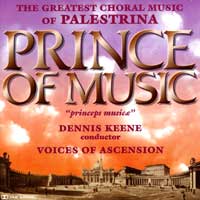 |
Pissa Papae Marcelli: -Kyrie eleison -Gloria -Credo -Sanctus -Benedictus -Agnus Dei I Motets and Offertories: -Secundum multitudinem -Tue es Petrus -Dum complerentur -O Domine Jesu Christe -Super flumina Babilonis -Canite tuba -Rorate coeli -Peccantem me quotidie Missa Papae Marcelli: -Augnus Dei II Alma Redemptoris Mater Sicut cervus Sitivit anima mea |
One of the finest (and most prolific) mixed choirs recording sacred music we have heard, NYC's exquisite Voices of Ascension turns their attention to Giovanni Pierluigi de Palestrina, the most famous Italian composer of his day. Laid to rest in one of the side chapels of St. Peter's in Rome at his death in 1594, the plaque on his coffin is inscribed "Prince of Music." Included here are the 6-part "Missa Papae Marcelli" and the 7th part, "Agnus Dei II," 8 "Motets and Offertories," and bonus tracks "Alma Redemptoris Mater," "Sicut cervus" and its second part, "Sitivit anima mea." The music is all a cappella, and to listen to any random movement, such as "Credo," "Sanctus," "Tue es Petrus" or "Peccantem me quotidie" is to hear the songs of angels, some of the most beautiful a cappella music ever written!
| 7726 CD $15.98 |
 |
Organist and Choirmaster of the Church of the Ascension Dennis Keene has dedicated a large part of his career to the music of Maurice Durufle, having conducted all of the French composer's choral works in performance. Here are Durufle's finest sacred works, the 9 soaring, dramatic movements of "Requiem, Op. 9," "Messe 'Cum Jubilo," Op. 11," and the lovely short piece, "Notre Pere." All orchestra-accompanied with some nice viola, violoncello, horn and harp solos. Vocal solos by Patricia Spence and Francois Le Roux are standouts. The Voices of Ascension is one of our favorite mixed choirs and "Album" is a wonderful collection of works by the master 20th century sacred composer.
|
 |
"Mysteries" is a very special collection of the Keene's and the Voices of Ascension's favorite pieces from many periods and countries having to do with Mary, mother of Jesus. Two of our favorites are two of the oldest pieces on the recording, the lovely a cappella "Alma Redemptoris Mater" by Giovanni Palestrina and Tomas Luis de Victoria's classic "Ave Maria." Other favorites are Anton Bruckner's "Gradual: Os Justi," Gabriel Faure's "Tantum Ergo," which only grows more beautiful with repeated hearings, Schubert's "Die Allmacht" and "Psalm 23," Pablo Casals' "Eucaristica," Charles Gounod's "Ave Maria," and Felix Mendelssohn's "Psalm 43." Some light accompaniment by harp, piano and organ. New York City's 38-strong, mixed-voice Voices of Ascension is one of our favorite choirs recording sacred music, and "Mysteries" is an inspiring joy from the first cut to the last!
|
 |
With this recording New York City's Voices of Ascension and Conductor Keene celebrate the 900th birthday of one of the most remarkable creative spirits of the Middle Ages, the Abbess Hildegard of Bingen (1098-1179). Although some musicians embellish Hildegard's single line chants with additional parts, the Voices of Ascension's approach is to present the inspired poetry and music of this mystic visionary "pure," without any contemporary additions. We are hearing, in these 14 haunting pieces, the Women of the Voices of Ascension, a mixed-voice choir on all their other excellent recordings. Soloists Kathy Theil, Michele Eaton, Alexandra Montano and Allessandra Visconti are particularly wonderful on cuts like "O virga ac diadema," "Vos Flores Rosarum," "Et Ideo," "O Pastor animarum,""Caritas Abundat," "Ave, generosa" and "O Jerusalem, aurea civitatus." All beautiful, soaring a cappella. This is simple, powerful music that touches and speaks to us across more than 8 centuries, in a way that its composer could never have imagined.
|
 |
Kyrie -- Antonio Bertali Toccata in C -- Johann Jakob Froberger Gloria -- Antonio Bertali Alleluia; Surrexit pastor bonus -- Christian Geist Sonata Petri et Pauli -- Pavel Josef Vejvanovsky Credo -- Antonio Bertali Resurrexi et adhuc tecum sum -- Christian Geist Sonata a 3 -- Antonio Bertali Sanctus -- Antonio Bertali Benedictus -- Antonio Bertali Sonata a 7 -- Antonio Bertali Sonata a 3 -- Pavel Josef Vejvanovsky Agnus Dei -- Antonio Bertali |
According to a note on the cover of the original manuscript, which survives in the Castle Archives at Kromeriz in the Czech Republic, Bertali’s Missa Resurrectionis was performed in Vienna, seat of the Holy Roman Emperor Leopold I, on Easter Sunday 1666. The Missa Resurrectionis is one of several dozen settings by Bertali that include all five sections of the Common of the Mass: Kyrie, Gloria, Credo, Sanctus & Benedictus, and Agnus Dei. This was by no means always the case - various religious feasts required only a Missa brevis (Kyrie and Gloria only), while others also included a setting of the Credo. Two motets by the North German singer-composer Christian Geist (1670–1711) set suitable Easter texts: Resurrexi et adhuc tecum sum is the Introit for Easter Sunday, while Surrexit pastor bonus comes from the Matins service for Easter Monday. Directed by former King's Singer Simon Carrington, this is a most fascinating recording.
| 8675 CD $15.95 |
 Choral - Home | Mens Choral | Womens Choral | Mixed Choirs | Mixed Ensembles | Early Music
Childrens Choir | Boys Choirs | Girls Choirs | Choral arrangements | Choral Christmas | Director's resources
African | English | Canadian | Bulgarian | Estonian | Hungarian | Scandinavian | Russian | Latin American
Spirituals | Madrigals | Budget Choral titles | DVDs | Complete choral list
 RSS Feed - Choral New Releases
Vocal Jazz | Choral | Contemporary | Barbershop | Christian | Collegiate | World | Doo Wop
Arrangements | Vintage Harmony | Budget titles | DVDs | Instructional for Singers
Christmas | Specials | FAQ | Juke Box | Video Channel
The Harmony Sweepstakes A Cappella Festival | West Coast A Cappella Summit
To find a specific song on any recording (or to find recordings by group name or CD title),
pick the search method and type the item you are searching for here:

All Rights Reserved All Content, page design, CGI Copyright © 2006 United Singers International


