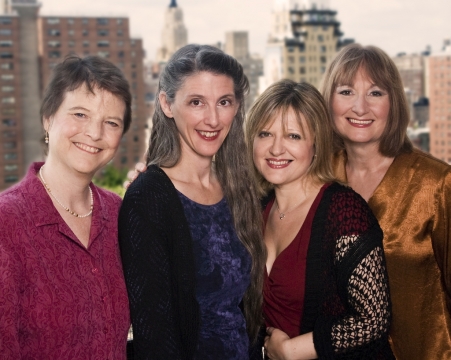

Originally formed in 1986 to experiment with the sound of medieval chant and polyphony as sung by higher voices, Anonymous 4 has become renowned for its astonishing vocal blend and technical virtuosity. The four women of Anonymous 4 combine musical, literary, and historical scholarship with 20th-century performing intuition as they create innovative programs interweaving music with poetry and narrative. Anonymous 4 has performed to critical acclaim on music series throughout North America, in such cities as Boston, Chicago, Cleveland, Denver, Houston, Los Angeles, Philadelphia, Pittsburgh, San Francisco, Seattle, Vancouver and Washington, DC.
The group has appeared on a wide range of radio and television programs, including NPR's "Performance Today," "Weekend Edition," and NPR stations around the country. Anonymous 4 has been featured on "CBS Sunday Morning" with Charles Osgood, Garrison Keillor's "A Prairie Home Companion," MPR's "St. Paul Sunday," and WNYC's "Around New York. " The ensemble appeared on Australian Broadcasting Company's program "Access All Areas," ZDF's "Ersteklassich!" and were also featured on Classic FM and BBC World Service.
Anonymous 4 appears regularly in concerts and festivals throughout Europe, including the Tage Alter Musik Festival (Regensburg), Eros & Ecclesia Festival (Berlin), Rheinisches Musikfest (Essen), Flanders Festival (Bruges), Oude Muziek Festival (Utrecht), Festival de Musica Antiga (Barcelona), Festival du Thoronet (France), Fondation Royaumont (Paris), Wigmore Hall and St. John Smith Square (London), Glasgow International Early Music Festival (Scotland), Birmingham and Cambridge Early Music Festivals, and the Turku Festival (Finland). The group recently made its Austrian debut with concerts in Salzburg and Graz. In the Far East, the Anonymous 4 was featured at Australia's Brisbane Biennial Festival, as well appearing in concerts in New Zealand and throughout Japan.
![]() |
I'm On My Journey Home An Address For All Wayfaring Stranger Where We'll Never Grow Old Ecstacy The Wagoner's Lad Mercy-Sat Return Again The Lost Girl Palmetto Pleading Saviour Merrick The Shining Shore Saint's Delight Just Over In The Glory Land You Fair And Pretty Ladies Parting Friends / Wayfaring Stranger Green Pastures |
On the heels of their successful hit album American Angels, the four-woman vocal group Anonymous 4 sets off on another musical journey into the rich songbook of traditional American folk music on the stunning new album Gloryland. Conceived as a collaboration between A4 and new-grass stars Darol Anger and Mike Marshall, Gloryland layers together lyric folk songs, religious ballads, shape-note tunes, and spiritual and gospel hymns into a musical tapestry that shimmers with joy and creativity.
Listen to "I'm On My Journey Home" in Real Audio.
| 8410 CD $18.98 |
![]() |
Holy Manna (Brethren we have met to worship) Abbeville (Come, Holy Spirit, come) Wondrous Love (What wondrous love is this!) Sweet Hour of Prayer Jewett (Amazing grace, how sweet the sound) The Morning Trumpet (O when shall I see Jesus) Resignation (My shepherd will supply my need) Poland (God of my life, look gently down) Wayfaring Stranger (I am a poor, wayfaring stranger) Sweet By and By (There's a land that is fairer than day) Blooming Vale (O, were I like a feathered dove) Idumea (I) (And am I born to die) Idumea (II) (My God, my life, my love) Sweet Prospect (On Jordan's stormy banks I stand) Shall We Gather at the River Amanda (Death, like an overflowing stream) Invitation (Hark! I hear the harps eternal) Parting Hand (My Christian friends, in bonds of love) Angel Band (My latest sun is sinking fast) |
Anonymous 4 turns from the medieval repertoire to explore the roots of American sacred music. Developed in Toni Morrison¼s Atelier program at Princeton in spring 2003, American Angels includes songs of redemption and glory from the time of the American Revolution to the present day: 18th-century psalm settings from rural New England, 19th-century shape-note and camp revival songs from the rural South, and some of the nation¼s best-loved gospel songs. Drawing from collections including "The Southern Harmony," and "The Sacred Harp," - the album explores the beauty and power of early American sacred music and the relatively obscure form of a cappella choral singing known as Sacred Harp.
Listen to "Amanda" in Real Audio.
| 7074 CD $16.98 |
![]() |
Awake and join the cheerful choir Good people all The seven rejoices of Mary The Lamb (John Tavener) A Scots Lilt Balulalow Balulalow (Richard Rodney Bennett) The holly and the ivy The Reel of Tullochgorum I saw three ships A Calendar of Kings (Peter Maxwell Davies) Air: La fuar geimhreadh An teicheadh go hEigipt A God and Yet A Man (Geoffrey Burgon) Grene growith the holy (Henry VIII) Wel, dyma'r borau gorau The Cherry Tree Carol Can wassel A New Year Carol (Benjamin Britten) |
Andrew Lawrence-King's virtuoso harp joins the voices of Anonymous 4 in a wealth of Yuletide music, favourite and rare, from the British Isles. Juxtaposing pagan and Christian traditions, the programme interweaves English, Irish, Scottish and Welsh ballads and carols with well-loved pieces by John Tavener (The Lamb), Benjamin Britten, and a newly commissioned work by Peter Maxwell Davies. Andrew Lawrence-King adds special colour playing a variety of instruments: psaltery, Baroque harp, and a remarkable Irish "Queen Mary" harp which sounds as if it contains its own peal of heavenly bells.\
Listen to "A God and Yet A Man" in Real Audio.
| 6951 CD $15.98 |
![]() |
intonent hodie exultemus et letemur gaudens in domino seint nicholas was borne in the citee of patras confessor dei nicholaus cantu mirro, summa laude sainte nicholaes whanne the bisshop of the citee of myre deied nicholai presulis cum quidam fluctuantia novus presul prodiit sainte nicholaes all the province of seint nicholas suffered... plaudat letitia salve cleri speculum/ salve iubar presulum sainte nicholaes a worschipfull man hadde thre doughtres virgines fulget nicolaus ex eius tumba/ sospitati dedit egros gaudens in domino and whanne oure lorde lust to take seint nicholas... psallar chorus/ eximie pater/ [aptatur] nicholae presulum micholaus pontifex |
1999 recording, celebrating the legend of St. Nicholas ("Jolly St Nick," or "Santa Claus"); as with most folk heroes, the actual biography of Nicholas, born in Turkey somewhere around 300 A.D., is much removed from present day interpretation. The New-York based classical women's quartet Anonymous 4, whose focus is medieval chant and polyphony, enliven these motets, hymns and conductus (medieval setting of Latin text) with an attention to historical realism that brings them very much to life. As the function of these chants was in the context of Catholic liturgy, they are by definition, an embodiment of all that is divine; neither rhythmically or harmonically complex, their appeal is their quiet beauty and distinctive texture.
| 6521 CD $15.98 |
![]() |
Que Est Ista O Quam Glorifica Ave Tuos Benedic In Adore Salve Mater Salvatoris Salve Sancta Parens Kyrie Gloria Benedicta Et Venerabilis Ave Gloriosa Mater Virga Ferax Aaron O Maria Stella Maris O Ceteris Preamabilis O Quam Glorifica... Recordare Virgo Mater Sanctus Agnus Dei Alma Dei Genitrix Salve Mater Salvatoris Paradisi Porta Ite Missa Est Pangat Melos Grex Devotus |
Anonymous 4 are known for their scrupulous recordings of 13th and 14th century English chant and polyphony. Lammas refers to the Celtic festival of harvest, celebrating the Assumption of the Virgin Mary. Much of the music of the time-at least that still existing today-was written to accompany the Catholic Mass. Therefore each part of the service, which was and is very specifically structured, assumed a certain form, depending on the context: motet, Antiphon, Conductus, introit, hymn, etc. The four women of Anonymous 4 take these relics and give them new life, gently and sweetly entreating them into the present day.
| 6217 CD $15.98 |
![]() |
Prosa: Gaude virgo salutata (chant) Polyphonic song: Edi beo thu hevene quene Introit: Salve mater redemptoris/ Salve lux langentium/ Salve sine spina/ Salve sancta parens Motet: Lux polis refulgens/ Lux et gloria Kyrie: Kyria christifera Gloria Motet: Spiritus et alme/ Gaude virgo salutata Song: Miro genere Gradual: Benedicta et venerabilis Alleluia: Alme iam ad gaudia/ Alme matris dei/ Alleluya per te dei Sequence: Missus Gabriel de celis Prosa: Gaude virgo gratiosa (chant) Polyphonic song: Salve virgo virginum Offertory: Felix namque (chant) Sanctus and Benedictus Sequence/Song: Jesu Cristes milde moder Agnus dei: Virtute numinis Communion: Beata viscera (chant and song) Rondellus: Flos regalis Chant setting: Ite missa est Hymn: Ave maria stella |
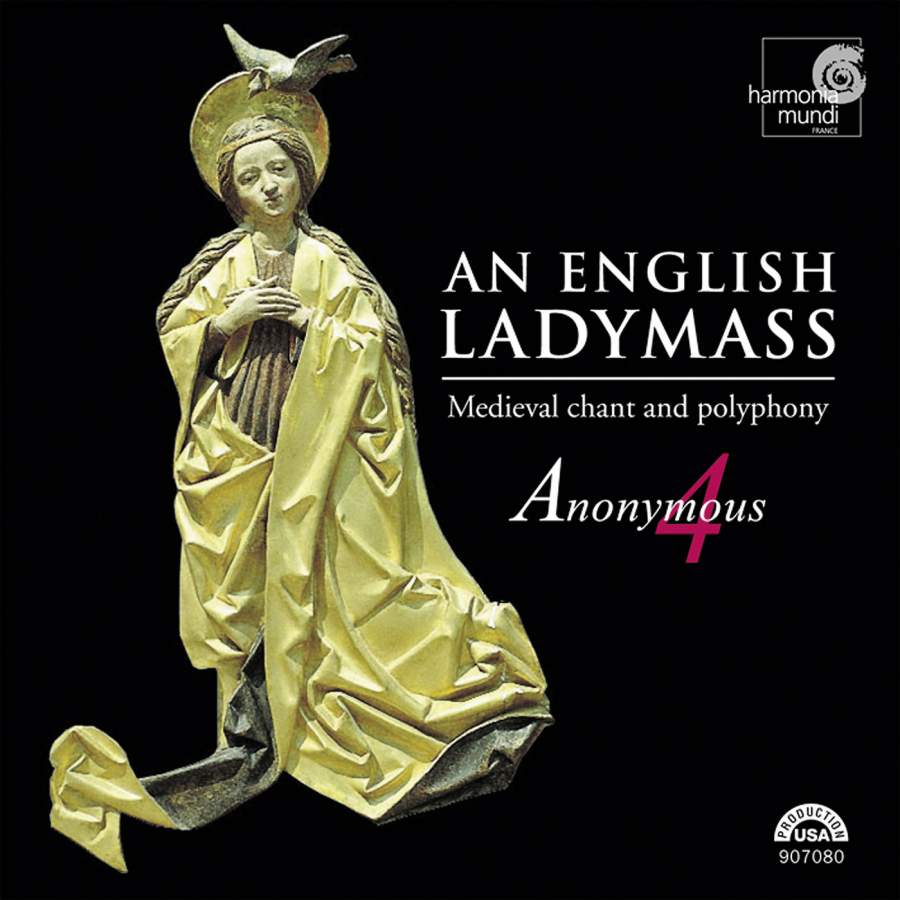
Here is a record to dispel
the old myth that chant and early polyphony are really uniquely the province
of male voices, men and boys. It is often forgotten that communities of nuns,
within the walls of their enclosure, sang exactly the same liturgical repertoire
as the monks, their male counterparts. Individual names of female singers do,
in fact, emerge from time to time: the noble Blesilla in the fourth century,
for example, commended by St Jerome for her excellent singing of the Alleluia,
or Abbess Hildegard in the twelfth century, who composed ravishingly beautiful
hymns and sequences. In our own century we have some good recordings of nuns'
choirs, Argentan in Normandy is one, and St Cecilia's, on the Isle of Wight,
another. But this disc represents something quite new: here is a professional
all-female vocal quartet uniquely devoted to the performance of chant and early
polyphony. Anonymous 4, whose very title recalls the authorship of a famous
medieval music treatise, have brought to the early-music scene a new approach
and a refreshingly new sound. They sing with clean, unpretentious voices a programme
of music that follows the basic structure of the Lady Mass, once so popular
in England. They fill it out with a well-chosen selection of thirteenth- and
fourteenth-century pieces in honour of the Blessed Virgin Mary: chants and polyphonic
items, mainly in Latin, but including two items in the vernacular, namely the
charming early strophic song Edi beo thu and the gentle sequence Jesu Christes
milde moder. There is a captivating simplicity and directness about their performance,
which naturally avoids many of the pitfalls of an overstretched attempt at reconstruction.
Songlist
| 6200 CD $15.98 |
![]() |
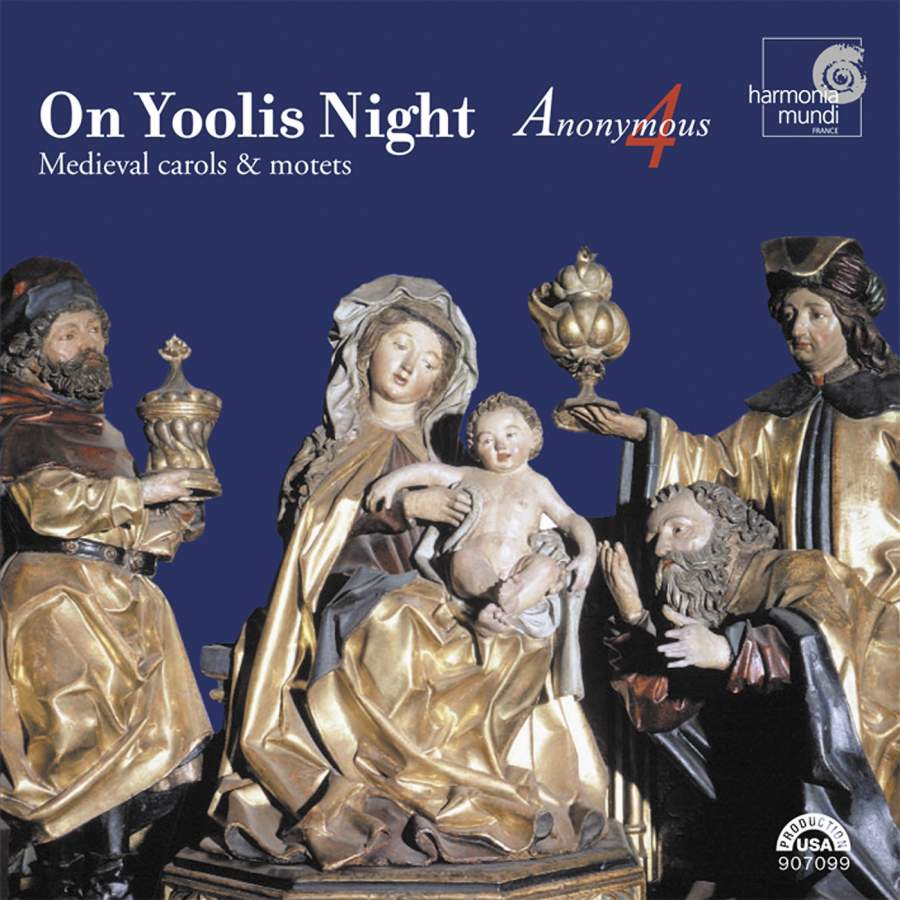
Hodie Christus natus est O nobilis nativitas²/²O mira dei²/²Odecus virgineum²/²Appruit Lux de luce Alleluya: A nywe werke Verbum supernun prodiens Balaam de quo vaticianas Ave Maria Gabriel, fram heven-king Lullay: I saw a swete semly syght Prolis eterne genitor²/²Psallat mater gracie Vox clara, ecce, intonat De supernis sedibus Qmnes de Saba Puellare gremium Lullay, lullay: Als I lay on Yoolis night Tria sunt munera Orto sole serene²/²Origo viri²/²Virga Iesse Peperit virgo Ecce quod natura A solis ortus cardine Ther is no rose of swych vertu Videntes stellam Owt of your slepe aryse |
The four female members of Anonymous 4 are dedicated to the preservation of Gregorian chant from medieval times, and this holiday selection of English plainchant, songs, motets and carols are all derived from this period. As one might expect, the texts are often sacred in nature, to be performed during religious rites and devotions, such as Advent (hymn, "Vox Clara, Ecce, intonat"). Carols often use the multiple verse and refrain format, that was a typical form ("Ther Is No Rose Of Swych Vertu," and others). Much more could be said about the historical and musical context of these works - and is, in the extensive liner notes - but this background, though fascinating, is not necessary to simply appreciate the supple grace and open sound of these gentle voices, which is more than enough.
Listen to "Hodie Christus natus est" in Real Audio.
| 6218 CD $15.98 |
![]() |
Ave spes nostra Mi Atyank Atya Isten Veni domine O mundi domina Fuit virgo Vox clara, ecce, intonat Omes unanimiter Dum medium silentium Primo tempore alleviata Speciosus forma Novum decus oritur Letentur cele Salvator noster Az idvozitor regenten Novus annaus adiit Exulta filia Syon Liber generationis Gaude et letare Exordium quadruplate²/²Nate dei²/²Concrepet infanti²/²Verbum caro Isten, teged |
A selection of liturgical and paraliturgical Christmas pieces, taken from
medieval Hungarian sources. Most are monophonic, but there is a modest sprinkling
of simple polyphonic pieces for two, three and four voices. The charm of the
performance lies in its unpretentious, almost childlike simplicity ‚ suggested,
maybe, by the delightful extracts from the Christmas story as quoted in the
notes. These extracts come from the "Peasants¼ Bible" ‚ Paraszbiblia:
Magyar Nepi Biblikus Tortenetek ‚ which contains Bible stories retold in simple
language, with homely, imaginative details and an atmosphere of fairy-tale.
The classic liturgical pieces, which include the Introit Dum medium silentium,
the splendid Gradual Speciosa forma, and others, are heard in a version which
tends to use the pentatonic scale, thus avoiding both B natural and B flat.
The sung readings are impressive with their polyphonic settings. I enjoyed the
rich Genealogy (Liber generationis) with its beautifully constructed and compelling
melody. Some of the vernacular pieces, as well as the Latin song for New Year¼s
Day, have a regular ternary rhythm. The Hungarian Te Deum (which appeared in
an earlier recording by the Schola Hungarica on Quintana) offers an interesting
alternative for the concluding verses: it simply transposes the original theme
up a fourth. The 110-page booklet, lavishly produced with both colour and black-and-white
illustrations, is a marvellous little tool and a joy to handle.
| 6219 CD $15.98 |
![]() |
Echo La Primavera Angelica Bilta Che Chos'e Quest' amor Nella Partita Non Do La Colp' a te Quanto Piu Caro Faj Se Pronto Non Sara Lasso! Per Mie Fortuna Ochi Dolenti Mie Muort' Oramai Per Allegreca Nella Mi Vita Abbonda Di Virtur Non Ara Ma' Pieta La Bionda Trecca Cara Mie Donna Gran Piant' Agli Ochi Echo La Primavera |
"Second Circle" is the latest release from the acclaimed and prolific Anonymous 4, who are Johanna Maria Rose, Marsha Genensky, Jacqueline Horner and Susan Hellauer. These are 14th century Italian love songs by Francesco Landini, an early "renaissance man," left blind by smallpox, who became a master musician, composer and poet, becoming the chief musician at the church of San Lorenzo in Florence. Anon4 gives us 18 of his beautiful songs, and to deepen our appreciation of them, there is one of the most lovely and extensive liner notes we have seen, actually a 46-page full-color booklet with a number of incredible paintings from the period. Much more than a group of lovely, obscure songs, we are treated to a short course in music appreciation and art history of the composer and his fascinating times!
| 6658 CD $15.98 |
![]() |
O Gloriosa Domina Pe Milde Lomb Isprad O Rode Ave Maria Gracia Plena Oh Maria Stella Maris Stabat Iuxta Christi Crucem Stillat In Stellam Radium Salve Virgo Singularis Stond Wel, Moder, Under Roode Oh Maria Virgo Pia In Ti Concipitur Jesu Cristes Milde Moder Veni Mater Gracie/ Dou Way, Robin O Mors Moreris/ O Vita Vera/Mors Salve Virgo Tonantis Solium Miserere Miseris Ave Maria Salus Hominum Memor Esto Tuorum Ave Regina Celorum |
This offering from Anonymous 4 is a selection of pieces dedicated to the Virgin
Mary from medieval England. These span some 200 years from the thirteenth century
to the early fifteenth. During this period, celebration of the Virgin increased
with a gathering impetus until the Marian cult dominated devotional worship,
and this is reflected in an outpouring of verse, in Latin and the vernacular,
much of which was set to music. Many of the verses are glosses on established
liturgical texts such as the Stabat mater or Salve regina, and it is the image
of the grieving mother at the foot of the Cross which prevails here, hence the
symbolism of the title: the virginal lily and the sacrificial lamb. Much of
the poetry ‚ and the music ‚ is very fine, and fans of Anonymous 4's previous
discs will not be disappointed. Their distinctive, all-female sound is as pure
and clear as ever and exerts a powerful attraction, especially if one is plunged
into it by hearing a track or two in isolation: very refreshing.
| 6223 CD $15.98 |
![]() |
Venite Omnes Cristicole Salve Festa Dies Voc Nostra Resonet Regem Regum Dominum Nostra Phalanx Plaudat Leta Ad Sepulcreum Beati Iacobi Ad Superni Regis Decus Iacobe Servorum Benedicamus Domino In Hac Die Laudes Cunctipotens Genitor Psallat Chorus Celestuim Alleluia: Gratulemur Et Letemur Ascendens Ihesus In Montem Qui Pius Ac Mitis Gratulantes Celebremus Festum Iacobe SancteTuum O Aditor Omnium Seculorum Portum In Ultimo Congaudeant Catholici Clemens Servulorum |
Susan Hellauers lucid introduction to the contents of Jacobus, the Liber Sancti Iacobi (the Codex Calixtinus) makes fascinating reading. Following Christopher Hohler, she points out that this extraordinary collection of liturgical items, non-liturgical pilgrim songs, sermons, chants and lessons in honour of St James, was originally destined for the use of French schoolboys, presumably with voix blanches. That being so, this recording by a group of high female voices may be easily vindicated: Anonymous 4 bring to their performance that smooth, unsophisticated vocal blend we have come to expect from them. It is a lovely sound, and their intelligent and imaginative approach sticks resolutely to middle ground, avoiding excesses of orientation and extremes of interpretative theory.
| 6224 CD $15.98 |
![]() |
Judicii Signum Quem Creditis Super Astra/Viri Galilei Celestis Terrestrisque Prudentia Prudentium Dominus in Sina Ascendens Cristus Salavator Mundi/Rex Omnipotens Die Hodierna Elevatus Est Rex Fortis/Viri Galilei Ante Secula Omnipotens Eterne Corpus Quod Nunc/Psallite Domino Apocalypse 21:1-5 Regnantum Sempiterna Cives Celestis Patrie |
This must be how the angels sound! That is the often evoked response of listeners to this exemplary quartet who explore, research, and bring to life medieval polyphony and chant. The blend of voices and virtuosity of creation is unparalleled by any other singers on earth. Once again, by research, the 4 have created a mass, this time "A Mass For The End Of Time." The end of time refers to the Last Judgement which is most strongly expressed in the liturgies of the Advent season, the Requiem mass, and the feast of Jesus's Ascension celebrated forty days after Easter. This work is based on the Ordinary and Proper chants of the Ascension mass with added tropes (newly written text and music) to enhance the feel of the music. Historically, the approach to the first millennium saw the collapse of Charlemagne's empire and alliances which yielded a tremendously unsettled period in European history. The church under the charismatic leadership of Pope Sylvester II created a spiritual anchor. Great cathedrals were begun and Christianity was seen as a primary civilizing influence. Musically, the traditional Roman plainchant was being renewed and greatly enlarged while developments in music such as staff line notation allowed these new creations to be rapidly learned and disseminated. Though the church provided a dynamic anchor, it also tended to foster a millennial belief in the end of time and that the Last Judgement was at hand. From this milieu, Anonymous 4 has recreated another incredibly beautiful liturgical testament.
| 6531 CD $15.98 |
![]() |
Venite Omnes Cristicole Ad Superni Regis Decus Portum In Ultimo O Maria Stella Maris Stabat Iuxta Christi Crucem Stillat In Stellam Raduim Primo Tempore Alleviata Speciousus Forma Mi Atyank Atya Isten Puisque Bele Dame MÕeime/FLOS FILIUS Ne Sai, Que Je Die/IOHANNE Amor Potest Conqueri/Ad Amorem Sequitur Quant Yver La Bise Ameine/IN SECULUM On Doit Fin(e) Amor/La Biaute/IN SECULUM Edi Beo Thu Hevene Quene Ave Maris Stella Salve Virgo Virginum Ther Is No Rose Of Swych Vertu Prolis Eterne Genitor/Psallat Mater Gracie Ecce Quod Natura Spiritui Sancto |
The culmination of a variety of skills and training, Anonymous 4 is one of the world's finest medieval singing groups. This CD celebrates the success of several of their recordings. Excerpts are taken from Miracles of Sant' Iago, The Lily & the Lamb, A Star in the East, Love's Illusion, An English Ladymass, On Yoolis Night and 11,000 Virgins. Their exquisite singing blends together the original spiritual intent with the modern artistic view of these ancient pieces. You will be moved by their breathtaking sounds.
| 6220 CD $14.98 |
![]() |
Veni creator spiritus Veni spiritus eternorum O quam mirabilis est The fire of creation O ignis spiritus paracliti Wisdom and her sisters O felix anima The fiery spirit O ignee spiritus Love Caritas habundat in omnia O eterne deus Beata nobis gaudia |
"Origin" is the 16th recording by the four angel-voiced women of Anonymous 4, of music by 12th century German abbess and mystic Hildegard of Bingen. Hildegard's intensely emotional chants and visions (including the monumental hymn "O ignee spiritus" and some of her finest antiphons) are performed here framed by hymns and sequences that she and her convent sisters would have heard and sung every day. 17 songs, the hymns "Veni creator spiritus" and "Beata nobis gaudia," " the antiphon "O quam mirabilis est," the vision "The fire of creation," the sequences "Veni spiritus eternorum" and "Oignis spiritus paracliti," and the responsory "O felix anima" are particularly wonderful, but we are deeply touched throughout this recording by the spirit and power of this music, hauntingly and perfectly performed by the stunningly talented Anonymous 4.
| 7502 CD $15.98 |
![]() |
Auctori vite psalmis Venite exsultemus domino O dulcissime amator Jesu corona virginum Spiritui sancto Specie tua Favus distillans Benedicamus domino Studium divinitatis Dominus regnavit/Studium divinitatis O Ecclesia Benedictamus domino Domine deus meus Mirabilis deus Cum vox sanguinis Magnificat anima mea/O rubor sanguinis Te lucis ante terminum Benedicamus domino |
The unique mystical music of Hildegard von Bingen has captivated all who listen. The German nun, who was barely educated, put forth an enormous body of work as a result of visions. At the age of 43 she had a vision of tongues of flame which compelled her to write down her spiritual experiences. She wrote several liturgical works for the feast of St. Ursula and the Eleven Thousand Virgins, which was probably an important date at her convent. Anonymous 4 has chosen some of these pieces for this recording of Hildegard's music. The framework of the album consists of portions of Vigil, Lauds and Vespers. They have included other liturgical chants and psalms in addition to Hildegard's works to recreate the powerful impression they first made. With their vocal clarity and passionate singing, Anonymous 4 has been lauded for their brilliant interpretation of the music of Hildegard
| 6221 CD $15.98 |
![]() |
Ave Spes Nostra Mi Atyank Atya Isten Veni Dommine O Mundi Domina Fuit Virgo Vox Clara, Ecce, Intonat Omnes Unanimiter Dum Medium Silentium Primo Tempore Alleviata Speciosus Forma Novum Decus Oritur Letentur Celi Salvator Noster Az Idvozitot Regenten Novus Annus Adiit Exulta Filia Syon Liber Generationis Exordium Quadruplate Lsten, Teged |
Ruth Cunningham, Marsha Genensky, Susan Hellauer and Johanna Maria Rose are the acclaimed, prolific a cappella group, Anonymous 4, and the beautiful polyphonic music in this CD almost didn¼t make it to us because of the invasion of Hungary by the Turks in 1541. The iconoclastic Turks destroyed artworks in all forms, including liturgical manuscripts. Fortunately some of the manuscripts were copied or carried away by fleeing monks, nuns and clerics. These plainchants are remarkably consistent, part of a major effort towards liturgical and musical uniformity. Ethereal, hauntingly beautiful, one can close one's eyes and be in the cathedral where the choir sent this perfect, sacred music heavenward‚as prayerful, meditative and joyful for the singers as for the worshippers. 20 sublime pieces.
| 6663 CD $11.98 |
![]() |
O maria o felix puerpera Pia mater gratie De la mere au sauveor O maria virginei Verbuym bonum et suave Ave salus hominum Mainte chancon ai fait Ave maria gracia plena Beata viscera Mundum renovavit Je te pri de cuer par amors Salve sancta parens Serena virginum De la tres douce Marie Ave virgo virginum Mater patris et filia Ave nobilis venerabilis |
The four beautiful, talented women who call themselves Anonymous 4 stun usonce
again with a soaring collection of a cappella choral music from the early Christian
church. One of the most respected and prolific choral groups(we like to think
of them as an institution) performing today, Anon 4 discovers the timeless choral
works that otherwise might never be heard, or heard by only a few, and brings
them to us in perfect, bell-like tones and harmonies--an unexpected gift from
centuries past. There are 17 songs here, all in Latin, and an amazing, comprehensive
set of illustrated liner notes that tell us everything we want to know about
the music. Put this CD on a really good music system, sit back and let the music
of the angels wash over you.
| 6757 CD $16.98 |
![]() |
Grace Jewett, by John Newton and R.F. Mann Dunlap's Creek, by Isaac Watts and F. Lewis New Britain, by John Newton and Columbian Harmony Journey The Morning Trumpet, by John leland and B.F. White Resignation, by Isaac Wats, arr. Johanna Maria Rose Poland, by Isaac Watts and Timothy Swan Wayfaring Stranger, arr. John M. Dye Sweet By and By, by Joseph P. Webster, arr. Johanna Maria Rose Invitation Holy Manna, by William Moore Abbeville, arr. Anonymous 4 Wondrous Love, arr. James Christopher Sweet Hour of Prayer, by William B. Bradbury Crossing Blooming Vale, by Isaac Watts, arr. Nym Cooke Idumea (I), by Charles Wesley and Ananias Davisson Sweet Prospect, by Samuel Stennett and William Walker Shall We Gather at the River, by Robert lowry Parting Amanda, by Isaac Watts, Justin Morgan Invitation, by F. Warren and William Hauser, arr. Marsha Genensky and Johanna Maria Rose Parting Hand, by John Blain and William Walker Angel Band, by Jefferson haskell, arr. Marsha Genensky and Johanna Maria Rose |
American Angels is the diary of Anonymous 4's first journey to the roots of Anglo-American spiritual vocal music. It includes 18th-century psalm settings and fuging tunes from rural New England, 19th century folk hymns and camp revival songs from the rural South, and gospel songs originating in the Northeastern cities and adopted in the late 19th Century by rural Southerners. Also included are the charts from some of their other recordings. SSAA
| 9545 SHEET MUSIC $9.95 |
Women's Choral
> Home l Amasong
| Anonymous
4 | Dzintars
| Elektra
Women's Choir | Le
Mystere des Voix Bulgares
Libana
| Malle
Babbe Women's Choir
| Mediaeval
Baebes
|
Manitou
Singers | Peninsula
Women's Choir
Philomela Female
Choir | Sofia
Chamber Choir | Sound
Circle | Tapestry
| Women's
Chorus of Dallas
Choral - Home | Men's Choral | Women's Choral | Mixed Ensembles | Mixed Choirs
Childrens Choir | Boys Choirs | Girls Choirs | Choral arrangements | Choral Christmas | Director's resources
African | English | Canadian | Bulgarian | Estonian | Hungarian | Scandinavian | Russian | Latin American
Spirituals | Madrigals | Budget Choral titles | DVDs | Complete choral list
RSS Feed - Choral New Releases
Vocal Jazz | Choral | Contemporary | Barbershop | Christian | Collegiate | World | Doo Wop
Arrangements | Vintage Harmony | Budget titles | DVDs | Instructional for Singers
The Harmony Sweepstakes A Cappella Festival | West Coast A Cappella Summit
RSS - New Releases
To find a specific song on any recording (or to find recordings by group name or CD title),
pick the search method and type the item you are searching for here: