
In Celebration of the Human Voice - The Essential Musical Instrument
Home | Doo Wop | Barbershop | World | Contemporary | Christian | Vocal Jazz | Choral | Christmas | Instructional | Arrangements
Classical | Opera | Musicals | Personality | Young Singers | Disney | Videos | Songs | The Artists

Oxford Camerata
Director: Jeremy Summerly
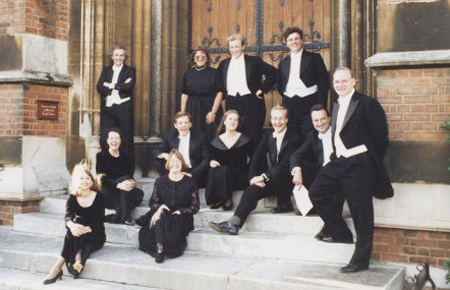
Mixed Choral Chorus from UK, England.
The Oxford Camerata was founded by Jeremy Summerly in 1984 since when the choir has given concerts throughout Europe and has made almost 30 CD recordings. The core group comprises 12 singers with or without keyboard accompaniment, but for certain projects the choir has been made up of as few as 4 singers and as many as 20. After a performance of Bach's St Matthew Passion in the Snape Maltings on Good Friday of 1986, Sir Peter Pears, who was at the performance, agreed to become the Oxford Camerata's first patron. Sadly he died within days but his place was immediately taken by Philip Ledger. Not long afterwards Lord Bullock also agreed to become patron to the choir. While the Camerata was initially recognised as a specifically Early Music group, since the early 1990s the choir has expanded its repertory to include music from Gregorian chant to the present day.
Oxford Camerata was founded by Jeremy Summerly, David Hurley, and Henrietta Cowling and gave its first concert at the Maison Francaise in Oxford on 22 May 1984. Since then the choir has given concerts throughout Europe and has made almost thirty CD recordings. The core group comprises twelve singers with or without keyboard accompaniment, but for certain projects the choir has been made up of as few as four singers and as many as twenty. After a performance of Bach's St Matthew Passion in the Snape Maltings on Good Friday 1986, Sir Peter Pears, who was at the performance, agreed to become the Oxford Camerata's first patron: sadly Sir Peter died within days but his place was immediately taken by Philip Ledger. Not long afterwards Lord Bullock also agreed to become patron to the choir; the Camerata was saddened to learn of Lord Bullock's death on 2 February 2004.
While the Camerata was initially recognised as a specifically early-music group, since the early 1990s the choir has expanded its repertory to include music from Gregorian chant to the present day. Hand in hand with this went the formation of the Oxford Camerata Instrumental Ensemble in 1992 and the Oxford Camerata Baroque Orchestra in 2007. Like the choir itself, the instrumental ensembles are of flexible size and can comprise from 4 to 20 players working with either modern or period instruments. The Oxford Camerata is regarded as one of the finest ensembles of its type in Europe, and in recognition of this the Camerata was awarded a European Cultural Prize by the Fordergemeinschaft der Europaischen Wirtschaft in 1995.
Discography
Displaying 1-8 of 8 items.
Review: Now enjoying cult status since her 're-discovery' 25 years ago, Hildegard von Bingen, the tenth child of an aristocratic family, entered a convent at the age of eight and spent the remainder of her eighty years as a nun as well as a mystic, the latter half as abbess of her own convent. Hildegard's great musico-poetic collection was completed around the year 1150. Symphonia armonie celestium revelationum (Symphony of the Harmony of Heavenly Revelations) is a collection of 77 songs and one music drama. The subjects of these songs are an idiosyncratic collection of individuals and groups - the pieces included on this recording are variously addressed to the Creator, the Redeemer, the Blessed Virgin Mary, St John the Evangelist, Apostles, Confessors, and Martyrs.
Songlist: O cohors milite floris, O successores fortissimi leonis, O vos imitatores excelse, O dulcis electe, O victoriosissimi triumphatores, O cruor sanguinis, O vis aeternitatis, O splendidissima gemma

Review: The Oxford Camerata was formed to meet the growing demand for choral groups specializing in Renaissance music. Now comprised of 12 mixed voices Camerata has since expanded its repertoire to include music from the medieval period to the present day. Jeremy Summerly founded the Oxford Camerata after studying music at New College, Oxford, graduating with 1st Class Honors in 1982. "English Madrigals" is divided into 4 sections, "Early Tudor Songs," ("Pastime with good company," attributed to Henry VIII, "Blow thy horn, hunter," by Wm. Cornish, and "Hey trolly lolly lo"); "Madrigals from the Golden Age" ("Draw on, sweet night" and "Weep, Weep Mine Eyes,'" by John Wilbye, Richard Carlton's "Sound Saddest Notes" and Robt. Ramsey's "Sleep, Fleshly Birth"); and "Romantic Songs and Partsongs," (Robt. Pearsall's "Lay a garland," Somerset's "The trees they do grow high," and Charles Stanford's "The Blue Bird"). Nice liner notes booklet with all the lyrics and group info. Camerata's music soars in perfect, effortless harmony!
Songlist: Pastime With Good Company, Blow thy horn, hunter, Ah Robin, gentle Robin, Hey Trolly Lolly Lo, Draw on, Sweet Night, Thule, the Period of Cosmography, Weep. Weep Mine Eyes, As Vesta Was, Sound Saddest Notes, Fair Phyllis, Sleep. Fleshly Birth, Mother, I will have a Husband, Lay a Garland, Rigg Fair, The Trees They do Grow High, The Blue Bird
Review: Without doubt the music written by the prince of Verona is some of the most macabre yet outlandishly fantastic music ever written. The famous unprepared chromatic side steps remain decidedly unnerving even to a devoted Second Viennese School. The effect of the chromatic spirals is often vertigo inducing but also deeply moving and ultimately awe-inspiring. This is truly sublime music by a neglected genius. The performances here are amongst the very best available of Gesualdo's music - at any price. This would be a perfect place to start exploring this bizarre but inspired musical universe.
Songlist: Illumina faciem tuam, Deus refugium et virtus, Exaudi Deus deprecationem meam, Tribulationem et dolorem, Tribularer si nescirem, Precibus et meritis beatae Mariae, O Crux benedicta, O vos omnes, Dignare me laudare te, Maria mater gratiae, Laboravi in gemitu meo, Ave dulcissima Maria, Domine ne despicias, Peccantem me quotidie, Sancti Spiritus Domine, Hei mihi Domine, Venit lumen tuum Jerusalem, Reminiscere miserationum tuarum, Ave Regina coelorum
Listen to
Riu riu chiu
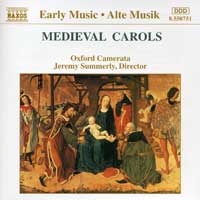
Review: In 15th-century England a tradition grew up for the composition of polyphonic carols. None of them is ascribed to a specific composer or poet, neither is their function completely understood. The form is that of alternating verses and burdens (refrains), the language generally being a mixture of Latin and English. The majority of the carols have sacred texts and it is possible that these were designed for liturgical use. Others are moralistic or celebratory and were possibly used to enliven feasts and banquets in aristocratic households or for recreational purposes at educational establishments. This CD is (along with the selection of songs from the Piae Cantiones) the Camerata's smallest-scale recording project. Only four voices are used throughout (Rebecca Outram, Deborah Mackay, Philip Cave, and Jeremy Summerly) although one of the tracks does also involve Jeremy Summerly playing the tambourine! The Christmas spirit was well captured by arranging to record this CD in December in sub-zero temperatures. The project attracted much attention and ulitmately resulted in the milennial publication of a volume of medieval songs and carols by Faber Music entitled Passetime with good company!
Songlist: Ave Maria, What Tiding's Bringest Thou, O Virdissima Virga, Alma Redemptoris Mater, Deo Gracias Anglia, Be Merry Be Merry, Riu, Riu, Chiu, There Is No Rose, Planctus Guillelmus, Eya Mater Stephane, Gaudate Christus Est Natus, Hail Mary Full Of Grace, Now We May Singen, Nowell Sing We, Planctus David
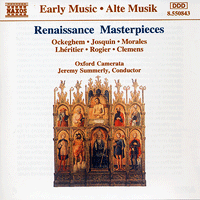
Review: It is doubtful whether any of the composers represented on this recording would have had an understanding of the term 'masterpiece' (let alone the term 'Renaissance') when applied to their own music. Similarly, it is unlikely that any of these composers would have considered themselves composers in the sense in which we now understand the word. The Renaissance musician was regarded as more craftsman than artist. Moreover, all of the music recorded here is entirely functional: it was all designed to be used within a living Latin liturgy; it had no other purpose. Beauty is in the eye of the beholder, but it may also be in the mind of the creator, and when composer and performer seem to perceive beauty within the same gesture (although separated by hundreds of years) we may be tempted to describe a work as masterly. In the Nunc dimiltis, for instance, Josquin's anonymous imitator may lack the technical refinement of his mentor, but the product is sincere and moving. Similarly, Thomas Morley's subsequent adaptation of Rogier's Laboravi in gemitu meo evidently reflects a contemporaneous respect for this beautifully-paced motet. And while King Joao IV may have been a discerning musical patron, he was neither a prolific nor great composer; however, Crux fidelis achieves a depth of emotion that was as recognizable to J. S. Bach as it must have been to King Joao's own subjects. Byrd's Laudibus in sanctis is the only concrete example on this recording of the composer giving a particular work his own seal of approval: its position at the head of the 1591 Cantiones sacrae proves that Byrd himself regarded this motet highly, and the fact that it now enjoys unreserved critical acclaim is comforting.
Songlist: Intemerata Dei mater, Nunc dimittis, Magnificat (Octavi toni), Surrexit pastor bonus, Laboravi in gemitu meo, Ego flos campi, Si ignoras te, Lauda mater ecclesia, Vadam et circuibo, Laudibus in sanctis, Crux fidelis

Review: O quam gloriosum and O magnum mysterium are both early motets, published in 1572, and are amongst the best loved in his output. Written for the feasts of All Saints and the Circumcision respectively they both lend themselves well to adaptation into "parody" Masses. Material in O quam gloriosum for instance comes in easily delineated sections which can be lifted entire - Victoria particularly likes the motive on "quocumque ierit" which ends several sections of the Mass; he does however leave the startling first three bars of the motet completely alone. Why Victoria should have been so fond of the parody technique in general (only one of his twenty Masses is free-composed) is difficult to say - a clue may lie in the fact of his republishing many of his old works in new volumes, and he is unusual among contemporaries in having almost all of his output published in his lifetime. He was not altogether the otherworldly innocent he made out. But Victoria was far from just a talented, functional composer. The intensity of works such as Ardens est cor meum has led to frequent comparisons with another child of the Counter-Reformation, El Greco. Adapting the words of Mary Magdalene when she discovers the tomb empty on Easter morning, it translates into a personal plea for spiritual revelation. This passionate style is also evident in Versa est in luctum by Alonso Lobo, a Spanish contemporary and regarded as an equal by Victoria. It was written for the funeral of Phillip II of Spain, and sets a movement from the Requiem Mass.
Songlist:
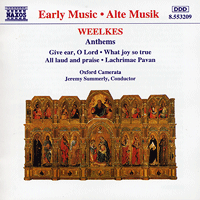
Review: If Weelkes stands slightly apart from his contemporaries then it is because he was perhaps the nearest the English got to a 'dare-devil'. The traits of the boldest compositions of his 1600 madrigal collection dig surprisingly deeply into the baroque psyche without ever drawing on specific 'baroque' practices: impetuosity, restlessness, a love of bold and startling symbolism, concentrated gestures, and an ambition for large structural coherence - all characteristics which would have found a natural home fifty years later. But when the madrigal soon, and ironically for Weelkes, became an anachronism he willingly turned his attention to the church, committed as he was to the bastion of counterpoint. However tempting it is to think of an innovator stifled by the conservatism of his age, the relatively experimental devices in the madrigals are surprisingly unintegral to Weelkes's musical style. He was never particularly responsive to words; as Hosanna to the son of David and Alleluia! I heard a voice display, his music is essentially driven by sonorous textures and an engagingly direct desire to set a text with the minimum of fuss.
Songlist: Hosanna to the son of David, Give ear, O Lord, All people clap your hands, What joy so true, O Lord, grant the king a long life, Lord, to thee I make my moan, All laud and praise, Lachrimae Pavan, A remembrance of my friend Thomas Morley, Passymeasures Pavan, Gloria in excelsis Deo, When David heard, Give the king thy judgements, O Lord, arise, O how amiable are thy dwellings, Most mighty and all-knowing Lord, Alleluia, I heard a voice
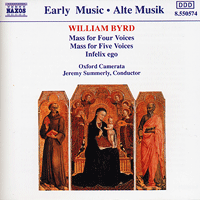
Review: The early 1580s marked an important change in the sacred music of William Byrd, just as they did in the history of Catholicism in England. Many of the Latin motets of the 1580s, collected in two volumes of Cantiones sacrae, set words about the Babylonian Exile, charged with penitential ecstasy. These are non-liturgical works - indeed the text of Infelix ego draws on the Bible only indirectly through the pen of savonarola. The words, written as that Catholic puritan demagogue awaited execution in Florence, reflect on his own personal guilt and the redemptive pity of God. They stimulate Byrd's wide technical resources, from two- and three-part writing to complex six-part polyphony to dramatic homophony, the whole reminiscent of the vast Marian antiphons of Christopher Tye or William Mundy. By contrast, the Mass settings are compact and controlled. They belong to a later period, when Byrd's response to his circumstances had changed from the impassioned to the practical; the Gradualia represent an attempt to set music for the entire Catholic liturgy, and the Masses may have been linked to the same project.
Songlist: Mass for Four Voices:, -Kyrie, -Gloria, -Credo, -Sanctus, -Agnus Dei, Infelix ego, Mass for Five Voices, -Kyrie, -Gloria, -Credo, -Sanctus, -Agnus Dei
Select a Category |
Want to Sing? - Find a Chorus Near You
List of Choruses by State | List of Choruses by City