|
Displaying 1-45 of 45 items.
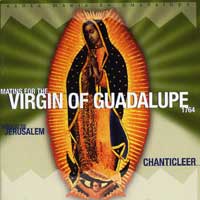
Review: The sequel to Chanticleer's best-selling and critically acclaimed Mexican Baroque recording, with more recently discovered choral masterpieces by Mexico City Cathedral's chapel master, Ignacio de Jerusalem. This recording brings to life one of the most monumental and elaborate choral works of the New World. Chanticleer is joined by Chanticleer Sinfonia, conducted by Joseph Jennings. Songlist: Matins para Nuestra Senora de Guadalupe - Ignacio De Jerusalem 
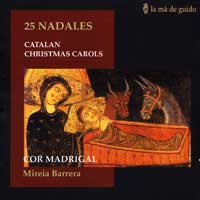
Cor Madrigal Vocal Ensemble : Catalan Christmas CarolsReview: Since 1967 the Cor Madrigal commissions from a different composer each year the harmonization of a traditional Catalan Christmas carol. After many years this initiative has allowed the choir to compile an important archive of scores and has contributed to the updating and regeneration of these beautiful songs. The carols that make up this recording are all traditional Catalan melodies and presents a varied range from well-known carols and popular melodies to more elaborated compositions which, without losing the traditional essence, treat the works in a more modern setting. A very interesting and enjoyable recording! Songlist: El Dimoni Escuat - Casanas, El Rabada - Oltra, El Petit Vailet - Pastrana, Les Besties Al Naixement - Sans, El Desembre Congelat - Vivancos, Sant Josep I La Mare De Deu - Jorda, Vos Sou La Meva Prendeta - Casanas, Fum Fum Fum - Cervera, Nit De Vitlla, Nadal - Bibiloni, Bressol De Nadal - Bibiloni, La Pastora Caterina - Marti, Del Cel Baixen - Oltra, Les Dotze Van Tocant - Just, Cap A Betlem Van Dos Minyons - Pastrana, Canco De Bressol - Pons, Ball Rodo - Mompou, El Pobre Alegre - Bonet, El Noi De La Mare - Cervera, Cap A Betlem Caminem - Marti, Deu Vos Guard Josep - Marti, Canco De L'infant - Oltra, El Cant Dels Ocells - Ribo, Pastors - Ben Alegres - Boliart, Cantem Al Xiquet - Gil-Tarrega
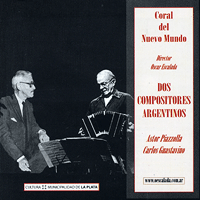
Coral del Nuevo Mundo : Dos Compositions ArgentinosReview: A great collection from the Argentinian maestro. Songlist: Milonga del Angel, Adios Nonino, Libertango, Las Estaciones Portenas:, -Invierno Porteno, -Primavera Portena, -Verano Porteno, -Otono Porteno, Pueblito mi pueblo, Anhelo, Indianas:, -Gala del dia, -Quien fuera como el jazmin, -Chanarcito, chanarcito, -Viento Norte, -Al tribunal de tu pecho, -Una de dos
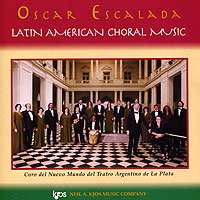
Coral del Nuevo Mundo : Latin American Choral Music Review: The Coro del Nuevo Mundo del Teatro Argentino de La Plata is a professional choir of sixteen singers and a pianist, percussionist and guitarist that tours extensively through Argentina, North and South America from their base in Buenos Aires, conducted by founder, composer and arranger Oscar Escalada. "Choral Music" features 11 works by South American composers. "Hanacpachap," 17th century Peruvian, is thought to be the first polyphonic music to be composed in the Americas. "Estrellita del Sur" is a lovely Peruvian waltz, "Manchai Puito" is a haunting folk song from Argentina, "Tonada y Cueca" and "La Doble" are joyf�ul dances, and we enjoyed the upbeat "Pueblito Mi Pueblo," a warm and elegant piece for women written by Carlos Guastavino, one of Argentina's finest composers. "La Chaparrita" is a bright Venezuelan folk melody, "Se Equivoco La Paloma" tells of a dove that loses its way, "Santafecino de Veras" is a joyful Argentinian dance and "Milonguera" is an exuberant and challenging work written by Oscar. A lovely, bright, surprising collection of South American music we rarely get a chance to hear! Some light accompaniment. Songlist: Hanacpachap, Estrellita del Sur, Manchai Puito, Tonada y Cueca, La Doble, Pueblito Mi Pueblo, Verano Porteno, La Chaparrita, Se Equivoco La Paloma, Santafecino de Veras, Milonguera
Review: Coro Cervantes is the only U.K. choir dedicated to the classical music of the Iberan Peninsula and Latin America. It was founded in 1995 by Carlos Aransay, under the auspices of the Instituto Cervantes in London. Its repertoire spans a wide variety of music from the Middle Ages and the Renaissance to the 21st Century, with a special emphasis on Romantic Music. Coro Cervantes often performs with distinguished solists and instrumentalists and contributes to the international propagation of Hispanic choral music through its performances, recordings and research. Its repertoire includes works sung in Latin, Spainsh (Castilian). Quechua (language of the Incas), Nahuatl (language of the Aztecs), Mediaeval Galician, Catalan, Basque and even in English. Songlist: En Aranjuez con tu amor, Xivarri, Aurtxoa Sehaskan, El Vito, Al pano fino, Volar, Negra sombra, Ondi jueron?, Ton pare non te nas, El cant dels ocells, Riverana, Esta tierra, Nana, Soy de Mieres, El gavilan, Arrorro, La tarara riojana, Adios, Granada, Epitafio de Don Quijote, Balada de Mallorca
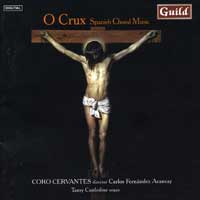
Coro Cervantes : O Crux - Spanish Choral MusicReview: The cover of O Crux suggests a programme of Spanish choral music from the age of Victoria. But no, it's actually a series of a cappella sacred music written in the eighteenth and nineteenth centuries. Albeniz, Granados, Manuel de Falla and Fernando Sor as we have never heard them before: caught up in the mystery of religion and drawing imaginatively, and often very audibly, on the styles of their illustrious ancestors. The first piece on the CD, a psalm from the "Office for the Dead" by Albeniz, is slow, predominantly chordal and sombre and sets the mood beautifully. One of the best pieces on the disc is the "Salve" by Ledesma, an organist from Aragon. The "Salutaris by Vives" and is almost operatic; after a soprano solo the full choir enters for the repetition of the text. The setting by Arriaga, who died aged only 20 in 1826, is much gentler - one can only wonder what the boy may have produced had he lived longer. Sor's "O Crux" has a finely melodic soprano line, and the two pieces by Eslava are simple and effective, "Bone Pastor" being a rare work here in triple time. The two pieces by Barbieri both have some highly dramatic word-painting, here rendered with precision by the choir. "L'herba de l'amor" by Granados has a nicely intonated soprano solo, (the text is sung in Catalan), leading to a gradual build up of voices. In similar vein is the build up in "Qui manducat" by de Monasterio. Vicente Goicoechea's "Christe Factus" est is highly chromatic. Songlist: Salmo Vl del Oficio de difuntos, Salve Regina, Invocatio ad Individuam Trinitatem, Christus Factus est, O Salutaris, O Crux, Salve montserratina, O Sacrum Convivium, A solis ortus, Liberame Domine, Ave Maria, Versa est in luctum, Salve Regina, O gloriosa Virginum, O salutaris, L'herba de l'amor, Qui manducat meam carnem, Salve en el mar
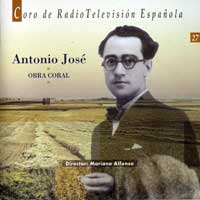
Review: Coro de RadioTelevision Espanola, under the direction of Mariano Alfonso, is considered to be one of Spain's most accomplished choirs and here sing the a cappella works of the Burgos composer Antonio Jose. Considered to one of the finest Spanish composers of the last century his promising future was cut short when he was executed by a Falangist firing squad in 1936. These fifteen works are a pleasure to hear and an interesting addition to any choirs' repertoire. Songlist: Himno A Castilla, Cuatro Canciones Populares Burgalesas, Tres Cantigas De Alfonso X, Cinco Castellanos
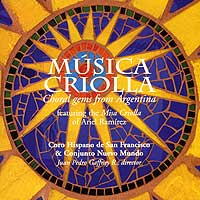
Coro Hispano de San Francisco : Musica CriollaReview: The Coro Hispano de San Francisco presents an exciting program including one of the most popular works of the Latin American choral repertoire, Ariel Ramirez's Musica Criolla. Since its composition, the Misa has been a showpiece for choirs around the world. In it, Ramirez has created a work at once spiritually exalting and deeply rooted in the folk idiom of his people. It's architectural simplicity, subtlety of detail, and vibrant colors make a moving experience which the Coro Hispano has lovingly and fully captured in this recording. Navidad Nuestra, a six-movement Christmas suite is a long-standing favorite with Coro Hispano's audiences. Rounding out the program is Oscar Bareilles' brilliant choral triptych Flor de Chanar -which is an ideal foil to Ramirez' masterwork. One sets the classic texts of the mass, the other deals with folk poems of love - but both drawing deeply from the rhythms and melodic modes of the people of Argentina. Songlist: -Misa Criolla, -Navidad nuestra, -Flor De Chanara
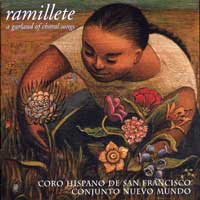
Coro Hispano de San Francisco : Ramillete  Review: If "Mexican Baroque" has caught your ear, this wide-ranging anthology of choral music from Mexico, Central and South America is a must; it's got Latin American Renaissance, Baroque, Classic, Romantic and folk-originate works in a rich array of textures, styles and sonorities, from chorus-orchestra down to voice-and-guitar, all performed to the nines by the nation's premiere ensemble dedicated to this repertory: Coro Hispano de San Francisco. Brilliant vocal solos and on-target instrumental work by some of the West Coast's leading names in early music combine with foot-stomping Veracruz zapateados and robust, ranchera-style singing in this sampler from a half-dozen different concert programs. Latin America's choral music is a little-known treasure that's been quietly awaiting rediscovery for decades (or centuries- depending on how far back you want to go). Leading the way in its interpretation is the Coro Hispano de San Francisco, which has been exploring and performing this repertory exclusively since its first concert in 1975. On this disc-its third CD release- the nation's premiere Hispanic chorus turns in an amazingly varied sampling of music for voices and instruments from the cathedrals of Puebla, Lima and Sevilla, the ranchos of Early California, the plazas of Veracruz, all the way to the rain-forest missions of Paraguay and the mountain villages of Nigeria. Songlist: Te Deum in C, Fecit Potenciam, Laudate Dominum, Cantico del Alba, Gloria, Agnus Dei, Virgen Sancta, Plaza, Plaza!, Las Mananitas Guadalupanas, Los Coflades de la Estleya, Keresimesi odu de o, O Quam Suavis, Digan, Digan, El Tilingo-lingo, La Golondrina, Cuando Uno Quiere a Una, Te Quiero Porque Te Quiero, Es Bueno Darte Gracias, Senor
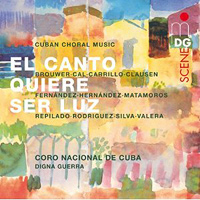
Coro Nacional de Cuba : El Canto Quiere ser Luz - Songs Want to Be LightReview: Choral music in Cuba - and, what is more, a cappella? Yes, the Coro Nacional de Cuba under its conductor Digna Guerra presents itself to the public in absolute top form: singing without vibrato, self-assuredly flawless intonation, the finest Latin American rhythms, and a choral sound full of dynamic power and absolute fascination. No wonder that the ensemble recently won the International Chamber Choir Competition with aplomb Songlist: Babalu en La Habana Vieja, Conoces un fuego que no da calor, Vertigo de lluvia, Las casas, La rosa roja, Missa sine nomine - Gloria, Missa sine nomine - Kyrie, Para ti, Juramento, Variacion, Remanso, cancion final , Media luna, Portico, El canto quiere ser luz, Prayer, Hay quien presisa, Locuras, Son Mercedes, Buena vista (Chan Chan)
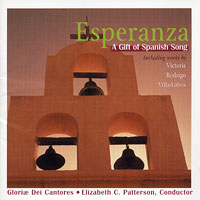
Review: Gloriae Dei Cantores celebrates the rich contribution of Spanish music and culture to the world. This recording spans 500 years, from the golden age of the Spanish Renaissance, with works by Guerrero, Victoria and Morales to the 20th century, with music by Rodrigo. Also included are works of Mexican composers de Zumaya (a striking setting of the Miserere) and Carlos Chavez, and Latin-American composers such as Villa-Lobos, Casals, and Joaquin Nin. Esperanza will be a revelation to those unfamiliar with the riches of Spanish literature and a great discovery for all devotees of choral music. Songlist: Manus tuae Domine Missa Beata Maria Virgine in Sabbato, Kyrie, Gloria, Sanctus, Benedictus, Angus Dei Three Christmas Carols, Oyd, oyd, una cosa, Virgen Sancta, A un nino llorando, O sacrum convivium, Miserere, Tree of Sorrow, Villancico Gallego, Villancico Asturiano, Villancico Castellano, Villancico Andaluz, Duermete, Nino, O vos omnes, Psalm 150, Salmo 150, Magnificat-Alleluia
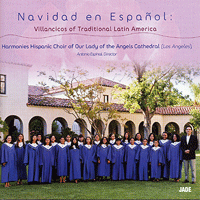
Review: This album is a special collection of rare Christmas songs and arrangements from all over Latin America, including traditional and recent renditions of tunes and melodies from Mexico, Cuba, Puerto Rico, Colombia, Ecuador, Chile, Paraguay, Peru, Brazil, and the Dominican Republic. These songs are performed by Harmonies, a girls choral group based in Los Angeles, comprised of girls ages 8 through 18 under the musical direction of Orchestral and Choral Conductor Maestro Antonio Espinal, founder of the choir. Songlist: Letania, Villancico Mexicano, Tarara Tarara Qui Yo Soy Anton, Por el Valle de Rosas, Navidad Guadalupana, El Tilingo Lingo Navideno, El Cha Cha Cha de la Navidad, A la Media Noche, Pastores a Belen, Los Tres Reyes Magos, Vamos Todos de Pachanga, Velo que Bonito, No Se Nino Hermoso, Ay Si, Ay No, Noche Buena Paraguaya, Villancico Negro, Festejo de navidad, Boas Festas, Bonus Track: Festejo de navidad - a Capella
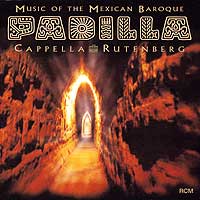
Los Angeles Chamber Singers : Padilla - Music of the Mexican BaroqueReview: Los Angeles Chamber Singers' Cappella was founded by director Peter Rutenberg in 1993 and performs a cappella musical literature from the 15th, 16th and early 17th centuries, in period vocal style. Many of the 19 mixed-voice singers are accomplished soloists, studio musicians, composers and choral directors in their own right. In addition to standard masterworks of the period by Lassus, Palestrina, Byrd, Victoria, Tallis, Josquin and others, the ensemble enjoys seeking out and performing significant but rarely heard, or recently rediscovered works. There are 13 pieces here by Juan Gutierrez de Padilla (1590-1664), who is rightly remembered as a master polychoralist, intense contrapuntalist and richly colorful harmonist. His work is seen as the first flowerings of Mexico's Golden Age, which reached full bloom with the music of Zumaya and Jerusalem 100 years later. "Deus in adiutorium meum intende," the five wonderfully harmonic movements ("Kyrie," "Gloria," "Credo," "Sanctus" and "Agnus Dei") of "Missa Ego flos campi," "Versa est in luctum," "Lamentations for Maundy Thursday," "Velum templi scissum est" and "Mirabilia testimonia tua" - these are soaring harmonic poems, designed to be sung in a cathedral's vast acoustics, to allow the worshippers to close their eyes and hear the sounds of angels. Extensive liner notes translate the lyrics and include a comprehensive history of the composer. Stunningly beautiful! Songlist: Deus in adiutorium meum intende, Missa Ego flos campi:, Kyrie, Gloria, Credo, Sanctus, Agnus Dei, Circumdederunt me dolores mortis, Versa est in luctum, Transfige, dulcissime Domine, Lamentations for Maundy Thursday, Velum templi scissum est, Vidi turbam magnam, Mirabilia testimonia tua
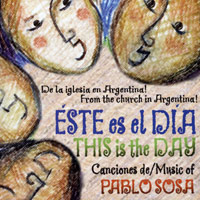
Pablo Sosa : Este es el DiaReview: This recording contains nineteen of Pablo Sosa's best church music compositions, reflecting both the folk and contemporary genres of Argentina. This recording is Sosa's legacy and inspiration to future generations of sacred music composers. Mostly written in Spanish, the songs on this recording communicate a great range of emotion through the richness of melody and allure of Latin rhythms. The folk and contemporary music of este es el Dia joyfully expresses the Gospel message with the colorful musical flavors of Argentina. The CD booklet contains singing translations of all songs. Songlist: Gloria, Miren que bueno!, Si fui motivo de dolor Latidos de Dios, El cielo canta alegria, Hemos cubierto la tierra, Querida Abya yala, este es el dia, La bendicion del Dios de Sara, Tuyo es el reino, Alli esta Jesus, Este momento en punto, Villancico del pibe laburante, Villancico del Dios transformado, Villancico del cartonero, Yo se que se, Stranger Unknown, Cristo vive!, Vamos!
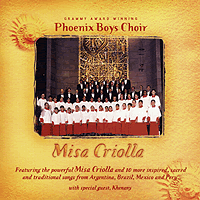
Phoenix Boys Choir : Missa Criolla  Review: Since 1948, the Phoenix Boys Choir has provided a top-quality music education for boys 7-14 and spirited entertainment for audiences around the world. Concert tours throughout the US, Europe, Australia, New Zealand, Canada, Mexico and the Orient have won the group a reputation as one of the world's outstanding boy choirs. In 2001 the Choir won a Grammy for Best Choral Performance for its recording of Penderecki's Credo with the Oregon Bach Festival Orchestra and Chorus, conducted by Helmuth Rilling. "Miso" features the powerful "Misa Criolla" and 10 more inspired, sacred and traditional songs from Argentina, Brazil, Mexico and Peru. Some favorites (some accompanied by the band Khenany from Sonora) are the familiar tunes "El Condor Pasa," "Escondido," "Cielito Linda," "Eu e voce" from Brazil, the five parts of the title tune," the a cappella sacred songs "Hosanna, Filii David," "Una Hora," "Judas Mercator" and "Laudi Alla Vergine Maria." "Misa" is a joy, the bright sounds of the boys' voices working equally well with Khenany's salsa-flavored folk tunes as with the soaring sacred music! Songlist: El Condor Pasa, Escondido, Pueblito, Mi Pueblo, Cielito Lindo, Eu E Voce, Misa Criolla:, Kyrie, Gloria, Credo, Sanctus, Agnus Dei, Hosanna Filii David, Una Hora, Judas Mercator, O Sacrum Convivium, Laudi Alla Vergine Maria
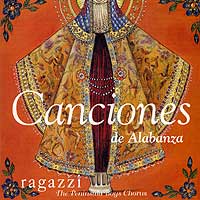
Ragazzi Boys Chorus : Canciones de AlabanzaReview: The 50 boy singers of San Mateo, CA's Ragazzi are conducted by Joyce Keil in this wonderful and diverse collection of songs of praise. From the solemn 14th-century pilgrim song ("Stella Splendens") and the wonderful Renaissance motet ("Salve Regina") to the folk rhythms of the "Misa Criolla" and the wild instrumental colors of the modern "Estampie Natalis," these songs all celebrate the birth of Jesus, and his mother. Taking on the hard work of learning these difficult pieces, the young singers skipped and danced out of the studio after perfecting a song. Other favorites are the 5 movements of Giacomo Perti's "Magnificat A 4," and Thomas Luis de Victoria's "O Sacrum Convivium." There is some accompaniment by organ, piccolo, strings, recorder, bass and percussion. A joyful, touching effort by talented Ragazzi. Songlist: Estampie N atalis, Stella Spelndens, Salve Regina, Salve Regina, Magnificat A 4:, Maginificat, Et misericordia, Fecit potentiam, Recordatus, Sicut locutus est, O Sacrum Convivium, Misa Criolla:, Kyrie, Gloria, Credo, Sanctus, Agnus Dei
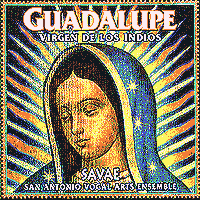
San Antonio Vocal Arts Ensemble : Guadalupe Virgen de los IndiosReview: The Virgin Of Guadalupe (Mexico), according to the account, appeared in a vision in 1531, and inspired many compositions in her honor, fusing the indigenous American and colonial Spanish musics of the period. Though many of the tracks on this CD are accompanied by the traditional instruments of the culture (pre-Columbian flutes, Mexican percussion) the excellence of the seven voices of SAVAE (featured on National Public Radio) makes this a worthy addition to our catalog. The works of Tomas Pascual are featured, as well as Franco and Valeriano; some, such as "Aufer A Nobis Iniquitates," are typical of the vocal polyphony of sixteenth century motets; others, such as "Hoi Nace La Nueba Estiella," are homophonic, with folk dance rhythms and simple tunes. A beautiful recording of great merit. Songlist: abrase el reyna del cielo, mananitas a la virgen de guadalupe, dios es ya nacido, aquestando tonceria, aufer a nobis iniquitates, nican mopohua, virgen madre de dios, o virgen maria, al prodigio mayor, de la sagrada mari/ forcado de amor, juantzin, juan diegotzin, bay magalhi/ magalhi, dulce consuelo/ de nepa tepatzin, hoi nace la nueba estiella, tepeyacac, in il huicac cihuapille, y technepa sacramento dios, ma xiccaqui
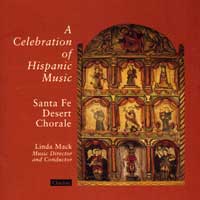
Review: A study of the evolution of musical style in Hispanic churches in the New World reveals a remarkable melding of a number of cultures. Spanish colonists carried the musical traditions of the European Renaissance to the native people of the Americas, and, through time and circumstance, these traditions merged in the American Southwest to create a musical genre with a rich historical grounding. A treasury of sacred works by the finest composers from Spain and the New World - from the Renaissance majesty of Morales and Victoria to the Misa Criolla, one of the 20th century's most beloved choral works. This is the program that was performed for a tour of Northern New Mexico historic churches during the summer of 2005. Songlist: Misa Criolla - Ariel Ramirez, Kyrie, Gloria, Credo, Sanctus, Agnus Die, Two Aztec Songs to the Virgin (Don Hernando Franco), Santa Maria yn ilhuicac, Dios itlaconantzine, Sancta Maria, succurre miseris - (Cristobal de Morales), Alleluia! Dic nobis Maria - (Francisco Lopez Capillas), Sanctus and Hosanna - (Francisco Guerrero), In Annuntiatione Benissimae Mariae - (Tomas Luis de Victoria), Egregie Doctor - (Antonio de Salazar/Manuel de Sumaya), Sol-fa de Pedro - (Manuel de Sumaya), In manus tuas - (Sebastian de Vivanco), Sa qui turo zente pleta - (Anonymous)
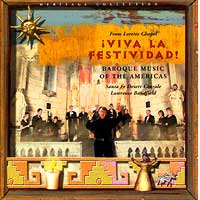
Review: Viva La Festividad! In the 17th and 18th centuries Latin America was alive with the musical idioms of indigenous America, Africa and Europe. On this disk we happily include the rollicking rhythms of African-influenced folk carols, naive hymns of faith from the pen of a Native American, and the sophisticated polyphony and counterpoint of Latin American composers schooled in the European tradition. Conducted by our founder, Lawrence Bandfield at the Loretto Chapel, Santa Fe, NM Songlist: "Eso Rigor E Repente", "Desvelado Dueno Mio", "Sa Qui Turo", Missa "Ave Regina Coelorum" - Part I, Missa "Ave Regina Coelorum" - Part II, Missa "Ave Regina Coelorum" - Part III, Missa "Ave Regina Coelorum"- Part IV, "Oigan, Escuchen, Atiendan", Circumdederunt Me Dolores Mortis, "Dios Itlaconantzine", "Sancta Maria Yn Ilhuicac", "Los Coflades De La Estleya", Misa A 5
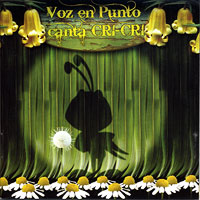
Review: We were treated to the live show of mixed-voice (3 men, 3 women) a cappella Mexican Vocal Jazz sextet Voz en Punto at the 2010 Harmony Sweeps Bay Area Regional, where their funny, sophisticated set drew a strong ovation and a third place finish. The ensemble has been singing together since 1990 when they were founded by director Jose Galvan. While still students, the group won some very important choral competitions, such as the Int. Choral Festival of Tamper (Finland) in 1991, and the Int. Choral Festival of the Netherlands in 1995. Since then the group has gained an international career with live performances in Europe, Egypt, Russia, Romania, Japan and the U.S., sharing the stage with a cappella legends Bobby McFerrin and the King's Singers. In 2010 "canta CRI CRI," the group's fifth CD, is nominated for a Contemporary A Cappella Recording Award. The beautifully-designed, extensive, full-color liner notes of the album have a lovely photo and great graphics, but they are all in Spanish, as are the 15 song titles. We can pick a few favorites, such as "Negrito Bailarin," "La Merienda," "El Telefono," "Cucurumbe," "Mi Amigo Hans," "Di Por Que," the sassy "Metete Tete," "Mexico Canta Cri Cri" and "Tema De Cri Cri," but this is all wonderfully-crafted, upbeat, sometimes silly, entertaining stuff! Songlist: Tema De Cri Cri, Negrito Bailarin, El Chorrito, La Merienda, El Telefono, Cucurumbe, El Comal y a Olla, Cochinitos Dormilones, Mi Amigo Hans, Di Por Que, Acuarela, Metete Tete, El Ropero, Mexico Canta Cri Cri, Tema de Cri Cri
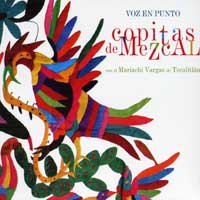
Review: The fourth from the award-winning, internationally-acclaimed mixed quintet (3 men, two women) Voz en Punto, and it's as spirited and juicy as we have come to expect from Voz. Beginning with the title tune and "La Negra," "Copitas'" song selection concentrates on the group's forte, crazy, silly, manic, romantic Mexican songs, some accompanied by a string ensemble. Our favorites of course are the a cappella numbers, like "La Bruja," "No Volvere," and "El Sinaloense." Voz en Punto's sound is as crisp and clean as they come, and they get into some marvelously fast Mexican "scat" singing that boggles the mind. "Copitas is big, fat, south of the border fun from beginning to end. Enjoy! ��� Songlist: Copitas De Mezcal, Lampara Sin Luz, La Negra, El Gavilancillo, La Bruja, La Malaguena, Cien Anos, No Volvere, Cucurrucucu, El Sin Aloense, Cielto Lindo
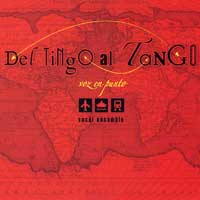
Voz en Punto : Del Tingo al TangoReview: In Mexican slang, "del tingo al tango" means to go "from pillar to post" without stopping, a phrase that seems to sum up mixed quintet Voz en Punto's career in many ways. From its founding by director Jose Galvan in 1990, the ensemble has focused its artistic energy on the colorful arena of Mexican culture, from Mexican colonial polyphony from the 16th and 17th centuries to songs in native tongues and/or with African influences, up to the folklore and music of living Mexican concert composers. The group has also presented programs of European composers, including motets and madrigals, Latin-American bossa novas and tangos, and negro spirituals. To quote the group's press notes, audiences become "Ecstatic," "On Fire" or "Delirious." "Del Tingo" is a 16-song smorgasbord of the group's repertoire, beginning with the spirited Mexican "La Negra" and the French "Margot labourez les vignes," the Brazilian "Rosa Amarela" and the German "Tanzen und Springen;" and country-hopping into England's "Come Again," Cuba's "Mama Ines," Japan's "Ue wo muite," Italy's "Amor Vittorioso" and the US spiritual "Swing Low, Sweet Chariot." Brazil's "Samba de uma nota so," Spain's "Chacona," Finland's Satumaa Tango" and Glenn Miller's "In The Mood ...Voz continually amazes us with their spirited versatility. Listen to this multilingual a cappella gem and become an instant Voz en Punto fan! Songlist: La Negra, Margot labourez les vignes, Rosa Amarela, Tanzen und Springen, Te quiero, Come again, Mama Ines, Ue wo muite, Amor Vittorioso, Puchicas caray, Swing low, sweet charriot, Samba de uma nota so, Chacona, Honor y Gloria, Satumaa Tango, In the mood
Voz en Punto : Mexico A CapellaReview: Self-described "Trailblazers" in Mexican music, mixed quintet Voz en Punto, winners of international awards for their versatility and ability to interpret music from the cultures of many countries, had to start somewhere, and "Mexico A Capella" is it, their first commercial recording. "Mexico" represents the impassioned fusion of two of the group's great loves: Mexico and choral singing. The CD topped as #1 seller on the Mexican classical charts, and 4 of the CD's singles, "Tilingolingo," "Male Betulia," "Jucheti Consuelito" and the Swingles-influenced "El Rascapatate" won the 2nd Tribune of Mexican Music and were chosen to represent Mexico in the 10th Tribune of Latin-American and Caribbean music. 15 songs, all in Spanish, favorites besides the 4 singles are the manic "Cucurumbe," the romantic "Besame Mucho," the crazed, Swinglish "Que Rico Mambo," the rhythmic gem "Tete," and the jazzy "Que Bonita Es Mi Tierra." "Mexico" created an a cappella sensation in Mexico, and it's easy to hear why. Great arrangements, hot, spirited vocals, fine song selection, dynamic live performances-it adds up to the kind of stardom that changes the popular culture of a nation! ``` Songlist: Introduccion, En Mexico, ElTilingolingo, Male Betulia, Jucheti Consuelito, Como Mexico No Hay Dos, Cucurumbe, Las Chiapanecas, El Rascapetate, Besame Mucho, Te Extrano, El Andariego, Que Rico Mambo, Tete, Nereidas, Que Bonita Es Mi Tierra
Voz en Punto : Mexico en Navidad Review: Three-Man, two women a cappella ensemble from Mexico, Voz en Punto is a spirited, talented quintet with fine harmonies, arrangements and a nice, clean sound, and the extensive liner notes have all lyrics and lots of info about the group. Unfortunately for this English speaker, all this information, as well as everything on all the websites about the group we found, is in Spanish. But certain things are pretty clear: There are 18 cuts and most of the material is traditional and sacred music, for example Tomas Luis de Victoria's "Ave Maria," Hernando Franco's "Sancta Maria," "Dios Itlaconantzine," "Jesos de mi goracon," "Eso rigor e repente" and "Mano fasiquivo." Some of it is funny in a manic sort of way; examples of this are Jose Galvan's "Navidad mexicana," "El nacimiento," "Elintercambio" and Son Veracruzano's "El tilingo navideno." The bottom line is, Voz makes fine harmonies, looks young and attractive, has a good sense of humor, and judging by the number of websites about them, has a legion of appreciative fans! Songlist: Las posadas, Arrullo, Oiga morenita, Navidad mexicana, Letania, Ave Maria, Sancta Maria, Dios Itlaconantzine, Jesos de mi goracon, Eso rigor e repente, Mano fasiquiyo, Nochpochtzine, A wue la gusto, Por el valle de rosas, El nacimiento, El intercambio, El tilingo navideno
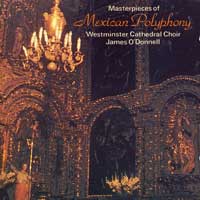
Westminster Cathedral Choir : Masterpieces of Mexican PolyphonyReview: One of England's top choirs, directed by James O"Donnell, have recorded here excellent examples of the most interesting choral works to come from the fascinating music of 16th and 17th century Mexico. Pailla's work for double choir along with many peices for 4 voices makes for fine examples of the period. Songlist: Salve Regina, Versicle and Response: Deus in adiutorium, Psalm for None: Mirabilia testimonium, Lamentation for Maundy Thursday, Alleluia: Die nobis, Maria, Magnificat Quarti Toni, Salve Regina, O Sacrum Convivium
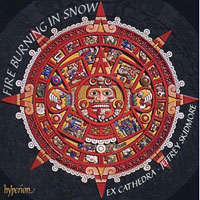
Ex Cathedra : Fire Burning in SnowReview: Fire Burning in Snow, the third volume in Ex Cathedra's series of Baroque music from Latin America, is strong testimony to the vitality of the musical scene in South America in the sixteenth and early seventeenth centuries. The bulk of this album is devoted to the sacred and secular choral music of Juan de Araujo (1648-1712), who was born in Spain, but whose family moved to South America when he was a child. He lived in Peru and Panama, but spent most of his adult life in La Plata, Bolivia, where he was the organist at the cathedral. The music recorded here is notable for its almost Monteverdian range of styles and expressiveness. This selection of Araujo's strongly rhythmic work includes a rigorously polyphonic motet for triple choir; a simple, lovely lullaby for women's voices; and many stylistically diverse choral villancicos. The standout work on the CD, though, is Hanacpachap cussicuinin, a 20-verse Peruvian hymn in the Quechua language that was the first example of choral polyphony published in the Americas in 1631. It's broken into four sections of five verses each, and performed with ensembles of differing sizes and varying accompaniments. The anonymous hymn has a startling grandeur, and even with 20 verses it's so compelling that it never wears out its welcome. Ex Cathedra Consort and Baroque Ensemble sing and play with high spirits and polish. Conductor Jeffrey Skidmore is to be commended for bringing this repertoire, much of which has never been recorded, to light, and for delivering such lively realizations and energetic and full-bodied performances. This SACD should be of strong interest to anyone who loves Renaissance and Baroque polyphony and fans of choral music with a Latin flavor. Songlist: Hanacpachap cussicuinin (verses 1- ), Dixit Dominus, Silencio, Dime, amor, A, del la region de luces, Hanacpachap cussicuinin (verses 6- 10), A, del cielo, Fuego de amor, En el muy gran Padre Ignacio, Hanacpachap cussicuinin (verses 11- 15), Salga el torillo hosquillo, Dios de amor, A, del tiempo, Hanacpachap cussicuinin (verses 16- 20)
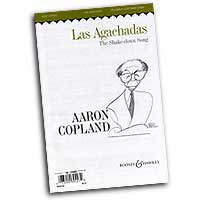
Aaron Copland : Las Agachadas - The Shake-down SongReview: Based on melody No. 202 in Kurt Schindler's collection: "Folk Music and Poetry of Spain and Portugal." The chorus is to be divided into two groups: The main choral body, and a conrasting smaller "Solo group" of approximately 3 or 4 voices to a part. Songlist: The Shake-down Song
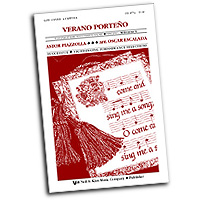
Astor Piazzolla : Tangos in Vocal HarmonyReview: It has been said that you can see Buenos Aires while listening to Astor Piazzolla's music. This is one of his talents that sets him apart from other composers. Piazzolla made a revolution with the tango, which created many problems for him in his country (traditionalists did not accept his music as tango). But everybody finally accepted his changes because his music put the Argentine dance, the tango, at the highest level. Gentle tango rhythms and modern harmonies infuse these folk-like tunes. Songlist: Verano Porteno, Libertango, Primavera Poertena, Invierno Poerteno, Otono Porteno, Reminiscense
Carlos Guastavino : IndianasReview: Carlos Guastavino writes in a romantic-nationalistic style, and even though he does not incorporate folk music, his music is permeated by the Argentine influence. These intriguing pieces can be performed individually or as a suite. Songlist: Gala del Dia, Quien Fuera Como el Jazmin, Chanarcito, Chanarcito, Viento Norte, Al Tribunal de Tu Pecho, Una de Dos
Oscar Escalada : Latin American Choral Series Review: A wonderful collection of contemporary Latin American choral music selected by noted Argintian conductor and composer Oscar Escalada. "La Chaparrita " is a brisk Venezuelan folk melody and is fun to sing and includes the vocal imitation of a typical pattern played on a "cuarto". "Candomble", from Uruguay, is written in a rhythm very close to the tango and the habanera. "La Ninez De America" is based on a poem of Argentinian poet Alberto del Carril and is inspired by the Incas. "Cancion Con Todos " is a two-part song based on two different rhythms. The first part is calm and recognizes each area of the Americas with characteristic elements such as copper for Chile, sun for Peru etc. The second part is rhythmic and exultant with the hope of bringing all the peoples of Latin America to sing together! Songlist: La Chaparrita, Candomble, Cancion Con Todos, Se Equivoco La Paloma (The Dove Was Wrong), La Ninez De America
Various Arrangers : Christmas South of the BorderReview: Add a multi-cultural element to your Christmas concerts and celebrate the Navidad season. The Mexican tradition of ""La Fiesta de la Posada"" recreates the search for a room at an inn. This delightful number by Sally Albrecht recreates that tradition in song with an English text that tells the story ("when we light luminarias and swing at the pinata."). Features an optional solo/duet in each verse. "Cantemos" is a beautiful, rhythmic Venezuelan folk carol with an English/Spanish text. "Vamos todos a Belen" - A detailed translation/pronunciation guide makes it easy to master the Spanish text of this traditional Mexican-American Christmas song, or perform it in English. Lilting six-eight piano creates a gentle rocking motion as we sing about going to Bethlehem to see the baby. In the middle, a solo is briefly accompanied by only the chorus before a thrilling modulation and final flourish to the glorious end. Songlist: La Fiesta de la Posada, El Pequeno Nino (The Tiny Baby), Cantemos, Vamos todos a Belen (Let Us Go to Bethlehem)
Various Arrangers : Latin AccentsReview: "Casita de Campo" is one of the most popular love songs from the Dominican Republic. It describes a modest, and yet beautiful, little rural house in the Cibao region where the composer evokes the consummation of a passionate and virginal love. It is a "cancion-bolero," a typical Caribbean romantic song form in quadruple meter, slow-paced, which is also a centerpiece of serenades. "Chanflin" is a typical Dominican merengue in its melody and form. Chanflin is a young woman, very good looking. The merengue section refers to a "neighborhood gossip." The jaleo section refers to Chanflin dressing in a finicky manner. "La Lluvia" is a folk melody from Ecuador traditionally played on the siku - the double row of panpipes that have been used in the high Andes for over a thousand years. With percussion. "Son de Camaguey" is a Cuban folk song from which the composer takes the refrain and then frames it with kaleidoscopic patters of ostinati inspired by the song, and by Afro-Cuban music in general. "O Sapo" - In this irresistible Brazilian song setting, vocal lines imitate percussion patterns to create a truly infectious groove. Newly arranged for SSATB chorus. With optional percussion. Songlist: O Sapo, Maquerule, Casita de Campo, Chanflin, La Lluvia, Son de Camaguey
Various Arrangers : Latin American Choral Series for Female VoicesReview: The Latin American Choral Series brings the exciting sounds of Latin America to choirs throughout the world. Selected by Oscar Escalada, the series includes a tremendous variety of styles ranging from the first polyphonic music composed in the New World, to traditional folksongs, tantalizing tangos, love songs and original compositions. Songlist: Mudanzas, Pueblito Mi Pueblo, Cinq Chansons Folklorques D'Guadeloupe, Five Folksongs From Haiti, Guanchi Torito (Little Orphan Calf), Libertango
Various Arrangers : Latin Pop HitsReview: "Bailamos" - Let the rhythm take you over...Bailamos! Enrique Iglesias #1 hit from 1999 sizzles with Latin fire in this setting that will totally energize your concert. A fantastic feature for pop and show choirs! "Bailando" - Enrique Iglesias inspires his fans all over the globe with this mega-hit dance song! A fantastic feature for pop and show groups, the irresistible hook and bilingual lyrics will unite your school or community in an enthusiastic expression of joy. "Vida" - It's a celebration! The supersong from the 2014 World Cup by Ricky Martin is a bilingual extravaganza that will energize your stage with dance and color and life! Songlist: Vida, Bailando, Bailamos
Various Arrangers : Navidad en EspanolReview: Share the rich culture of a Spanish Christmas with your students. These charming Spanish folk carols will bring joy to every performance. From a variety of cultures these creatively arranged songs will add a multi-cultural element to your concert and will be appreciated by the Spanish speakers in your audiences. Perform them in Spanish, English, or a combination of both. Songlist: A La Nanita Nana, Three Spanish Carols (Collection), El Noi De La Mare (The Son of Mary), A la Puerta del Cielo, Spanish Allelu
Various Arrangers : Spanish CarolsReview: A fine collection of unaccompanied Spanish Christmas carols with both English and Spanish text along with a pronunciation guide. The Emily Crocker arrangements, as always, are delightful and are most rewarding in performance. The King's Singers arrangements of three traditional carols are a special treat and the Norman Luboff arrangement of "A La Nanita Nana" is from his Holiday hit album "Songs of Christmas". Rounding out the collection are three arrangements of sixteenth century carols from the New York Pro Musica series. Songlist: Three Spanish Carols, Three Spanish Carols, Pastores a Belen, Que Regalo? (What Shall I Bring?), Spanish Shepherds' Song, Over All The Land, E La Don Don Verges Maria, Riu, Riu, Chiu, Dadme albricias, hijos d'Eva, Riu, Riu, Chiu: El Lobo Rabioso, Adorar al Nino (Come Adore The Baby)
Various Arrangers : Spanish Carols, Lullabies and FolksongsReview: "Come, come, shepherds let us go! Let's run to Bethlehem." Written in the "Bambuco Fiestero" rhythm of the Andes Mountains of Columbia, the characteristic dance rhythm of 6/8 against 3/4 is the main feature of this a cappella setting. In Spanish, with English translation. "Canticos De Navidad" - Juan Orrego-Sala, a noted Latin American composer, is Professor Emeritis of Composition and Latin American Music at the Indiana University School of Music. This charming set of Christmas pieces reflects his native country, Chile, not only in the language, but in the characteristic rhythms and harmonies. The second of the three, Alleluya, can be extracted for year-round performance, and, although diminutive in length, deserves a place along side the well-known "Alleluia" by Randall Thompson with whom the composer studied. The original settings of "Four Spanish Lullabies" create the feeling of tenderness and sorrow so typical of the Spanish lullaby. A litling Brazilian style lullaby, a 3-part a cappella chorus, a flight of imagination and a comical nursery rhyme make up this compelling set. The energetic Colombian folksong "Maquerule" tells the tale of a friendly baker who learns the hard way to collect the cash upfront! Strong syncopation and a staccato singing section add to the fun. Includes suggestions for using optional percussion. Songlist: Canticos De Navidad, Maquerule, Four Spanish Lullabies, Fum, Fum, Fum
Various Arrangers : Spanish Songs For Treble VoicesReview: "La Lluvia" is a folk melody from Ecuador traditionally played on the siku - the double row of panpipes that have been used in the high Andes for over a thousand years. Hot-blooded and haughty, a mixture of delight and disdain. The central paradox of performing "Las Amarillas" it that the rhythms must be very incisive and exact, yet the precision must be combined with the devil-may-care festive attitude that prevents the precision from sounding clinical. Mangulina is a dance derived from Zapateado Espanol (a Spanish heel-tapping dance). "Guayacanal," originally written in the 1950's by Dominican songwriters Luis Kalaff and Bienvenido Brens, embodies what is known as the Mangulina today, and is so famous that when asked, people often think it's a folk song. This piece is best accompanied with tamborra (a double-headed drum from the Dominican Republic) and guira (a metal scraper from the Dominican Republic, scraped with a metal fork.) These delightful miniatures are wonderful for concert, contest and small ensembles. Careful part-writing and attention to range make these a good choice for younger treble groups. Includes: "A la puerta del cielo (At the Gate of Heaven)," "El Senor nacio en Belen (The Lord Was Born in Bethlehem)," and "Gloria a Dios en las Alturas (Glory to God in the Highest.)" Songlist: La Lluvia, Gloria A Dios, Guayacanal, Las Amarillas
Deke Sharon : Latin A Cappella Vol 1Review: With music from Latin America growing in popularity, here is a fun way to integrate an important cultural phenomenon into your program. This collection of four traditional songs, arranged for contemporary a cappella groups, represent but four of the many Latin musical styles: from Mexico, mariachi (Cielito Lindo), bolero (Sin Ti) and Latin rock (La Bamba), and from Cuba, Son (Guantanamera). SATB Songlist: Cielito Lindo, Guantanamera, Sin Ti, La Bamba
Various : Latin Pop HitsReview: 25 hot contemporary Latin songs arranged for piano, voice and guitar, including: Ahora Dice (Chris Jeday) - Bailando (Enrique Iglesias) - Despacito (Luis Fonsi & Daddy Yankee) - Dura (Daddy Yankee) - ...chame La Culpa (Luis Fonsi & Demi Lovato) - Havana (Camila Cabello) - I Need to Know (Marc Anthony) - La Camisa Negra (Juanes) - La Tortura (Shakira) - Propuesta Indecente (Romeo Santos) - Smooth (Santana feat. Rob Thomas) - Súbeme La Radio (Enrique Iglesias) - and more. Songlist: I Need To Know, Algo Mas, Havana, Livin' La Vida Loca, Smooth, Whenever, Wherever, A Puro Dolor, La Camisa Negra, La Tortura, Despacito, Me Enamora, Bailando, Vivir Mi Vida, Subeme La Radio, El Perdon, Echame La Culpa, Ahora Dice, Dura, Ay Vamos, Eres Mia, Felices Los 4, Hasta El Amanecer, Propuesta Indecente, Vente Pa' Ca, Vuelve
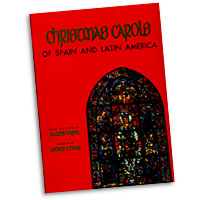
Walter Ehret : Christmas Carols of Spain and Latin AmericaReview: A collection of 27 traditional carols for unison and 2 part voices arranged by Walter Ehret. In Spanish with English translations. Songlist: A La Nanita Nana, Come, My Dear Old Lady, Thou Art Well Content, Foom, Foom, Foom, The Son Of Mary, Holy Joseph And Mary The Maid, King Herod, The Icy December, Carol Of The Birds, We'll Speak Very Softly, O Bethlehem, A Fire Is Started In Bethlehem, Bells Over Bethlehem, O My Loveliest One, In Bethlehem's Cradle, The Holy Child, At The Hour Of Midnight, Song Of The Wise Men, Shepherds In Bethlehem, Happily Singing, We Are Singing, As The Frightened Baby Jesus, The Journey, Going To Bethlehem, Pray Give Us Lodging, The Babe, Hasten Now, O Shepherds
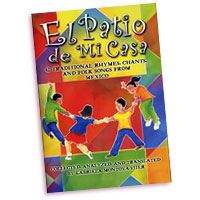
Gabriela Montoya-Stier : El Patio de Mi CasaReview: This endearing collection of folksongs from Mexico is perfect for any teacher looking to broaden the multicultural dimensions of their elementary or preschool music class with time-tested authentic music. Each song and rhyme includes teaching suggestions, English translations, game directions, and background information. Songs are categorized as rhymes, chants, singing games, song tales (romances), or lullabies, and there is even a pinata song. Songlist: Rhymes, Chants, Singing Games, Song Tales (Romances), Lullabies, Pinata Song, Rhythm And Melodic Analysis Charts, References, About The Author Voicing: Children
Bruce Trinkley : Nine Latin American Folk Songs - HighReview: These nine Latin American gems will be a stunning addition to your vocal repertoire. Whether performed in Spanish or English, these masterful arrangements feature sophisticated piano accompaniments and stylish vocal lines which emphasize the dramatic nuances of their delightful texts. Nine wonderful and heartfelt songs, which offer a wide variety of styles and tempos. Songlist: Vuela Suspio (Fly, My Sighs), Donda Vas, Alfonso Doce, A cantar a una nina, Nesta Rua, Una tarde fesquita de Mayo, El Capotin, Al pasar por Sevilla, Villancico Voicing: High
Style: World / Folk
Bruce Trinkley : Nine Latin American Folk Songs - LowReview: These nine Latin American gems will be a stunning addition to your vocal repertoire. Whether performed in Spanish or English, these masterful arrangements feature sophisticated piano accompaniments and stylish vocal lines which emphasize the dramatic nuances of their delightful texts. Nine wonderful and heartfelt songs, which offer a wide variety of styles and tempos. Songlist: Vuela Suspio (Fly, My Sighs), Donda Vas, Alfonso Doce, A cantar a una nina, Nesta Rua, Una tarde fesquita de Mayo, El Capotin, Al pasar por Sevilla, Villancico Voicing: Medium Low
Style: World / Folk
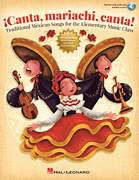
Jose Hernandez : Canta, Mariachi, Canta!Review: Experience authentic mariachi styles and rhythms in your general music class! Eight traditional Mexican songs transport you and your students to a place rich with harmony and ensemble camaraderie. These arrangements by 3-time Grammy nominated world-renowned mariachi composer and performer Jose Hernandez, work well with piano or guitar accompaniment. Add pitched Orff instruments for even more fun. The Teacher Edition offers vocal parts with Spanish lyrics and pronunciation guides, piano and guitar accompaniment, Orff parts, brief song translations and history. This all-in-one collection also includes digital access to authentic recordings produced by Maestro Hernandez and performed on traditional mariachi instruments for added authenticity! Students can model the singing and then perform with the full-sounding accompaniment recordings. You will also receive digital access to PDFs of singer and instrument parts when you purchase the Teacher Edition. Suggested for grades 3-6. Songlist: Silent Night, Cielito Lindo (My Pretty Darling), La Llorona, El Venadito, La Sandunga, Los Barandales Del Puente, La Golondrina, Las Mananitas |