
In Celebration of the Human Voice - The Essential Musical Instrument
Home | Doo Wop | Barbershop | World | Contemporary | Christian | Vocal Jazz | Choral | Christmas | Instructional | Arrangements
Classical | Opera | Musicals | Personality | Young Singers | Disney | Videos | Songs | The Artists

Madrigals CD Recordings
| Madrigal, in music, secular composition for two or more voices, introduced in Italy in the 14th century and revived in a different form during the 16th century, at which time it also became popular with English, French, German, and Spanish composers. The word madrigal is thought to have been derived from mandriali (a short pastoral poem) or from matricale (a rustic song or poem in the mother tongue), or perhaps madriale (a hymn to the Virgin Mary). |
Songbooks, Arrangements and/or Media
Displaying 1-15 of 15 items.
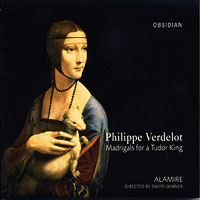
Alamire : Madrigals For A Tudor King - Verdelot Philippe Verdelot was the most important composer of Italian madrigals in the early 16th century and recognized as the greatest innovator of the genre. A Frenchman, he occupied several important musical posts in Italy, including the Florentine posts of maestro di cappella at the Baptistry of S. Maria del Fiore and the great Duomo itself. In the mid 1520s, during his time in Florence, a set of part-books were assembled, probably under Verdelot's supervision, for the court of Henry VIII. Most, if not all, of the works were composed by Verdelot. This is the first recording of the complete madrigals in the collection, which stands not only as the most exceptional of diplomatic musical gifts but is also an important source for the history of the early madrigal. Songlist: Italia mia bench' el parlar', Con l'angelico riso, Quanto sia lieto il girono, Lasso, che se creduto, O dolce nocte, Madonna qual certeca, Afflicti spirti mei, Dentr' al mio cor', Quando nascesti, Amore?, Piove da li occhi, Pur troppo, donna, I vostri acuti dardi, Chi non fa prove, amore, Leit' e madonna et io pur, Con lacrim' et sospir' negando porge, Donna, se fera stella, Ognun si duol' d'amore, Altro non e el mio amor', Madonna io v'amo e taccio, Si suave e l'inghanno, Se ben' li occhi, Cortese alma gentile, Quanta doleca amore, Donna che sete fra le donne belle, La bella donna, Deh, quant' e dolc' amor, Donna leggiadr' et bella, Madonna, per voi ardo, Amor, io sento l'alma, Ultimi mei sospiri 
Cambridge Singers : Old English Madrigals & Folk Songs Fa la la, a cornucopia of your favorite Madrigals! John Rutter and the Cambridge Singers sing English madrigals and folk songs. As entertainment for public occasions and a relief from boredom, the English madrigal comes in a wide variety of styles from dramatic to silly. This recording includes lighter pieces such as "Now is the Month of Maying" and "My Bonnie Lass She Smileth" by Thomas Morley, the somber "Silver Swan" by Orlando Gibbons and the comical "Fair Phyllis" by John Farmer. In addition, the program includes folk song arrangements by Gustav Holst and Ralph Vaughn Williams. A classic recording. Songlist: Come Away, Sweet Love, Weep, O Mine Eyes, Fair Phyllis I Saw, Now Is The Month Of Maying, Fairwell, Dear Love, April Is In My Mistress' Face, Draw On, Sweet Night, Sing We At Pleasure, My Bonny Lass She Smileth, The Silver Swan, Mother, I Will Have A Husband, Dainty Fine Bird, As Vesta Was from Latmos Hill Descending, I Love My Love, My Sweetheart's Like Venus, Bushes and Briars, The Turtle Dove, The Three Ravens, Dashing Away With The Smoothing Iron, O Waly, Waly, Greensleeves
Cambridge Singers : Flora Gave Me Fairest Flowers  The sixteenth-century madrigal was an Italian form. The term 'madrigal' was loosely applied to a wide variety of music, but generally denoted a polyphonic setting for four or more voices of an amorous or pastoral text which was closely depicted in the music. Thomas Morely transplanted the form into England in the 1590s; this marked the beginning of the brief but brilliant flowering of the English madrigal. Between the 1590s and the early 1620s, twenty composers published a total of 36 books of madrigals, after which the form virtually disappeared. Some of these composers, such as Morely and Weelkes, followed the Italian model closely; others, such as Byrd and Gibbons, mostly stayed with the simpler English form of the consort song, where the tune remains in one voice, word-painting is not used, and strophic form is preferred to the continuous structure of the madrigal proper. Among the twenty-one items selected for this recording there are examples of several types of piece, ranging from true Italianate madrigals such as Too much I once lamented, via more popular 'balletts' such as Fyer, fyer!, to the simple part-songs like A little pretty bonny lass. The variety, imagination, and inspired blending of poetry and music characteristic of the best of the 'English Madrigal School' afford a particular kind of delight in performance, shared equally by singer and listener. Songlist: Hark, all ye lovely saints above, Though Amaryllis dance in green, Round about in a fair ring, Adieu, ye city-prisoning towers, Flora gave me fairest flowers, Sweet Suffolk owl, As Vesta was from Latmos hill descending, Lullabye, This sweet and merry month of May, Now Is The Month Of Maying, A little pretty bonny lass, Fyer, fyer!, Too much I once lamented, My bonny lass she smileth, Ha ha! This world doth pass, Quick, quick, away, dispatch!, Dainty fine bird, Come again! Sweet love doth now invite, Mother, I Will have a husband, Draw on, sweet night, Sleep, fleshly birth, Weep, weep, mine eyes, Death hath deprived me, The silver swan, Adieu, sweet Amaryllis
Ensemble Amarcord : Book of Madrigals A musical journey to sixteenth-century Europe with secular vocal music of the Renaissance! The vocal ensemble amarcord brilliantly interprets the music of this epoch in its newest production "The Book of Madrigals" (RK ap 10106). With this CD, the young ensemble presents Renaissance music and madrigals by European composers such as John Dowland, Thomas Morley, Ludwig Senfl, Adriano Banchieri, Orlando de Lasso, and Josquin des Prez. Cipriano de Rore's "Anchor che col partire" - one of the most popular madrigals of its time, and in arrangements and adaptations still an "evergreen" over a century later - is also masterfully sung here. With the release of "The Book of Madrigals," amarcord has added another impressive CD to its discography. Songlist: Now Is The Month Of Maying, Bonjour Et Puis Quelles Nouvells?, Bonjour Mon Coeur, Come Away Come Sweet Love, Anchor Che Col Partire, Ach Elslein, Liebes Elselein, Remember Me My Dear, Since Robin Hood, Strike It Up, Tabor, Vecchie Letrose, Innsbruck, ich Muss Dich Lassen, I Love, Alas I Love Thee, Il Est Bel Et Bon, Come Again Sweet Love Doth Now Invite, Mein Gmuth Ist Mir Verwirret, Weep, O Mine Eyes, Pastyme With Good Companye, Contrappunto Bestiale Alla Mente
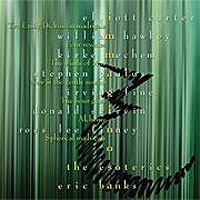
Esoterics : Immaginosa - American inspiration and the modern madrigal The Esoterics' fifth CD, IMMAGINOSA features premieres by William Hawley and Stephen Paulus and other pieces that represent springtime song cycles on love and life. Recorded after the IMMAGINOSA concert series in May 2004, this CD features several of The Esoterics' favorite cycles. Ross Lee Finney's Spherical madrigals resonates with the exploration and creativity of the Age of Reason, and Irving Fine's artful cycle of six Ben Jonson poems - The hour glass - traverses the evolution of love during the human lifetime. The second half of IMMAGINOSA will either put spring in your step or send you off into blissful dreams. First, revel in recordings of two premiere performances: Four reveries by New York composer William Hawley, followed by a spring madrigal, Now is the gentle season, by Minnesota composer Stephen Paulus. Next, enjoy two contrasting settings of Emily Dickinson by Elliott Carter - Heart not so heavy as mine and Musicians wrestle everywhere. Finally, immerse yourself in two cycles of spectacular strophes by Sara Teasdale: The winds of May by San Francisco composer Kirke Mechem, and Donald Skirvin's Alchemy, which was commissioned by The Esoterics. Songlist: O know to end as to begin- The hour-glass (1949), Have you seen the white lily grow? - The hour-glass (1949), O do not wanton with those eyes - The hour-glass (1949), Against jealousy - The hour-glass (1949), Lament - The hour-glass (1949), The hour-glass - The hour-glass (1949), Echo - Four reveries (1995), Remembrance - Four reveries (1995), My river runs to thee - Four reveries (1995), Meeting at night - Four reveries (1995), Heart not so heavy as mine (1938), Now is the gentle season (1978), Love is a circle - Spherical Madrigals (1947), When again all these rare perfections meet - Spherical Madrigals (1947), All-circling point - Spherical Madrigals (1947), His body was an orb - Spherical Madrigals (1947), On a round ball - Spherical Madrigals (1947), Nor doe I doubt - Spherical Madrigals (1947), See how the Earth - Spherical Madrigals (1947), Musicians wrestle everywhere (1945), The tune - The winds of May (1965), Let it be forgotten - The winds of May (1965), Over the roofs - The winds of May (1965), I shall not care - The winds of May (1965), Song - The winds of May (1965), Living gold - Alchemy (2002), Cups of fire - Alchemy (2002), Jewelled blaze - Alchemy (2002), O Beauty - Alchemy (2002)
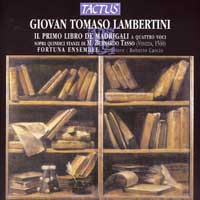
Fortuna Ensemble : Italian Madrigals of Giovan Tomaso Lambertini The Italian madrigals are some of the most exquisite vocal works ever written. This is the music found in Giovan Tomaso Lambertini's first book of madrigals. They are fifteen stanzas by Messer Bernado Tasso composed in 1544, during the poets period of residence in northern Europe with the patronage of the prince of Salerno. While other composers set some of the stanzas to music, Giovan adorned all fifteen of them with music and completed the works in his first book with six poetic works by the composer himself. It was published in 1560, the same year as some of Bernado's most important works. Experience this beautiful music for four voices created by various groupings of the Fortuna Ensemble, conducted by Roberto Cascio. Songlist: Se ben di sette ardenti'e belle, Fosti amante com'io, Tu piangevi 'l tuo amor, Vita de la mia vita, Oime dov'e'l mio ben, Morto son io, Lume de gli occhi miei, Ombra son di colui, Ahi dispietato'Amor, Ma scorgami destin, Vostro fui, vostro son e'saro vostro, Porto de miei desir, Accoglietelpietosa, Questo sia guiderdon gentil e degno, Ma folle io spargo le mie rime'al vento, Struggesti la mio cor (strumentale), Accoglietel pietosa (strumentale), Vita della mia vita (strumentale), L'altrui tener non lice, Stringo la bella man, Hor liev'ape foss'io, Struggesti lo mio cor, Non e gia vero'occhi felici e vaghi, La lucida chirezza ch'io scorgo'in voi
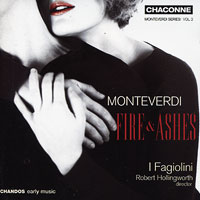
I Fagiolini : Monteverdi - Fire & Ashes Monteverdi's madrigals are a theatre of the senses: touches, glances, scents, the textures of fabrics, of lips and skin, the shining gold of hair, the deep blue of eyes, the sounds and vistas of nature, the coolness of water, the sun's warmth, the ecstatic agony of fire and ice. The second volume in I Fagiolini's Monteverdi conspectus allows us to trace this evolution from the early Mantuan a cappella madrigals that made his reputation to the late concerted madrigals of the 1630s written for the Viennese court - styles seemingly worlds apart, yet both forged by the same desire, to confront and master afresh in each new work the ever-present tension between mere art and real life. Songlist: Sinfonia from "Ballo Delle Ingrate", Ardo, Avvampo, Rimanti in Pace, Ogni Amante E guerrier, Si Ch'io Vorrei Morire, Che Dar Piu Vi Poss'io, E Cosi, A Poco A Poco, Vorrei Baciarti, O Filli, Chiome D'oro, Batto, Qui Pianse Ergasto, Entrata from "Ballo Delle Ingrate", Lagrime D'amante al Sepolcro Dell'amata, Tirsi e Clori
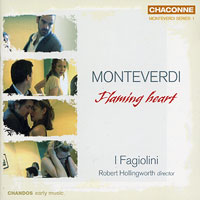
I Fagiolini : Monteverdi - Flaming Heart Monteverdi: Flaming Heart' offers works from Book IV to VIII, a selection that demonstrates both the extraordinary compass of his art and the unprecedented depth and subtlety of response to a text. In recent years we have settled for a certain lack of danger in our search for an 'ideal' Monteverdi. I Fagiolini's 'The Full Monteverdi', revealed a new side to this music a Monteverdi of both beauty and horror, colourful, vivid, sometimes chaste, sometimes dirty, and always completely alive. Songlist: Prologo: La Musica, Luci Serene E Chiare, Anima Mia, Perdona, Tempro La Cetra, Ahi, Come A Un Vago Sol Cotese Giro, Con Che Soavita, Sinfonia, Ch'io T'ami, Partenza Amorosa, Parlo Miser'o Taccio, Volgendo Il Ciel, Longe Da Te, Cor Mio, Piagn'e Sospira
La Venexiana : Claudio Monteverdi La Venexiana presents its latest recording achievement, a set of madrigal interpretations of a work that is a jewel and a success by any standard: the Third Book of Claudio Monteverdi, undoubtedly the greatest composer of the genre. The reason why this book of madrigals enjoyed such success is soon told. The Third Book is a colourful sequence of styles and forms. We find virtuosic works (with two or three soprano voices), works in chromatic style, madrigals in concitato, declamatory style and courtly madrigals. Briefly put, it is the summa of what at that period one would have understood by the word "madrigal" and its most representative forms. Moreover, Monteverdi's choice of poets in this book is typical of those of the nuovo stile, including Torquato Tasso and Battista Guarini, ideal to display "serious" emotions and feelings. Songlist: La giovinetta pianta, O come e gran martire, Sovra tenere erbette, O dolce anima mia, Stracciami pur il core, O rossignol, Se per estremo ardore, Vattene pur crudel, O Primavera, Perfidissimo volto, Ch'io non t'ami cor mio, Occhi un tempo mia vita, Vivro fra i miei tormenti, Lumi miei cari, Rimanti in pace
Mary Lynn Lightfoot (editor) : Masterworks and Madrigals for Middle School Choirs These eleven masterwork and madrigal selections have been carefully selected to meet the needs of developing choirs and the changing voice. Encompassing a broad spectrum of composers, styles and periods, and in a variety of voicings, this exciting new offering is a practical and versatile resource for the middle school/junior high choral classroom. Also featured, where applicable, are both English and original language text options, as well as interesting composer/performance notes. All available in this outstanding collection for less than half the cost than if purchased separately - a welcome budget stretcher! Songlist: Sing For Joy!, Today We Shall Be Merry, Cantate Domino, The Sound of Pipe and Drum, Jubilate Deo, Sing Joyfully, Gloria in Excelsis, O Bella Fusa, Life's Joy, Gloria In Excelsis Deo, Music, Most Beauteous Art, Masterworks and Madrigals: A Brief History
Monteverdi Choir : Monteverdi & His Contemporaries Claudio Monteverdi (1567 - 1643) was an Italian composer, violinist and singer. His work marks the transition from Renaissance to Baroque music. During his long life he produced work that can be classified in both categories, and he was one of the most significant revolutionaries that brought about the change in style. Here for the first time on CD is John Elliot Gardiner, one of World's top conductors, in his earliest recordings feauring the madrigals of Moneteverdi (including his 6 madrigals "Sestina" and others such as John Wilbye, Orlando Gibbons and Thomas Morley. Songlist: Sestina Incenerite, Ditelo o Fiumi, Dara la Notte, Ma te Raccoglie, O Chiome d' or, Dunque Amate Reliquie, Zefiro Torna, Era L'Anima Mia, Ohime, Se Tanto Amate, Dolcissima Ma Vita, Weep Weep Mine Eyes, Oft Have I Vowed, What Is Our Life, O Grief Even On The Bud, Draw On Sweet Night
Oxford Camerata : English Madrigals And Songs The Oxford Camerata was formed to meet the growing demand for choral groups specializing in Renaissance music. Now comprised of 12 mixed voices Camerata has since expanded its repertoire to include music from the medieval period to the present day. Jeremy Summerly founded the Oxford Camerata after studying music at New College, Oxford, graduating with 1st Class Honors in 1982. "English Madrigals" is divided into 4 sections, "Early Tudor Songs," ("Pastime with good company," attributed to Henry VIII, "Blow thy horn, hunter," by Wm. Cornish, and "Hey trolly lolly lo"); "Madrigals from the Golden Age" ("Draw on, sweet night" and "Weep, Weep Mine Eyes,'" by John Wilbye, Richard Carlton's "Sound Saddest Notes" and Robt. Ramsey's "Sleep, Fleshly Birth"); and "Romantic Songs and Partsongs," (Robt. Pearsall's "Lay a garland," Somerset's "The trees they do grow high," and Charles Stanford's "The Blue Bird"). Nice liner notes booklet with all the lyrics and group info. Camerata's music soars in perfect, effortless harmony! Songlist: Pastime With Good Company, Blow thy horn, hunter, Ah Robin, gentle Robin, Hey Trolly Lolly Lo, Draw on, Sweet Night, Thule, the Period of Cosmography, Weep. Weep Mine Eyes, As Vesta Was, Sound Saddest Notes, Fair Phyllis, Sleep. Fleshly Birth, Mother, I will have a Husband, Lay a Garland, Rigg Fair, The Trees They do Grow High, The Blue Bird
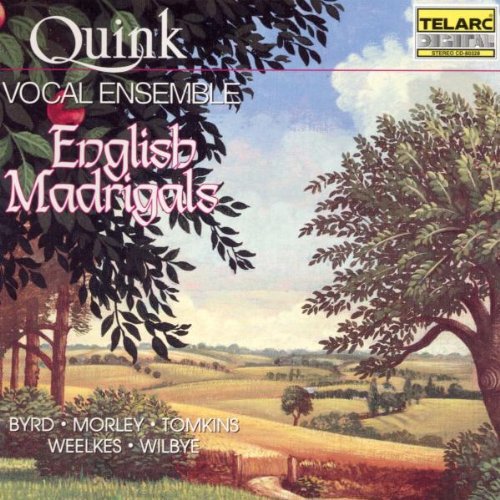
Quink Vocal Ensemble : English Madrigals Between 1588 and 1627, the isolation of English musical culture was broken by the influx of Italian music and composers, and during this period a beautiful collection of Madrigals with English words and composers was created. The acclaimed Quink Vocal Ensemble (Kees-Jan de Koning, bass, Harry van Berne, tenor, Paula de Wit, soprano, Machteld van Woerden, soprano, and Corrie Pronk, alto) bring us 18 perfectly-recorded madrigals from this period, three from Thomas Morley, two from Francis Pilkington, two from Thomas Tomkins, two from Thomas Bateson, two from William Byrd, one from John Farmer, four from John Wilbye, and two from Thomas Weelkes. This music is bright and romantic, with a lively grace and harmonic clarity, the result of probably the first English musical "craze!" Songlist: Now Is The Month Of Maying, Farewell, Disdainful, No, No Nigella, Why Should I Grieve?, Sweet Phylida, Phyllis, Now Cease To Move Me, Too Much I Once Lamented, Those Sweet Delightful Lilies, Phyllis, Farewell, Come To Me Grief, Forever, Come, Woeful Orpheus, Fair Phyllis I Saw, Weep, Weep, Mine Eyes, (1st Part)I Fall, I Fall, O Stay Me, (2nd Part) And Though My Love Abounding, Adieu, Sweet Amaryllis, The Nightingale, The Organ Of Delight, Hark, All Ye Lovely Saints
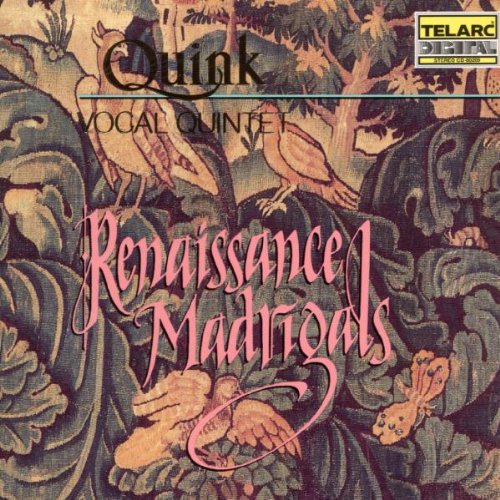
Quink Vocal Ensemble : Renaissance Madrigals From about 1520 to about 1620 the Italian madrigal, which refers to almost any musical setting of secular verse (but especially those whose subject is love and death) of two to eight voice parts, had its brief but brilliant lifetime. Quink, (Kees-Jan de Koning, bass, Harry van Berne, tenor, Paula de Wit, soprano, Machteld van Woerden, soprano, and Corrie Pronk, alto) since its debut in 1978 has established its reputation and following on the international concert scene. "Renaissance" features 14 madrigals, one by Cipriano de Rore, four by Giaches de Wert, three by Claudio Monteverdi, two by Alessandro Scarlatti and four by Alessandro Stradella. The liner notes contain bios of these men, and the words of all the songs in Italian and English. Beautiful harmonies! Songlist: Alla Dlce ombra, Dura Legge D'Amor, Lo Non Son Pero Morto, Datemi Pace, Vezzosi Augelli, Baci, Soavi E Cari, Lo Mi Son Giovinetta, Si Ch'io Vorrei Morire, O Selce, O tigre, O Ninfa, Mori Mi Dici, Tirsi Un Giorno Piangea, Pupilette Amorose, Piangete, Occhi Dolenti, Clori Son Fido Amante
Tallis Scholars : English Madrigals To celebrate their 25th anniversary, sacred music specialists the Tallis Scholars re-released on their own Gimell label a disc that has been a cipher in their catalog for a long time, English Madrigals, recorded in 1982 for EMI's Classics for Pleasure imprint and unavailable for so long as to be virtually forgotten. It is heartening to see the list of singers active under Peter Philips' direction in that bygone era -- Emily van Evera, Margaret Philpot, Michael Chance, and Andrew King among them -- all names unknown in 1982 that have figured very prominently in the early music boom soon to follow. As the original Classics for Pleasure LP, though digitally recorded, ran short by twenty-first century standards, Gimell has expanded it through including the odd pieces used to fill out an early release, Tomkins: The Great Service. As one comes to expect from the Tallis Scholars in music of a more serious kind, the performances of the English Madrigals are terrific; in the notes, Philips states that their ultimate single-mindedness might have slackened somewhat "if there hadn't been so much first-rate sacred music to explore." Songlist: Hark, All Ye Lovely Saints, Hark, Alleluia, Phyllis, I Fain Would Die Now, Cruel Madame, Ah Dear Heart, Draw On Sweet Night, All Creatures Now, Sleep, Fleshly Birth, Carters, Now Cast Down, Woe Is Me, Though Amaryllis Dance, The Silver Swan, When David Heard, Then David Mourned, Almighty God, The Fountain Of All Wisdom, Woe Is Me, Be Strong And Of A Good Courage, O Sing Unto The Lord A New Song, O God, The Proud Are Risen Against Me |
 Choral Music - Home
All Choral Groups | Choral Christmas | Composers | Choral Directors | Choral arrangements
Mixed Voice Groups | Mixed Voice CDs | Mixed Childrens Choirs | Mixed Childrens CDs | Mixed Voice Christmas CDs
Male Choral Groups | Male Choral CDs | Boyschoirs | Boyschoirs CDs | Male Choral Christmas CDs
Womens Choral Groups | Womens Choral CDs | Girls Choirs | Girls Choirs CDs | Female Choral Christmas CDs
Early Music Groups | Early Music CDs | Early Music Christmas CDs
Spirituals | Church Choirs | Madrigals | Choral DVDs | Complete choral list
Choral Development - Home | Choral Conducting | Techniques & Methods | Warm-Ups & Exercises | Rehearsal
Choral Choreography | Instructional DVDs | Children's Choir Development | Pedagogy | Singers Resources | Director Resourses
Choral music by Country - America | England | Canada | Bulgaria | Hungary | Germany | Estonia
Latvia | Russia | Denmark | Netherlands | Sweden | Africa | Latin American
Select a Category |
Want to Sing? - Find a Chorus Near You
List of Choruses by State | List of Choruses by City