
In Celebration of the Human Voice - The Essential Musical Instrument
Home | Doo Wop | Barbershop | World | Contemporary | Christian | Vocal Jazz | Choral | Christmas | Instructional | Arrangements
Classical | Opera | Musicals | Personality | Young Singers | Disney | Videos | Songs | The Artists

Estonian Choral Music
Estonia is a European country not quite the size of Pennsylvania, with just over 1 million citizens, for centuries changing hands between Russia, Sweden, Denmark, Germany and later the U.S.S.R. But for a country not allowed to govern itself for most of the last millennia, it has produced impressive choral talents. Their state-sponsored choirs are one of their best-known exports, and it's an honor they've earned. They may not have been an independent nation long in their recent incarnation, but they've definitely earned boatloads of national pride. If you have never heard choral music from Estonia before, this is your chance to remedy that!
|
Displaying 1-32 of 32 items.
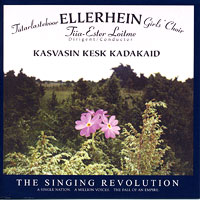
Listen to Ellerhein Girl's Choir : Kasvasin Kesk KadakaidReview: In a nation as passionate about choral music as Estonia where excellent choral groups abound it is a real accomplishment for a choir to be considered one of the best but that is the lofty status of the Ellerhein Girls' Choir. This Grammy award winning choir was featured in the highly acclaimed movie "The Singing Revolution" where the ensemble is filmed in rehearsal along with exrtended interviews with the choir director Tiia Este-Loitme. For fans of girls choirs or directors looking for interesting repertoire this recording is a must have. Songlist: Ave Maria, Quam Pulchra Es, Gratias Agamus Domino Deo Nostro, Examine Me Psalm 139, Oh, Peter, Go Ring Them Bell, Babylon's Fallin', Amazing Grace, Clara hallilaul, Uisutajad, Kevadtuul, Lehtivad pungad, Ohtune taevas, Toominga all, Kollane leek, Hiliskevadel, Ule taeva jooksevad pilved, Kanarbik, Sinu akna all tuvid, Kadakad 
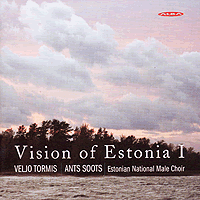
Estonian National Male Choir : Visions of EstoniaReview: Veljo Tormis is best known for his preservation of folk songs and folklore in his music. On Vision of Estonia, his concern for the oppression of the Estonian people is mixed with this aspect. These pieces for male choir are fantastic. The title piece "Vision of Estonia" was written during the fall of the Soviet Union and finished when Estonian independence was declared. Tormis is also known for his orchestral choral sounds. In "Incantation for the Sea" and "Litany to Thunder" he translates the dramatic images depicted in the poetry into massive choral sounds. "Incantation for the Sea" comes from the epic poem Kalevala. Due to international interest in his music, Tormis uses a Latin translation to make his piece widely accessible to non-Estonian speaking choirs. The Estonian National Male Choir, led by Ants Soots, is dynamic in this music which honors their country. Songlist: Double Dedication (Diptych), Vision of Estonia, The Viru Oath, Draught, Story of a Betrayer, The Last Ship (Valse triste), Hamlet's Songs, Incantatio maris aestuosi, Litany to Thunder, Our Shadows (Once We Will Reappear), Herding Calls, The Sarcasms of Juhan Liiv, A Conscripts's Escape from Toompea Castle Home to Kuusalu
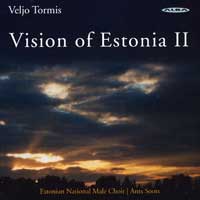
Estonian National Male Choir : Visions of Estonia 2Review: Estonian composer Veljo Tormis (1930-) emphasizes the role of verbal text and its message in his compositions, directed at the present, past and future of Estonian life. Written for men's chorus, "Visions of Estonia II" records in music the anxiety that was suppressed through the decades of Soviet repression. With "The Ballad of Mary's Land," composed in 1969, Tormis began a series of powerful large-scale choral compositions containing also his most famous work, "The Curse Upon Iron" for mixed chorus, written in 1972. "Reflections with Hando Runnel" (1981), is one of a series of short, sarcastic songs of protest he wrote during that period. "Days of Outlawry," with the subject of resistance fighting, was written for the banned film "The Outlaws;" "Journey of the War Messenger" and "Let The Sun Shine" take their texts from the Estonian National epic "Kalevipoeg." "Forget-me-not" is a national lament dedicated to former chief conductor Gustav Ernesada. Although none of these 23 songs is in English, we can feel the power and Tormis' deep feeling within this music through the performance of the Estonian National Male Choir. Songlist: The ballad of Mary's Land, Reflections with Hando Runnel, Days of Outlawry, God Protect Us from War, Journey of the War Messenger, Let the Sun Shine!, Voices from Tammsaare's Herdboy Days, Forget-me-not, Men's Songs
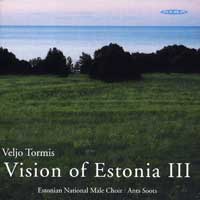
Listen to Estonian National Male Choir : Visions of Estonia 3Review: The third collection under the title "Vision of Estonia" continues recording the work of Estonian composer Veljo Tormis by the veteran Estonian National Male Choir. All song titles and lyrics of the piece are in Estonian. These lyrics, their meanings, and the history of the composer, the choir, and this dramatic, powerful piece are included in the extensive liner notes. The deeply emotional composition, written under the thumb of the Soviet occupation of Estonia, is divided into 32 movements--from the eight parts of "Dialektilisi aforisme," all less than a minute in length, and the 9-minute "Muistse mere laulud" to the intense 2 -minute "Sottaminck." "Vision III" a difficult, eclectic work that explodes into non-vocal percussion and vocal outbursts of protest and pride. Luckily, it is being sung by one of the best all-male choirs in the world, who perform it with tremendous spirit and feeling. Some accompaniment. Songlist: The Singer, Songs Of The Ancient Sea, Plague Memory, Feelin' Groovy (The 59th Street Bridge Song), Going To War, Dialectical Aphorisms, Song About Level Land, We Are Given, An Aboriginal Song, The Estonians Political Parties Game, Song About Keeping Together, Martinmas Songs, Christmas Is Coming, Shrovetide Songs, Three I Had Those Words Of Beauty
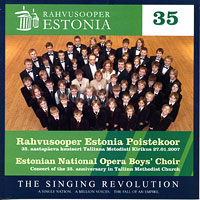
Estonian National Opera Boys' Choir : RahvusooperReview: Founded in 1971, the Estonian National Opera Boys' Choir was adopted by the Estonian National Opera in 1997. The Choir functions as a choral studio with three different levels, so that about 140 young singers study vocal music there. The Choir has received acclaim (and a number of Gold Medals in competitions) in many European countries, Canada, the US, Australia and Japan. This 35th Anniversary (of the group's founding) live concert has 11 cuts, several that feature Estonian composers, such as Simon Brix' wonderful 17 -minute long "Magnificat," Rene Eespere's "Two Jubilations" and "The Time of Awakening," Juri Ruut Kangur's "In Paradisum," Ester Magi's powerful, a cappella "Beloved Homeland" and "Meditation of the Viru Poet," Velgo Tormis' "Step Up," and Kadri Hunt's "We Must Hold Each Other Dear." Also included, and lovely, are Handel's "Lascia Ch'io Pianga" and Bob Chilcott's 15-minute "Jubilate." Many of these cuts are accompanied. A beautiful collection from this talented ensemble! Songlist: Magnificat, Lascia Ch'io Pianga, Jubilate, Kaks Jubilatsiooni, In Paradisum, Siin Mu Roomumaa, Viru Lauliku Motted, Astuge Ette, Arkamise Aeg, Ta Lendab Mesipuu Poole, Uksteist Peab Hoidma
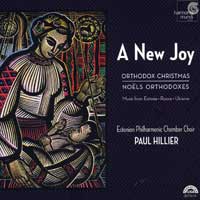
Listen to Estonian Philharmonic Chamber Choir : A New JoyReview: Drawing upon the rich treasury of 19th and 20th century liturgical hymns and carols of the nativity feast, this unique collection of Orthodox music from Russia and the Urkraine includes several first recordings of music by composers who were suppressed by the Soviet government. At the end of the 19th-century, Alexander Kastalsky founded the world-famous Moscow Synodal School of Church Singing. Bolshevik persecution of the Russian Orthodox Church forced the closing of the school and the disbanding of the choir. Georgiy Izvekov, a priest and well-respected composer of liturgical music, was arrested in 1931 for 'anti-Soviet activities' and was executed by firing squad. Important choral composers in the Ukraine met with similar fates - for example, Vasyl Barvinskyi was sentenced to ten years' imprisonment by the Soviet government. Paul Hillier leads the Estonian Philharmonic Chamber Choir in this gloriously atmospheric collection of Christmas music, which begins with the tolling of the bells of St Alexander's cathedral in Tallinn, Estonia. Songlist: Our Father, Rejoice, O Virgin, Verses Before The Six Psalms No.2, Shepards Of Bethlehem, Oh, What A Wonder, Today The Virgin Gives Birth, Verses Before The Six Psalms No. 1, The Angels Exclaimed, A New Joy, Bells Rang Early In Jerusalem, When Augustus Ruled Alone Upon The Earth, A Song Of Good Cheer, Throughout The World, The Legend, Christ Is Born, God Is With US, Blessed is The Man
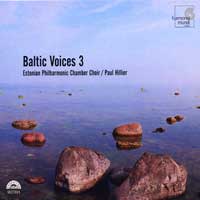
Estonian Philharmonic Chamber Choir : Baltic Voices 3Review: Acclaimed conductor Paul Hillier and the Estonian Philharmonic Chamber Choir conclude their exploration of the choral riches of the Baltic region with a third and final volume of the Baltic Voices series. The disc features music of established figures in the genre (Bergman, Gorecki, Gudmundsen-Holmgreen) and recent works by the younger generation (Saariaho, Tuur). Baltic Voices 3 includes CD premieres of works by Saariaho, Gorecki and Tuur. Hillier proves time and again that there's a huge quantity of highly effective new choral music out there that's not only entertaining and beautiful but also distinctive and not anachronistic. Highly recommended. Songlist: The Stomping Bride, Statements, Nuits, adieux, The Dazzled Eye lost its Speech, Vier Galgenlieder Op. 51b, Alleluia, Meditatio, 5 Kurpian Songs
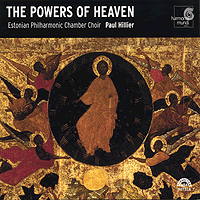
Estonian Philharmonic Chamber Choir : Orthodox ChantReview: For their second recording together, Paul Hillier leads the Estonian Philharmonic Chamber Choir in a selection of deeply moving sacred choral masterworks from the Slavic tradition of "Divine worship." Dmitry Bortniansky's sublime setting of The Cherubic Hymn represents one of the supreme summits of Orthodox liturgy. Songlist: Let My Prayer Arise (Dmitry Bortiansky), Now the Powers of Heaven (Giuseppe Sarti), The Cherubic Hymn (Bortiansky), O Most Holy Maiden Mary (anon), Glory / Only Begotten Son (from "Service in a Minor key") (Vasily Titov), In the Flesh Thou Didst Fall Asleep (Baldassare Galuppi), I Lift Up My Eyes to the Mountains (Bortiansky), Praise the Name of the Lord (Nikolai Diletsky), With My Voice I Cried Out to the Lord (Bortiansky), By the Rivers of Babylon (Artemy Vedel), Lord, Make Me to know My End (Bortiansky)
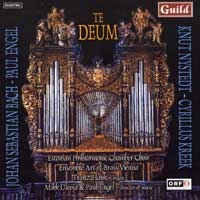
Estonian Philharmonic Chamber Choir : Te DeumReview: Paul Engel's Venetian Deja-vu is a virtuoso piece, which in a rather free manner is based both on the motet Jubilate Deo omnis terra and the well-known Sonata No. XIII for eight instrumental voices in two choirs by Giovanni Gabrieli. Even though this roughly 15 minute long composition cannot be regarded as sacred music, it was still composed for performance as part of a concert of church music. Engel's Te Deum is a piece in four movements of approximately 25 minutes in length which forms a musical arch beginning with the music for several voices of the occident and stretches to a modern, generally harmonic tonal language. Cyrillus Kreek worked like Bartok for many years as a musical researcher. He collected spiritual folksongs, which he catalogued and revised. He wrote 450 songs for choir with various voices and arranged 500 hymns in polyphony. In 1927, he completed his "Estonian Requiem" which is regarded as his masterpiece. Kreek's settings of David's Psalms form a kind of bridge between the comprehensive form of the requiem and the spiritual folksongs. They distinguish themselves through their emotional balance which is never monotonous. The Norwegian composer Knut Nystedt's "Immortal Bach" is based on the Bach chorale, Komm, susser Tod. Nystedt interprets this chorale in a manner typical for his style by attempting to unite the old with the new. Songlist: Te Deum, Venetian Deja vu, Psalms of David, Toccata, Adagio and Fugue in C major, Orgelbuchlein: Wenn wir in hochsten Noten sein, Immortal Bach
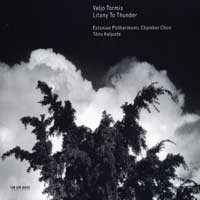
Estonian Philharmonic Chamber Choir : Veljo Tormis, Litany To ThunderReview: Veljo Tormis's timeless compositions draw inspiration from Estonia's ancient history, and these evocations of the past, influenced by folk musics of the Baltic region, are often mesmerizing in sheer physical power. There is nothing else in contemporary choral music that can be compared with "Curse Upon Iron", where the fierce declamations of the Estonian Philharmonic Chamber Choir are underpinned by the pounding pulse of a shaman's drum. At such moments, Tormis's music seems possessed, and even the quieter episodes - such as the runo-songs performed by two young sopranos - have an hypnotic insistency. Songlist: How Can I recognize My Home, Singing Aboard Ship, Curse Upon Iron, The Singer's Childhood, Songs Of The Ancient Sea, The Bishop And The Pagan, Litany To Thunder, The Lost Geese
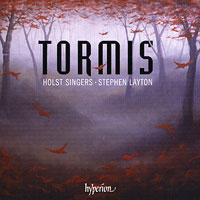
Holst Singers : TormisReview: The Holst Singers are acclaimed as one of England's greatest non-professional choirs. The talent and commitment of the individual members and the leadership of their mercurial conductor, Stephen Layton, ensure that their performances are always of the very highest standards. Veljo Tormis (born 1930) is - along with Arvo Part - Estonia's most famous living composer, holding an almost mystic status in his home country. He is also the passionate and practical torch-bearer for folk-singing revival, and the integration of an ancient cultural inheritance into thoroughly modern, post-Soviet lives. Interestingly, he trained at the Moscow Conservatory and was steeped in Soviet instruction during his early musical life. His music is almost all written for choirs; few other composers have been so committed to one genre. Tormis's choral specialization marks him out from Bartok, Kodaly, Vaughan Williams and Grainger, whose pioneering interest in folksong was ultimately limited to the use of textless tunes in instrumental or orchestral works. For Tormis, the words and the music are inseparable. The Holst Singers have recently been invited to Estonia to perform Tormis's music - a great honor, and a mark of their mastery of this repertoire. Songlist: Early summer's fairy tale, Soundlessly somewhere murmurings homeward, The grindstone game, The finger-binding game, The ship game, O, my gentle tender mother, Daughters of the Meadow Matron, The wave Rolls, Waking the birds, At Pasture, Shrovetide, Wee winkie mouse, Sang the father, sang the son, Singing aboard ship, It is late summer, Clouds are racing, Pale Light, Painfully red are the leaves, Wind over the barrens, Cold autumn night, Heather, I sing for my child, It's time for the little berry to sleep, Let the cradle swing!, Lulling, Childhood memory
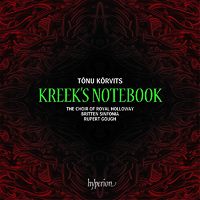
Royal Holloway Choir : Korvits - KreekÕs NotebookReview: Rupert Gough and the Choir of Royal Holloway offer listeners another fascinating album of contemporary Baltic music. The primary work on the recording is based on Estonian folk hymns collected in the early twentieth century by Cyrillus Kreek, who was the Estonian equivalent of Bart—k or Grainger. During the Soviet era, the singing of these religious songs was forbidden and the entire genre was all but forgotten. By the end of the twentieth century, fresh light could be shone on these folk collections and composer Tonu Korvits was particularly struck by the music's fresh possibilities. In writing Kreek's Notebook, Korvits both pays homage to Kreek and presents his own totally modern take on the folk hymn idiom. Although there is a dramatic unity to this eight-movement work, there is much diversity in timbre and scoring. The effect is improvisatory in the creative ornamentation of the vocal lines, and suffused with dreamy textures that bring to mind the great tradition of Eastern European choral writing. Songlist: Nuud ole, Jeesus, kiidetud (May Jesus now be praised), Nuud on see paev ju loppenud (Now the day is over), Ma kiitlen ukspainis neist verisist haavust (I alone praise those wounds that bleed), Oh vota, armas Jeesus, vastu mult (Oh receive from me dear Jesus), Su hooleks ennast annan ma (I shall give myself up to your care), Lenda ules kurbtusest (Fly up from your sorrows), Minu hing, oh ole roomus (My soul, oh be joyful), Ma vaatan ules maele (I gaze up at the hill), The night is darkening round me, Lacrimosa (Maskats), In memoriam (Plakidis), Tuksnesu karstos putekjos (In the hot dust of desert)(Fatamorgana-Mirage), Kas kaiteja an dziedat (Why should I not sing?), Meza virins (The forest elves), Lugums naktij (Prayer to the night)(Maskats)
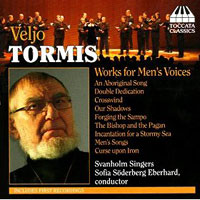
Svanholm Singers : Veljo Tormis: Works for Men's VoicesReview: Although Veljo Tormis is the second-most-famous modern Estonian composer (the most famous being Arvo Part), his music remains scarcely known in the west. Unlike Part, Tormis' work hasn't undergone a major stylistic shift; he has remained committed to using Estonian folk song as a basis for his music from the beginning of his career. He's not simply an arranger or transcriber, though. The folk influence may be overt, or principles of its structure and distinctive characteristics may be submerged in a thoroughly contemporary soundworld. Even the most clearly modern pieces have a sense of emotional gravity and primal power that set them apart as the work of an individual musical thinker. Choral music has always been Tormis' preferred medium, and he has written over 500 choral works. This small sampling of works for (or arranged for) men's voices demonstrates the power and originality of his imagination. There is a sense in which his work seems a-historical, the product of a real maverick; it's hard to pinpoint any classical tradition or earlier composers from which his sound might have been derived. Composers since have made some of Tormis' qualities sound commonplace, but he has been writing like this throughout his long career. Central to his distinctiveness is his use of texture and rhythm, as elements more prominent than melody or harmony; the melodies may not stay with you, but the power of the driving pulse and eccentric textures is unforgettable. Many of the works include what would technically be considered extended vocal techniques, but in this context sound more primal than modern -- panting, shouting, chanting, whispering, and whistling. Tormis also uses a hugely resonant shamanic drum in several pieces, and it contributes to the ritualistic, primitive atmosphere that some of his work creates. One of the most effective pieces recorded here is also his most famous, Raua needmine (Curse Upon Iron), which has a profound monumentality and a sense that a mysterious rite is being enacted. Svanholm Singers, directed by Sofia Soderberg Eberhard, performs this music as if it had it in its blood. The group shows remarkable assurance in singing not only with obvious discipline, but with the wildness the music requires. The sound is full, present, and immediate. Fans of modern choral music who aren't familiar with Tormis' music owe it to themselves to explore it, and this collection makes a terrific place to start. Songlist: An Aboriginal Song, I'd Like to Sing a Song, Stars, Crosswind, Our Shadows (Once We Will Reappear), Forging the Sampo, The Bishop and the Pagan, Incantation for a Stormy Sea, Men's Song, Bundling Song, Betrothal Visit Song, Song of the Turkish War, Serf's Song, Dancing Song, Curse Upon Iron
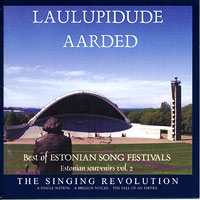
Various Artists : Best of Estonian Song Festivals - Laulupidude AardedReview: Estonia is a small nation, and again and again a quarter of them get together on the Song Festival Ground, with its massive "Arch of Song" and grounds, by the high limestone bank of Lasnamae, Tallinn, to take part in this wonderful festival, either as a singer or a listener. They arrive in a long, colorful parade, and then the fanfares start sounding, playing the theme from Ludig's song "The Dawn." The first of these festivals took place in 1869, and they have always been an expression of national consciousness and pride in this small Soviet-bloc nation as it strove for self-governance and freedom from oppression. "The Dawn" is joined by U. Vinter's powerful, a cappella "The Song of the Northern Land" as the two songs that resonate most in the hearts of the oppressed nation. There are 24 songs here, anthems that express the Estonians' pride and love for their country, beautiful examples are A. Kunleid's "My Fatherland Thou Are My Love" and "Until I Die;" K.A. Hermann's "Let Us Go Up To the Hills," R. Tobias' "The Young Blacksmiths" and "Wouldn't You Know;" G. Erneasaks' "The Young Spring" and "The Reaping Song;" M. Saar's "The Northern Spirit" and R. Eespere's "The Era of Awakening." There is occasional accompaniment, and extensive, colorful liner notes tell the story in both Estonian and English. A joyous collection from this powerful, phenomenal Festival of Song! Songlist: Laulupeo Fanfaard, Mu Isamaa On Minu Arm, Sind Surmani, Laul Roomule, Enne Ja Nuud, Kaunimad Laulud, Mingem Ules Magedele, Noored Sepad, Eks Teie Tea, Laulik, Sirisege Sirbikesed, Noor Kevade, Arge Unustage Laulu, Loikuse Laul, Mets, Rukkiraak, Someralt Sormikule, Pohjavaim, Nokturn, Kes Selle Tamme Istutas?, Laul Pohjamaast, Laulu Algus, Arkamise Aeg, Tuljak
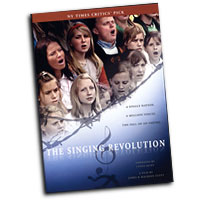
Various Artists : The Singing RevolutionReview: Most people don't think about singing when they think about revolution. But song was the weapon of choice when Estonians sought to free themselves from decades of Soviet occupation. The Singing Revolution is an inspiring account of one nation's dramatic rebirth. It is the story of humankind's irrepressible drive for freedom and self-determination. Hundreds of thousands of people faced down their oppressors... armed only with hope, truth and song. Recommended.
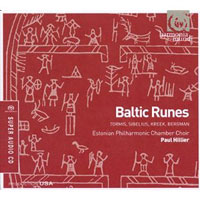
Estonian Philharmonic Chamber Choir : Baltic RunesReview: Paul Hillier leads the Estonian Philharmonic Chamber Choir in a program tracing the Balto-Finnic folksong tradition through the works of Jean Sibelius, Cyrillus Kreek, Erik Bergman and Veljo Tormis. Hillier's previous forays into this repertoire (his three-volume Baltic Voices series) have been met with the highest critical acclaim. Hillier was also recently awarded a GRAMMY for his recording of David Lang's Little Match Girl Passion. Songlist: Laulusild, Rakastava (The Lover), Sirisege, sirbikesed!, Maga, maga Matsikene, Mis sa sirised, sirtsukene?, Pilspa ja pakana, Lapponia, Jannilaulud
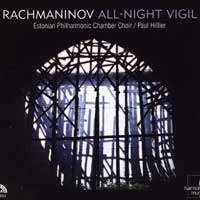
Estonian Philharmonic Chamber Choir : Rachmaninov - VespersReview: The period from 1880 to 1917 marked a renaissance in Russian choral music. Previously, Russian choral music had been dominated by German and Italian influences. Now composers returned to old Russian chants as the source of their works, thus creating a thoroughly Russian choral style. Although Sergei Rachmaninov wrote only few choral works, they are among the finest example of Russian choral music ever written. Of those works, the All-Night Vigil (more commonly referred to as the Vespers) stands as his crowning achievement and is widely regarded as the pinnacle of the Orthodox church music as a whole. Composed in 1915, the All-Night Vigil is comprised of texts for services of Vespers, Matins and Prime. In writing the work, Rachmaninov employed a system known as "choral orchestration," which requires singers to make use of a wide range of complex vocal techniques. But for all the innovation and technical prowess evident in Rachmaninov's All-Night Vigil, it is the work's intense emotion and deep spirituality that stays with the listener. Songlist: Come, let us worship, Praise the Lord, O my soul, Blessed is the man, O gentle light, Lord, now lettest Thou, Rejoice, O Virgin, The Six Psalms, Praise the name of the Lord, Blessed art Thou, O Lord, Having beheld the Ressurection, My soul magnifies the Lord, The Great Doxology, Today salvation is come, Thou didst rise from the tomb, O queen victorious
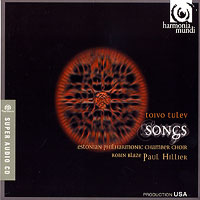
Estonian Philharmonic Chamber Choir : Tulev - SongsReview: Toivo Tulev is one of the principal figures in Estonian music today. Deeply influenced by his study of Gregorian chant, Tulev's works have a mystic, incantatory dimension. Songs is the title of the largest work on this CD, but it reflects on the other works as well, and not only because they are vocal or choral. During the 1980s, the composer was a member of the Estonian Philharmonic Chamber Choir. This background has given him an innate sense of what singers can do. The linear interweaving of which Tulev's music is constructed is essentially vocal; even when played on instruments it is song. Dedicated to Paul Hillier, Songs is a polychoral piece with various groups of singers and instruments distributed around the concert venue. The text is a collage created by the composer from various sources: the Bible, the Song of Songs and two poems, Cantico espiritual and Coplas del alma que pena por ver a Dios by St John of the Cross. The small orchestra includes recorder and duduk, an instrument whose longing quality is well suited to the poems. World-renowned countertenor Robin Blaze joins Paul Hillier and the Estonian Philharmonic Chamber Choir in this world premiere recording. Songlist: By Night, Where Have You Hidden, Beloved, This Life That I Live, Nigra Sum, Behold, Thou Art Fair, I Am Come Into My Garden, Reveal, Reveal Your Presence, Mira Que La Dolencia De Amour, Der Herr Ist Mein Getreuer Hirt I, Rejoice, Rejoice, Rejoice,, Leave, Alas, This Tormenting, Jusquez au Printemps, Der Herr Ist Mein Getreuer Hirt II
Ken Berg : Three Estonian CarolsReview: Fun settings of a traditional Estonian carols, these secular winter-themed songs reflects on the joys of winter and skating in a gentle waltz feel. Brisk and energetic songs with simple melody, limited ranges and shared rhythmic patters make them enjoyable for high school mixed choirs.. In Estonian, with a pronunciation guide and a singing English translation, this suits both beginning and more advanced mixed choirs, with quick and easy preparation for both choir and accompanist. Both Estonian and English text. Songlist: Ule Lume Lagedale (Over Snowy Winter Roads), Skating (Uisutamas), Little Tommy's Choir
Veljo Tormis : Autumn LandscapesReview: Veljo Tormis is recognized especially for his vocal and choral works. For him, music begins with words; he does not have "purely musical" ideas. Tormis is a real master of large-scale choral composition. His music is often connected with ancient folk songs of Estonian and other Balto-Finnic peoples. For female voices. Songlist: On hilissuvi (It is Late Summer), Ule taeva jooksevad pilved (Clouds are Racing), Kahvatu valgus (Pale Light), Valusalt punased lehed (Painfully Red are the Leaves), Tuul konnumaa kohal (Wind Over the Barrens), Kulm sugisoo (Cold Autumn Night), Kanarbik (Heather)
Veljo Tormis : Autumn LandscapesReview: Veljo Tormis (b. 1930) is recognized especially for his vocal and choral works. For him, music begins with words; he does not have "purely musical" ideas. Tormis is a real master of large-scale choral composition. His music is often connected with ancient folk songs of Estonian and other Balto-Finnic peoples. Songlist: On hilissuvi (It is Late Summer), Ule taeva jooksevad pilved (Clouds are Racing), Kahvatu valgus (Pale Light), Valusalt punased lehed (Painfully Red are the Leaves), Tuul konnumaa kohal (Wind Over the Barrens), Kulm sugisoo (Cold Autumn Night), Kanarbik (Heather)
Veljo Tormis : Four Estonian LullabiesReview: Veljo Tormis (b. 1930) is recognized especially for his vocal and choral works. For him, music begins with words; he does not have "purely musical" ideas. Tormis is a real master of large-scale choral composition. His music is often connected with ancient folk songs of Estonian and other Balto-Finnic peoples. Songlist: Laulan lapsele (I Sing for My Child), Marjal aega magada (It's Time for the Little Berry to Sleep), Lase kiik kaia! (Let the Cradle Swing!), Aiutus (Lulling)
Veljo Tormis : God Protect Us From WarReview: Veljo Tormis is an Estonian composer, regarded to be one of the greatest living choral composers and one of the most important composers of the 20th century in Estonia. Internationally, his fame arises chiefly from his extensive body of choral music, which exceeds 500 individual choral songs, most of it a cappella. The great majority of these pieces are based on traditional ancient Estonian folksongs (regilaulud), either textually, melodically, or merely stylistically. This work for men's voice is challenging yet very worthwhile. Songlist: God Protect Us From War
Veljo Tormis : Ingrian EveningsReview: Contents: Röntyshkä (Dance Song) I - Röntyshkä II - Röntyshkä III - Röntyshkä IV - Röntyshkä V - Chastushka (Jocular Song) I - Chastushka II - Roundelay - Ending and Going Home. Songlist: RONTYSHKA (DANCE SONG), RONTYSHKA II, RONTYSHKA III, CHASTUSHKA (JOCULAR SONG), CHASTUSHKA II, ROUNDELAY, RONTYSHKA IV, RONTYSHKA V, ENDING AND GOING HOME
Veljo Tormis : Karelian DestinyReview: Veljo Tormis (b. 1930) is recognized especially for his vocal and choral works. For him, music begins with words; he does not have "purely musical" ideas. Tormis is a real master of large-scale choral composition. His music is often connected with ancient folk songs of Estonian and other Balto-Finnic peoples. 'Karelian Destiny is from the "Forgotten People" Series Songlist: The Weeping Maiden, The Suitors from the Sea, As a Serf in Viru, Oak-feller, A Lullaby
Veljo Tormis : Singing Aboard ShipReview: Beneath the apparent simplicity and charm lies a richness and complexity that rewards. Tormis' choral works marry traditional Estonian folk melodies with contemporary but accessible harmonies. Songlist: Singing Aboard Ship
Veljo Tormis : Songs of the Ancient SeasReview: The texts for this composition have been compiled from runic songs about the sea, using source material from Haljala, Kuusalu, Ridala and Muhu in Estonia. The written transcriptions of the texts, translated from the vernacular, were made in 1973-74. Songlist: Songs Of The Ancient Sea
Veljo Tormis : Spring SketchesReview: Veljo Tormis is recognized especially for his vocal and choral works. For him, music begins with words; he does not have "purely musical" ideas. Tormis is a real master of large-scale choral composition. His music is often connected with ancient folk songs of Estonian and other Balto-Finnic peoples. For female voices. Songlist: Kevadtuul (Spring Wind), Lehtivad pungad (Flowering Blossoms), Ohtune taevas (Evening Sky), Toominga all (Under the Bird-cherry Tree), Kollane leek (Yellow Flame), Hiliskevad (In Late Spring)
Veljo Tormis : Summer MotifsReview: Veljo Tormis is recognized especially for his vocal and choral works. For him, music begins with words; he does not have "purely musical" ideas. Tormis is a real master of large-scale choral composition. His music is often connected with ancient folk songs of Estonian and other Balto-Finnic peoples. For female voices. Songlist: Pouailm (Dry Weather, Aike (Thunderstorm, Suveoo (Summer Night)
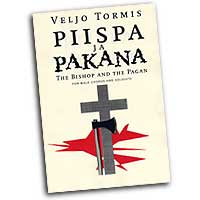
Veljo Tormis : The Bishop and the PaganReview: The Story of the Bishop and the Pagan, drawn from musical documents and folklore, tells of the death of the British warrior and Christian missionary Bishop Henry at the hands of the Finnish peasant farmer Lalli near the town of Turku (Abo) in the winter of 1158. By a fortunate and unusual historical circumstance, the viewpoints of both sides have been preserved: a written Latin Gregorian chant "The Sequence Of Saint Henry" documents the British Christian side, and numerous folk songs represent the event as seen by the Finnish pagan. A fascinating and rewarding work for unaccompanied male voices. Songlist: The Bishop and the Pagan
Veljo Tormis : Vespa Rajad (Vespian Paths)Review: From the series Forgotten Peoples Songlist: OEKENE, SIGUKENE, VENESSE PURGIV NEIU, TAEVASED KOSILASED, LAKSIN MINA KIKOILASSE, KUKKU JA KUKKU, LAKSIN MINA VEELE, KIISE-MIISU, LAULDA TEILE LAULUKE, KUS SA TANA MAGASID, MIS TEIL TEHAKSE, RONIS HARG KUUSE OTSA, VAGISI MEHELE, AIUTUS, AINUS POEG, TUTU-LUTU KARJANE
Veljo Tormis : Winter PatternsReview: Veljo Tormis is recognized especially for his vocal and choral works. For him, music begins with words; he does not have "purely musical" ideas. Tormis is a real master of large-scale choral composition. His music is often connected with ancient folk songs of Estonian and other Balto-Finnic peoples. For female voices. Songlist: Talvehommik (Winter Morning), Kulm (Cold), Tuisk (Blizzard), Virmalised (Northern Lights - Aurora borealis) |
 Choral Music - Home
All Choral Groups | Choral Christmas | Composers | Choral Directors | Choral arrangements
Mixed Voice Groups | Mixed Voice CDs | Mixed Childrens Choirs | Mixed Childrens CDs | Mixed Voice Christmas CDs
Male Choral Groups | Male Choral CDs | Boyschoirs | Boyschoirs CDs | Male Choral Christmas CDs
Womens Choral Groups | Womens Choral CDs | Girls Choirs | Girls Choirs CDs | Female Choral Christmas CDs
Early Music Groups | Early Music CDs | Early Music Christmas CDs
Spirituals | Church Choirs | Madrigals | Choral DVDs | Complete choral list
Choral Development - Home | Choral Conducting | Techniques & Methods | Warm-Ups & Exercises | Rehearsal
Choral Choreography | Instructional DVDs | Children's Choir Development | Pedagogy | Singers Resources | Director Resourses
Choral music by Country - America | England | Canada | Bulgaria | Hungary | Germany | Estonia
Latvia | Russia | Denmark | Netherlands | Sweden | Africa | Latin American
General Search | Choral Search | Arrangement Search | Instructional Search | Solo Voice Search | Barbershop Search
For More of The Primarily A Cappella On-Line Catalog
Christian | Collegiate | Doo Wop | Barbershop | World | Choral | Contemporary | Vocal Jazz
Groups | Directors | Composers | Arrangers | Vocal Coaches
Arrangements | Solo Voice | Christmas | DVDs | Instructional for Singers | New Additions
The Harmony Sweepstakes A Cappella Festival
Site Map | A Cappella News | Regional Newsgroups | FAQ | Twitter
All Rights Reserved All Content, page design, CGI Copyright © United Singers International
