
In Celebration of the Human Voice - The Essential Musical Instrument
Home | Doo Wop | Barbershop | World | Contemporary | Christian | Vocal Jazz | Choral | Christmas | Instructional | Arrangements
Classical | Opera | Musicals | Personality | Young Singers | Disney | Videos | Songs | The Artists

Estonian National Male Choir
Director: Ants Soots
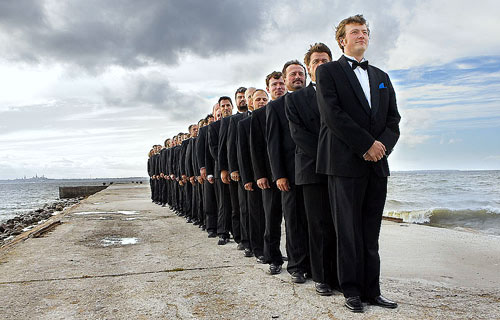
Group.
The Estonian National Male Choir (RAM) is currently the largest full-time professional male choir in the world. Founded in 1944 by the legendary composer and leader of the Estonian choral movement, Gustav Ernesaks, the choir has since been conducted by several highly esteemed Estonian choral conductors, including Olev Oja, Kuno Areng, Ants Uleoja, Ants Soots and 2005-2008 Kaspars Putninsh from Latvia.
In a cooperative project with Conductor Paavo Jarvi, The Estonian National Symphony Orchestra (ERSO), the Estonian girls Choir "Ellerhein", and The Estonian National Male Choir (RAM), won a Grammy Award in 2004 in the category of "Best Choral Performance" for their recording of Sibelius' Cantatas (Virgin Classics, 2003). A year later their recording of Edvard Grieg's "Peer Gynt" (recorded by the same line-up) was voted the orchestral album of the year in BBC Music Magazine.
Over its' 65 years of existence, RAM has performed more than 6000 concerts all across Estonia, the former Soviet Union, many Western European countries, Israel, Canada and the United States. In the early years, the Choir devoted it's working repertoire almost exclusively to a cappella choral music, much of which was composed by it's founder Gustav Ernesaks. Since that time RAM, has divulged itself into the Classical mainstream and is now most famous for its interpretations of large-scale orchestral works, frequently performed with the world's leading orchestras and conductors. At any given time, RAM has approximately 30 large-scale orchestral works available in its' repertoire, and most of the current tours abroad are large-scale cultural projects that provide a forum for these performances.
During the last decade, the choir has paid homage to the musical trends and performance styles of several different periods and regions, working with such guest conductors as Lev Sivuhhin, Robert Sund, Josep Prats, Roman Toi, Chifuru Matsubara (Japan), Kaspars Putninsh, Anatoly Grindenko, Lone Larsen (Sweden), Timothy Brown (UK), Vytautas Mishkinis, Toomas Siitan and Jaan-Eik Tulve.
Over the last 5 years Estonian National Male Choir has recorded 12 CD-s for Deutsche Grammophon, Sony, Virgin, Finlandia, CCn'C, Forte, Alba, GB Records and other record labels.
Discography
Displaying 1-3 of 3 items.
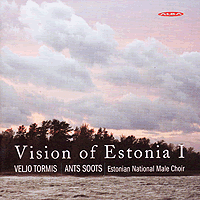
Review: Veljo Tormis is best known for his preservation of folk songs and folklore in his music. On Vision of Estonia, his concern for the oppression of the Estonian people is mixed with this aspect. These pieces for male choir are fantastic. The title piece "Vision of Estonia" was written during the fall of the Soviet Union and finished when Estonian independence was declared. Tormis is also known for his orchestral choral sounds. In "Incantation for the Sea" and "Litany to Thunder" he translates the dramatic images depicted in the poetry into massive choral sounds. "Incantation for the Sea" comes from the epic poem Kalevala. Due to international interest in his music, Tormis uses a Latin translation to make his piece widely accessible to non-Estonian speaking choirs. The Estonian National Male Choir, led by Ants Soots, is dynamic in this music which honors their country.
Songlist: Double Dedication (Diptych), Vision of Estonia, The Viru Oath, Draught, Story of a Betrayer, The Last Ship (Valse triste), Hamlet's Songs, Incantatio maris aestuosi, Litany to Thunder, Our Shadows (Once We Will Reappear), Herding Calls, The Sarcasms of Juhan Liiv, A Conscripts's Escape from Toompea Castle Home to Kuusalu

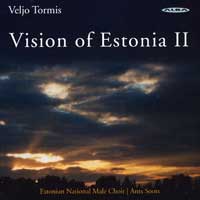
Review: Estonian composer Veljo Tormis (1930-) emphasizes the role of verbal text and its message in his compositions, directed at the present, past and future of Estonian life. Written for men's chorus, "Visions of Estonia II" records in music the anxiety that was suppressed through the decades of Soviet repression. With "The Ballad of Mary's Land," composed in 1969, Tormis began a series of powerful large-scale choral compositions containing also his most famous work, "The Curse Upon Iron" for mixed chorus, written in 1972. "Reflections with Hando Runnel" (1981), is one of a series of short, sarcastic songs of protest he wrote during that period. "Days of Outlawry," with the subject of resistance fighting, was written for the banned film "The Outlaws;" "Journey of the War Messenger" and "Let The Sun Shine" take their texts from the Estonian National epic "Kalevipoeg." "Forget-me-not" is a national lament dedicated to former chief conductor Gustav Ernesada. Although none of these 23 songs is in English, we can feel the power and Tormis' deep feeling within this music through the performance of the Estonian National Male Choir.
Songlist: The ballad of Mary's Land, Reflections with Hando Runnel, Days of Outlawry, God Protect Us from War, Journey of the War Messenger, Let the Sun Shine!, Voices from Tammsaare's Herdboy Days, Forget-me-not, Men's Songs
Listen to
soovid
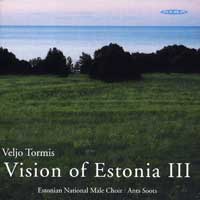
Review: The third collection under the title "Vision of Estonia" continues recording the work of Estonian composer Veljo Tormis by the veteran Estonian National Male Choir. All song titles and lyrics of the piece are in Estonian. These lyrics, their meanings, and the history of the composer, the choir, and this dramatic, powerful piece are included in the extensive liner notes. The deeply emotional composition, written under the thumb of the Soviet occupation of Estonia, is divided into 32 movements--from the eight parts of "Dialektilisi aforisme," all less than a minute in length, and the 9-minute "Muistse mere laulud" to the intense 2 -minute "Sottaminck." "Vision III" a difficult, eclectic work that explodes into non-vocal percussion and vocal outbursts of protest and pride. Luckily, it is being sung by one of the best all-male choirs in the world, who perform it with tremendous spirit and feeling. Some accompaniment.
Songlist: The Singer, Songs Of The Ancient Sea, Plague Memory, Feelin' Groovy (The 59th Street Bridge Song), Going To War, Dialectical Aphorisms, Song About Level Land, We Are Given, An Aboriginal Song, The Estonians Political Parties Game, Song About Keeping Together, Martinmas Songs, Christmas Is Coming, Shrovetide Songs, Three I Had Those Words Of Beauty
Male Choral Groups | Male Choral CDs | Boyschoirs | Boyschoirs CDs | Male Choral Christmas CDs
A Cappella Arrangements for Male Voices
Select a Category |
Want to Sing? - Find a Chorus Near You
List of Choruses by State | List of Choruses by City