
In Celebration of the Human Voice - The Essential Musical Instrument
Home | Doo Wop | Barbershop | World | Contemporary | Christian | Vocal Jazz | Choral | Christmas | Instructional | Arrangements
Classical | Opera | Musicals | Personality | Young Singers | Disney | Videos | Songs | The Artists

Pokrovsky Ensemble
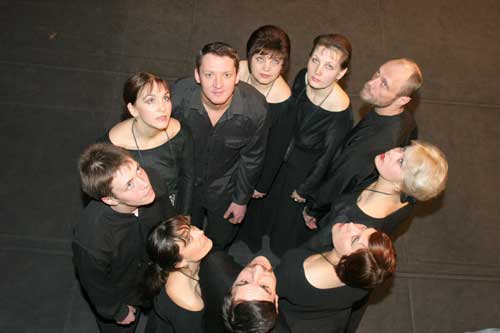
Mixed Choral Ensemble from Moscow, Russia.
In the early 1970s, Dmitri Pokrovsky was a student of conducting and the balalaika at Moscow's Gnessin Pedagogical Institute of Music. Frustrated with the current musical scene, he felt the need to discover something fresh and different as an alternative musical language--something that would break through all the old patterns and rules. He found it in a tiny, remote village in Russia embedded within the oldest of traditions. In the strange sound made by a group of five old women singing, Pokrovsky heard songs passed down from generation to generation for thousands of years. The songs were extraordinary, complicated, dense in form, and unknown in towns and cities; these were the Russian folk songs. He knew he was deprived of a great art form and separated from his heritage. This began his musical odyssey.
To develop this exploration, Dmitri founded an ensemble--his "living laboratory." It was created by musicians coming together with psychologists, mathematicians, and physicists in a spirit of scientific observation and experiment. Rather than conducting a clinical analysis that would kill the spirit of their study, they undertook a personal exploration of rural village life. In order to know the essence of village ritual, they became part of it. While researching, the ensemble lived in the village and experienced the relationships between individuals, nature, and ritual. Travelling throughout Russia learning about these traditions has contributed to the richness of the Pokrovsky Ensemble's live performances.
The Pokrovsky Ensemble has performed in Austria, Belgium, Finland, Germany, Japan, Poland, Switzerland, and the U.S. They have been featured in more than two dozen motions pictures and appear regularly on Soviet television, bringing this ancient music into the modern era. In 1988, Mikhail Gorbachev honored Dmitri Pokrovsky with the Government Award, the Soviet Union's highest recognition for artistic excellence--a testament to the scholarship, musicianship, and vitality with which he and his ensemble have revived traditional Russian culture and customs.
Select a Category |
Want to Sing? - Find a Chorus Near You
List of Choruses by State | List of Choruses by City