
In Celebration of the Human Voice - The Essential Musical Instrument
Home | Doo Wop | Barbershop | World | Contemporary | Christian | Vocal Jazz | Choral | Christmas | Instructional | Arrangements
Classical | Opera | Musicals | Personality | Young Singers | Disney | Videos | Songs | The Artists

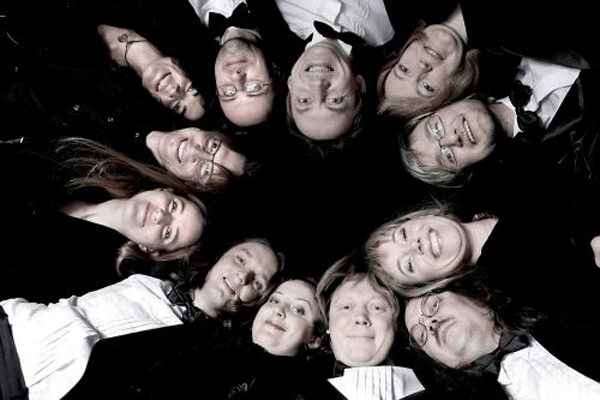
Group.
Discography
Displaying 1-9 of 9 items.
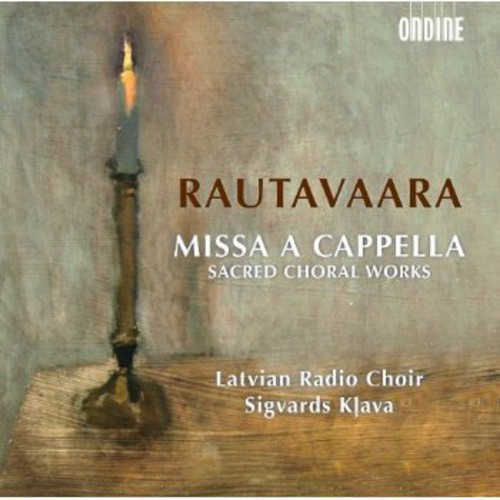
Review: Ondine continues its long-term collaboration with Einojuhani Rautavaara, the Latvian Radio Choir and Sigvards Klava by presenting the world premiere recording of Rautavaara's Missa a cappella. Being praised by Gramophone as an outstanding body of singers, the Latvian Radio Choir is one of the top chamber choirs in Europe. This is choir's follow-up disc to their highly successful recording of Rachmaninov's All-Night Vigil, which was Gramophone's Recording of the Month in February 2013. For the Missa A Cappella alone, this album will likely become a seminal recording of Rautavaara's sacred choral repertoire. Those wishing to become more familiar with this challenging, nuanced literature would do well to add this CD to their collection. --John Guarente, Choral Journal, Nov 2014
Songlist: MIissa A Cappella, Psalm Of Invocation, Evening Hymn, Missa Duodecinica, Ave Maria Gratia Plena, Canticum Mariar Virginmis, Our Joyful Feast, Die Erste Eligie

Review: Jonathan Harvey is Britain's foremost composer of electronic music and has developed a complex and personal musical language for which he is globally recognized. His catalogue of works explores unique sound worlds and imaginative ensembles. The works on this disc, composed within seven years of each other during one of the most productive periods of Harvey's career, demonstrate the stylistic range of his choral writing and his unique approach to the combination of live performance and electronic sound, as well as his innate sympathy for the voice. The Latvian Radio Choir have been labelled as the creators of a new choral paradigm: a testament to their diverse range of voices and skilful performances of challenging experimental works. The choir champions the works of many leading Latvian composers and much focus is placed on exploring the capabilities of the human voice. The singers explore their skills by turning to the mysteries of traditional singing, as well as every other vocal utterance, from speech to breath. They make their Hyperion debut with thrilling performances of Jonathan Harvey's The Angels, Ashes Dances Back, Marahi and The Summer Cloud's Awakening.
Songlist: The Angels, Ashes Dance Back, Marahi, The Summer Cloud's Awakening
Review: Sergei Rachmaninov's setting of the Divine Liturgy of St John Chrysostom - Eastern Christianity's common Eucharistic service liturgy - is regarded as one of the great cornerstones of 20th-century sacred music. This work of symphonic proportions was composed in the summer of 1910, in less than three weeks. After its completion, Rachmaninov wrote to a friend that he had been carried away by the project and that it had been a long time since he had written music with such pleasure. The outcome was judged by contemporary church officials as "...absolutely wonderful, even too beautiful... it is not church music." This a cappella choral work is performed by one of the foremost choruses in the world, the Latvian Radio Choir, under the direction of Sigvards Klava. The soloist roles are sung by K rlis R tent ls (tenor; celebrant priest) and Gundrars Dzi ums (bass; deacon). The recording was made at the Riga Dome Cathedral.
Songlist: Blessing, Bless the Lord, o my soul, Glory to the Father ? Only begotten Son of God, In Thy Kingdom, Come, let us worship, O Lord, Save - Holy God, Cherubic Hymn, Father, Son, and Holy Spirit, Creed, A Mercy of Peace, We hymn Thee, Hymn to the Mother of God, The Lord's Prayer, Communion Verse, We have seen the true light, Let our mouths be filled, Blessed be the name of the Lord, Many years
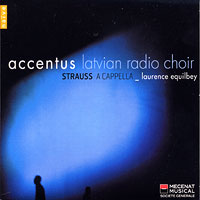
Review: Richard Strauss, though better known as a composer of operas and tone poems, wrote significantly in other genres as well. One of those mediums that fascinated him throughout his entire life was the a cappella choral work. The earliest pieces recorded here-the Zwei Gesange - come from 1897, the year of Ein Heldenleben; the latest piece-Traumlicht, the second of the Drei Mannerchore - from 1935-36, those years in which Strauss was occupied with the operas Friedenstag and Daphne. The most extensive work here, and perhaps the most difficult to perform, is the Deutsche Motette. Written in 1913, between his work on the operas Ariadne auf Naxos and Die Frau ohne Schatten, it is a one-movement tone poem for voices. There are moments of incredible difficulty, requiring the basses to perform notes more than two octaves below middle C for passages at a time. The sopranos, on the other hand, are asked to sing passages requiring high Cs, more than two octaves above middle C. The singers here are up to the challenge. This is no small feat for a piece that contains at its highest number 23 individual parts! The earlier Zwei Gesange are also given very fine performances. The ensemble work here is much better in terms of blend. In the beginning of Der Abend (the first of the two Gesange) the singers are very good at overlapping and matching, creating a seamless wall of sound as they transfer from one section to the next. Each entry proceeds smoothly, through the odd chromatic wandering, until the very end when the ensemble creates an almost organ-like sonority. The two remaining pieces are equally thrilling and well done.
Songlist: Deutsche Mottette, op 62, Trumlicht, op 123, Zwei Gesange, op 34, Der Abend / Hymne
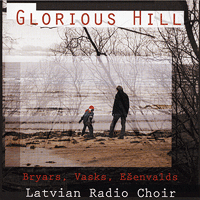
Review: In recent years Gavin Bryars has concentrated to a great extent on writing for the human voice - and a great deal of this is choral music. He has a close relationship with ensembles from the Baltic, especially the Latvian Radio Choir, now without doubt one of the world's greatest choirs. His first collaboration with them on GB Records was the superb On 'Photography', which was an Editor's Choice in Gramophone and extensively played on BBC Radio 3. This very fine choir is at home in all forms of contemporary music, but also in music from the baroque as well as early music. Many of Gavin Bryars' works on this recording take forms from early music, and some pieces originate in collaborations with early music ensembles - such as the Hilliard Ensemble and Trio Mediaeval. Here we have the stunning female voices of the Latvian Radio Choir in 9 and 11 part laude; the whole choir a capella in Glorious Hill and, in Cadman Requiem, accompanied by Riga Cathedral's magnificent organ in the cathedral's stunning acoustic. As on the first recording with the Latvian Radio Choir, Gavin Bryars has included works by Latvian composers close to his heart. Eriks Esenvalds is a young composer whose work recorded here was awarded first place at the 2006 International Rostrum for Composers. Peteris Vasks is perhaps the best known of all living Latvian composers. The work of both composers has a profound concern for the spiritual, which has led it to be linked with the music of composers such as Arvo Part or Giya Kancheli.
Songlist: Lauda 22, Fammi cantar l'amor, Lauda 23, Glorious Hill, Legende de la femme emmuree, Dammi conforto Dio, Lauda 24, Ziles zina, Cadman Requiem, -Kyrie/Requiem, -Creation Hymn Paraphrase (Bede), -Agnus Dei, -Creation Hymn, -In Paradisum
Review: This all a cappella recording features some most interesting and talented composers. Gavin Bryars's numerous recordings have been among the bestselling CDs by any contemporary composer. Two of his albums, "The Sinking of the Titanic" and "Jesus' Blood Never Failed Me Yet", have sold more than 250,000 copies. This recording is notable for the extraordinary beauty of its choral sound, the precision of its ensemble, the perfection of its intonation, the subtlety of its phrasing, and the striking individuality of its soloists.
Songlist: And so ended Kant's Travelling in this World (Gavin Bryars), Three Poems of Cecco Angiolieri, Da ispravitsa molitva moja (Arturs Maskata), Expessa Solis, Resonare Fibris, Diptychon (Silvestrov), The Lord's Prayer, Testament
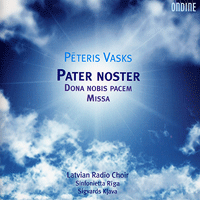
Review: Peteris Vasks (1946), Latvia's most prominent composer, was the son of a Baptist minister, and while he always felt a strong affinity for sacred music, he didn't feel free to express it through vocal music since it would never have been allowed to be performed under the Communist regime. Since the early '90s, he has turned his attention more and more to religious texts, and this CD includes three of his most significant sacred choral works, including a setting of the Mass. Vasks' style of choral writing links him to the composers who have come to be described as "holy minimalists," a group that includes Part, Gorecki, Kancheli, and Tavener, whose music, while stylistically diverse, tends to rely on tonal and modal harmonies, is frequently harmonically static or slow-moving and is often linked to plainchant and ancient liturgical traditions. Vasks' choral music is firmly rooted in Western polyphony and is for the most part traditional-sounding; there is little in it apart from certain unconventional harmonic progressions that would make it immediately identifiable as a product of the late twentieth century. Among the other holy minimalists, the sound of his music is most closely related to that of Gorecki in its harmonic textures and the somber earnestness of its moods. The three works recorded here are polyphonically and harmonically sensual, in spite of their serious tone. An exception to the sober tone is the Mass' Sanctus, which, while not exactly lighthearted, is lively; the composer imagines it "sung by happy, little angels." The Latvian Radio Choir sings with warmth and passion and with excellent control in the composer's extended, sustained vocal lines. Sigvards Klava, conducting Sinfonietta Riga, leads them in deeply felt performances. The CD should be of interest both to fans of choral music and of new trends in minimalism tinged with Romanticism.
Songlist: Pater noster, Dona Nobis Pacem, Missa
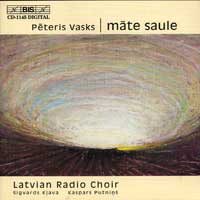
Review: Peteris Vasks' songs for mixed choir, like all of his compositions, provide a look at events, a portrait of the times. Quality, not quantity, is the keyword. This recording contains those compositions which the composer feels to be his best contributions to a genre which he has approached relatively sparingly.
Songlist: Three Poems By Czeslaw Milosz, Window, So Little, Encounter, Zemgale, Mate Saule (Mother Sun), Madrigals (Madrigal)#, Litene# (Ballad for 12-voiced chorus to a text by Uldis Berzins ), I, II, Dona nobis pacem
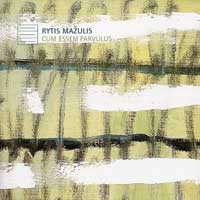
Review: Conductor Kaspars Putni s leads this wonderful choir on the works by Rytis Mazulis.
Songlist: Canon Solus, Sybilla, Cum Essem Parvulus, Ajapajapam
Select a Category |
Want to Sing? - Find a Chorus Near You
List of Choruses by State | List of Choruses by City