
In Celebration of the Human Voice - The Essential Musical Instrument
Home | Doo Wop | Barbershop | World | Contemporary | Christian | Vocal Jazz | Choral | Christmas | Instructional | Arrangements
Classical | Opera | Musicals | Personality | Young Singers | Disney | Videos | Songs | The Artists

Danish National Radio Choir
Director: Stefan Parkman
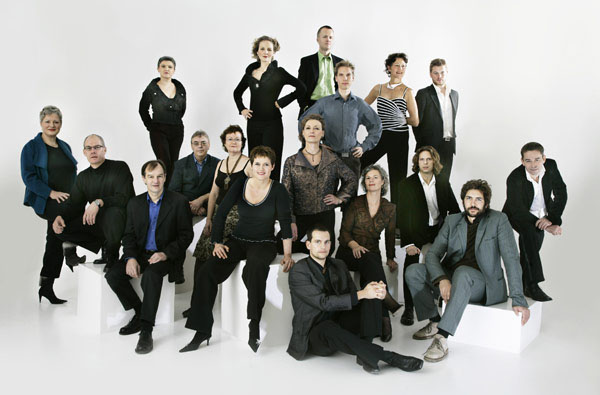
Mixed Choral Chorus from Denmark.
The Danish National Radio Choir was founded in 1932 with the purpose of performing the wide-ranging repertoire of oratorios, and symphonic works for choir and orchestra. The choir numbers 74 professional singers, 31 of whom are permanently employed forming the chamberchoir. The remaining 43 singers, who form the symphonic choir, are under 5-year contracts. Every season the choir appears regularly within the Thursday Concert Series of the Danish National Radio Symphony Orchestra.
In 1937 the smaller full time professional chamberchoir was established in order to develop the art of a cappella singing and to inspire the composers to investigate new possibilities in this field. Throughout the years the DNRC has performed with special acclaim under conductors such as Fritz Busch, Rafael Kubelik, Sergiu Celibidache, Kurt Sanderling, Gustav Kuhn, and the chief conductors of the Danish National Radio Symphony Orchestra Herbert Blomstedt 1967-77, Lamberto Gardelli (1984-1988), Leif Segerstam 1989-1995 and, from August 1995, Ulf Schirmer. Since 1989 Stefan Parkman has been Chief Conductor of the DNRC and in 1992 Uwe Gronostay was appointed Principal Guest Conductor.
The DNRC has toured extensively in recent years both in Denmark and abroad, including the USA, Australia, Canada, Finland, Great Britain, the Netherlands, France, Stockholm New Music Festival, Ultima Festival in Oslo, the Alte Oper in Frankfurt. In 1992 the DNRC appeared with the Danish National Radio Symphony Orchestra at the Schleswig-Holstein Festival and at the BBC Proms in Royal Albert Hall, London. In June 1996 the choir performed a concert version of Carl Nielsen's opera Maskarade in the Vienna Konzerthaus and in Brussel's Palais des Beaux-Arts together with the DNRSO. In co-operation with the Nederlands Kamerkoor and The Sixteen the DNRC form the Great Choirs of Europe, where, since 1994, an annual concert series with all three choirs has been performed in each of the three capitals Den Haag, London, and Copenhagen.
Discography
Displaying 1-5 of 5 items.
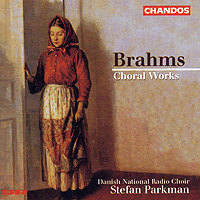
Review: The best known choral piece by Brahms is his German Requiem. Since his teenage years he was involved with choral groups and continued to work with them throughout his life. He wrote numerous songs for a cappella ensembles as well as with accompaniment. The most familiar of these pieces is the Zigeunerlieder, op. 103. These Gypsy songs are usually performed by a soloist and piano, but were originally written for a quartet. This phenomenal recording by the Danish National Radio Choir highlights some of Brahms' work in the choral genre.
Songlist: Drei Gesange, Op. 42, Funf Gesange, Op. 104, Vier Gesange, Op. 17, Sechs Quartette, Op. 112, Zigeunerlieder, Op. 103

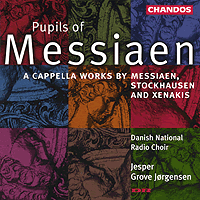
Review: Founded in 1932, the Danish National Radio Choir, directed by Jesper Grove Jorgensen, tours all over Europe, Australia, Canada and the USA. "Pupils" features 6 eclectic works by Olivier Messiaen (1908-1992), 3 works by Karlheinz Stockhausen (b. 1928) , and 3 works by Iannis Xenakis (b. 1922). Working all his life in the church, the French composer Messiaen's "Cinq rechants" offers abrasive dissonances and monodies, and lines with a vital rhythmic energy. His pupil Stockhausen goes off in a different direction, combining religious and erotic elements. Xenakis went in still another direction, the political, writing "Nuits" for 12 voices, an appeal on behalf of political prisoners; and choral music for ancient dramas like "A Helene" and "Serment." Stockhausen's "Die Nachtigall," Armer junger Hirt" and "Agnus Dei" are lovely. Messiaen's "Modere-Presque vif," Bien modere" and "Tres vif" are particularly nice. Very different, beautifully performed choral music! Extensive liner notes with lyrics and histories of the composers.
Songlist: Cinq rechants:, i. Mondere - Presque vif, ii. Bien modere, iii. Lent, caressant, iv. res vif, v. Vif, Chore fur Doris (Helle Charlotte Pedersen soprano), Die Nachtigall, Armer junger Hirt, Agnus Dei, Choral, A Helene, Nuits, Serment
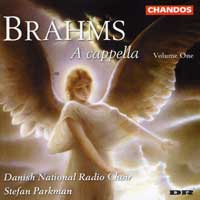
Review: The German-born Brahms (1833-1897) is considered one of the greatest Romantic composers, while the Danish National Radio Choir (Stefan Parkman, Chief Conductor) is one of the most respected European Choirs performing today. Their pure yet robust sound is a fine complement to the mastery of form that Brahms' works display. Indeed, one of the distinguishing characteristics of his style was his fascination with the contrapuntal forms so often identified with the Baroque and pre-Baroque era: canon, motet, fugue, and the variations thereof. It was accepted at that time to use a folk song or other well-known melody as the basis for the composer's own originality, which was demonstrated through his technical facility and manipulation of accepted idioms. A series of "Marienlieder" comprise a third of the recording, along with seven motets and three compositions commissioned for the Hamburg Industrial Exhibition of 1889. A recording of excellent virtue.
Songlist: Marienlieder, Op. 22:, Der englische Gruss, Marias Wallfahrt, Der jager, Ruf zur Maria, Magdalena, Marias Lob, Two Motets, Op. 29:, Es ist das Heil uns kommen her, Schaffe in mir, Gott, ein rein Herz, Two Motets, Op. 74:, Warum ist das Licht gegeben dem Muhseligen?, O Heiland, reiss die Himmel auf, Fest-und Gedenkspruche, Op. 109:, Unsere Vater hoften auf dich, Wenn ein starker Gewappneter, Wo ist ein so herrlich Volk , Three Motets, Op. 110:, Ich aber bin elend, Ach, arme Welt, Wenn wir in hochsten Noten sein
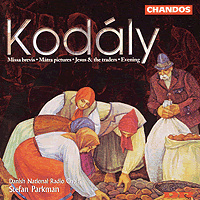
Review: Zoltan Kodaly is best known for his research of folk music and his contribution to the field of music education. A large part of his output is concentrated in the area of choral music. The four works heard on this recording come from the early third of the twentieth century. The Missa Brevis for chorus, alto, tenor, bass solos and organ, is the latest of these pieces and was expanded from his Mass for solo organ. Matrai kepek (Matra pictures) is a set of five pieces which are based on Hungarian folk songs from the Matra region ordered to form a narrative thread. Kodaly's music is dramatic with colorful writing.
Songlist: Missa brevis' (8 Movements), Jezus es a kufarok (Jesus and the traders), Este (Evening), Matrai Kepek
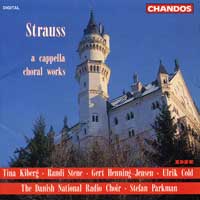
Review: The 75 professional singers of the DNRC are directed by Stefan Parkman, who has conducted most of Sweden's symphony orchestras and several excellent choirs. Probably the least-known of Richard Strauss's (1884-1949) major works are his compositions for unaccompanied chorus--not surprisingly, because only the most accomplished choirs are qualified to perform them. When they are performed, however, the rewards are great: 16 part harmony with antiphonal block passages alternating with intricate polyphony. Six pieces: "Der Abend Op. 34 Nr. 1," "Hymne Op. 34 Nr. 2," Deutsche Motette Op. 62," "Die Cottin im Putzzimmer," and "An den Baum Daphne," featuring the Copenhagen Boys' Choir. This is beautiful, fine, intricate stuff, with soaring harmonies and solos. Extensive liner notes with all lyrics and histories.
Songlist: Der aben op 34 nr 1, Hymne op 34 nr 2, Deutsche mottette op 62, Die gottin im putzzimmer, An den Baum Daphne
Select a Category |
Want to Sing? - Find a Chorus Near You
List of Choruses by State | List of Choruses by City