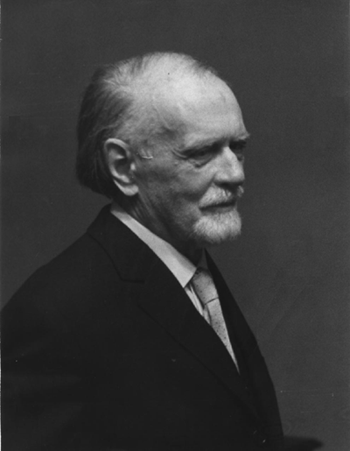

Zoltán Kodály (1882-1967), prominent Hungarian composer and musician, directed a significant portion of his creative endeavors to the musical education of the Hungarian nation-an interest which developed over many years. Such efforts were initiated with the folk song collection beginning in 1905. As he became aware of the great need to improve the quality of singing and music training of teachers and children alike, he began composing for children's choruses in the 1920's and required his composition students to do the same. Folk music provided inspiration, as well as the musical basis, for many of the compositions. By 1929 he was determined to reform the teaching of music and to make it an integral part of the education of every child.
In a lecture on children's choirs in 1929, he said, "Teach music and singing at school in such a way that it is not a torture, but a joy for the pupil;instill a thirst for finer music in him, a thirst which will last for a lifetime… If the child is not filled at least once by the lifegiving stream of music during the most susceptible period-between his sixth and sixteenth years-it will hardly be of any use to him later on. Often a single experience will open the young soul to music for a whole lifetime. This experience cannot be left to chance, it is the duty of the school to provide it. "
Kodály believed that music is meant to develop one's entire being-personality, intellect and emotions. He said, "… music is a spiritual food for everybody. So I studied how to make more people accessible to good music." (Kodály, 1966) Kodály realized this was part of everyone's basic heritage and was necessary for human development and should be started at as early an age as possible. Jenö Adám, an early and prominent colleague of Kodály, stated, "The most important thing is to actualize the instinctive love of the child for singing and playing, to realize the changing of his moods through the songs, his feelings, his experiences … in other words, to bring about the miracle of music."
![]() |
Welcome Kodaly's Life The Kodaly Concept Demonstrations Extra Features On The Foundation Impressum |
For decades, there has been a great, worldwide interest in Zoltan Kodaly's concept of music education (better known as the Kodaly Method) which, from time to time, had a different geographical emphasis. Hungarian public education has been operating with successes in spite of the changed social and economical circumstances. Even today, the "Hungarian Method" - to use Kodaly's words- serves as a model for many music pedagogues all of the world. This DVD-ROM provides a many-sided and faithful introduction to the Kodaly Concept; and also presents the study programme of the Kecskemet "mother institute" in an attracting and inspiring way. As well as textual introductions to Kodaly's life and the Kodaly Concept of music education the DVD-ROM provides an overview of the practical application of the method through video excepts of demonstration classes in kindergarten thru secondary school.
| 6645 DVD - ROM $39.95 |
![]() |
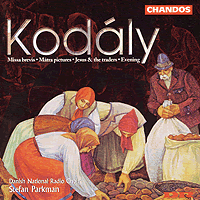
Missa brevis' (8 Movements) Jezus es a kufarok (Jesus and the traders) Este (Evening) Matrai Kepek (Matra pictures/5 Movements) |
Zoltan Kodaly is best known for his research of folk music and his contribution to the field of music education. A large part of his output is concentrated in the area of choral music. The four works heard on this recording come from the early third of the twentieth century. The Missa Brevis for chorus, alto, tenor, bass solos and organ, is the latest of these pieces and was expanded from his Mass for solo organ. Matrai kepek (Matra pictures) is a set of five pieces which are based on Hungarian folk songs from the Matra region ordered to form a narrative thread. Kodaly's music is dramatic with colorful writing.
| 7328c CD $15.98 |
![]() |
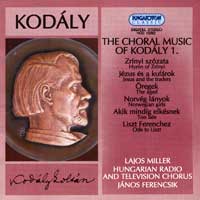
Hymn of Zrinyl Jesus and the traders The aged Norwegian girls Too late Ade to Liszt |
In the 1930s Hungarian composer Zoltan Kodaly breathed new life into a form that had been dormant in Europe since the Renaissance, polyphonic choral music. Janos Ferencsik directs the Hungarian Radio and Television Choirs in 6 of Kodaly's best, all sung a cappella in Hungarian: "Hymn of Zrinyl," "Jesus and the Traders," "The Aged," "Norwegian girls" (written in 1940 and said to be in sympathy with Norway, just overrun by Hitler's Reich), "Too Late" and "Ode to Liszt." This is striking, dramatic, impressionistic, historic music, beautifully performed by one of Europe's great mixed choruses.
| 7759 CD $15.98 |
![]() |
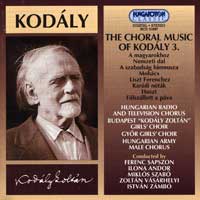
To the hungarians National Song Soldier's Song Battle Song Wish for Peace 0 The year 1801 The Hymn of Liberty Geneva Psalm CL I will go look for Death The Forgotten Song of Balint Balassi Mohacs Ode to Ferenc Liszt Molnar Anna Orphan am I Songs from Karad Huszt The Peacock |
Legendary Hungarian composer Zoltan Kodaly's 150-odd vocal works created a second golden age in the history of choral music and a flowering of the choral singing movement. These 16 songs, performed by Hungarian Radio and Television Chorus, Conducted by Janos Ferencsik, with Budapest "Kodaly Zoltan" Girls' Choir and Hungarian Army Male Chorus, are filled with national fervor and love of liberty and peace: "To the Hungarians," "National Song," "Soldier's Song," "Battle Song," "Wish for Peacethe Year 1801," "The Hymn of Liberty," "Geneva Psalm CL," "I will go look for Death," "Orphan am I," "Songs from Karad" and "The Peacock"these are inspirational, dramatic songs, some of them national anthems. "Choral Music of Kodaly 3" beautifully shows the power of one of the most brilliant 20th century composers to create a new renaissance of spirited choral groups and music.
| 7758 CD $15.98 |
![]() |
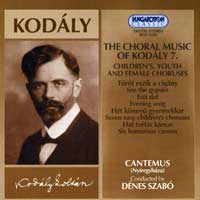
See the gypsies Evening song Seven easy children's choruses Dancing song Stork song Hippity, hoppity Six humorous canons Honey, honey King Laszlo's men Gypsy lament Cohors generosa Horatii carmen Greeting on St John's Day St Gregory's Day Geneva Psalm CL A Christmas carol Hymn to St Stephen Angels and shepherds Epiphany Whitsuntide |
Hungary's most famous and innovative composer, Zoltan Kodaly explains his artistic mission thus: "One must write original works, whose point of departure, in their texts and melodies, is the child's soul and the child's voice." One of Kodaly's main interests was the teaching of singing in schools, and conductor Denes Szabo has followed that path, beginning at Primary School No. 4 in Nyiregyhaza in 1969. He directs the school's Cantemus Children's Chorus in 21 of Kodaly's compositions for children's, youth and female choruses, like "See the gypsies," "Evening song," "Seven easy children's choruses," "Hippity hoppity," "Honey, honey," "Gypsy lament," "St. Gregory's Day," "Angels and Shepherds" and "Epiphany." Spirited, award-winning Cantemus, directed by Szabo, is the perfect choice to sing this difficult, beautiful material. "Choral Music of Kodaly 7" is a treat!
| 7557 CD $15.98 |
![]() |
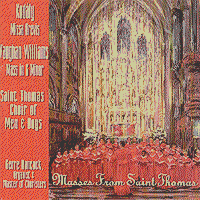
Missa Brevis: Introitus - Maestoso Kyrie - Andante Gloria - Allegro Credo - Allegro moderato Sanctus - Larghetto Bendictus - Tranquillos Agnus - Adagio Ite, missa est - Maestoso Mass in G Minor Kyrie - Slow Gloria in excelsis - Moderato Credo - Con moto Sanctus, Osanna I - Lento, Moderato maestoso Benedictus, Osanna II - Moderato tranquillo, Moderato maestoso Agnus Dei - Moderato |
Hungary's Zoltan Kodaly (1882-1967) and England's Ralph Vaughan Williams (1872-1958 ) were contemporaries who composed beautiful, dramatic Christian sacred music. NYC's Saint Thomas Choir of Men and Boys brings us examples of the best work of the two men, the 8 movements of Kodaly's "Missa Brevis" and the 6 movements of Williams' "Mass in G Minor." Now 75 years old, the Mass has long been a masterpiece of the first order, calling for no formal analysis. An extraordinary interplay of solo voices and choir, this powerful revival of Tudor church music places the listen at the very center of a medieval cathedral choir. "Missa Brevis," written by Kodaly in the middle of WWII, is a dramatic sacred piece that carries us aloft with the main theme of the Kyrie, finally bringing us back to a quieter space with "Sanctus Larghetto," "BenedictusTranquillo, Larghetto. Beautiful, stunning music performed by the pride of New York City, the Saint Thomas Choir of Men and Boys.
| 6920 CD $15.98 |
![]() |
Laudes Organi Esti Dal Panga Lingua Este Missa Brevis Introitus Kyrie Eleison Gloria Credo Sanctus Benedictus Agnus Dei Ite Missa Est |
"Laudes Organi" was the last large scale work (1966) Kodály completed. A secular rather than a religious work, it is based on an eloquent Latin text and is "a fantasy on a twelfth century sequence". The work is a summing up of the composer’s many interests; the spirit of Gregorian chant, the parlando of Hungarian folk song, the almost visual effects he paints with the divided voices and the magnificent organ interludes, reminiscent of the polyphonic writing of Bach. The whole is nevertheless unmistakably Kodály and is a wonderful affirmation of his faith in the life-giving power of music. The much-loved " Esti Dal" is based on a folksong collected in Northern Hungary by Kodály in 1922. "Este", a youthful work - Kodály was barely 20 when he set the poem by his university teacher Pál Gyulai. The work attained its final form in 1904 and shows remarkable maturity and control. The six-part mixed choir is used to paint a wonderfully evocative pastel of the poem’s subject, the peaceful drifting into sleep.
| 8477 CD $15.95 |
![]() |
Misere Este / Evening Turot Eszik A Cigany / See The Gypsies Munching Cheese Uj Esztendot Koszonto / A Christmas Carol Koszonto / A Birthday Greeting Matrai Kepek / Matra Pictures Oregek / The Aged Akik Mindig Elkesnek / Too Late Jezus Es A Kufarok / Jesus And The Traders Horatii CArmen II. 10 Szekely Kereves / Transylvanian Lament Molnar Anna / Annie Miller Liszt Ferenchez / Ode To Liszt A Magyarokhoz / Song Of Faith |
Kodaly stared composing choral works in his student years but he only became a primarily choral composer after the success of Psalmus Hungaricus, from the mid-1920s. This compilation is the first in the set of the Complete Works for Mixed Choir by Zoltan Kodaly. The CD contains, with the exceptions of a short occassional piece, the a cappella compositions of more than three decades. The composer's corrections in the manuscripts and printed scores could be adopted in this recording courtesy of Mrs. Sarolta Kodaly.
| 9848 CD $15.95 |
![]() |
The Peacock - Ady Our Father - Szedo Hymn To The King Saint Stephen Evening Song Greeting On St. John's Day Do Not Grieve - Horvath Norwegian Girls Weores First Communion - Szedo The Forgotten Song Balint Balassi - Gazdag Cohors Generosa Advent Song Geneva Psalm 121 Beseeching - Balassi Song From Gomor To The Transylvanians - Peotfi BAttle Song - Petofi The Hungarian Nation - Petofi Lament - Bodrogh |
Even if we consider only his works for mixed choir, we can see how prolific Zoltan Kodaly was between 1937 and 1947, although this recording contains some later transcriptions as well. Corrections printed in the scores were adopted in this recording thanks to Mrs. Sarolta Kodaly.
| 9845 CD $15.95 |
![]() |
To The Singing Youth - Varga Adoration Wish For Peace - Virag The Arms Of Hungary - Vorosmarty Mohacs - Kisfaludy Media Vita In Morte Sumus La Marseillaise - De L'isle Epigraph - Jankovich Stabat Mater - Todi Te Deum Of Sandor Sik Come, Holy Ghost - Batizi Hymn Of Zrinyi I Will Go Look For Death - MAsefield An Ode For Music Geneva Psalm L |
The period from 1948 to his death in 1967 was for Kodaly about reaping the fruits. He was a Member of the Hungarian Academy of Sciences and Chairman from 1946 to 1949. He received three Kossuth Awards (1948, 1952, 1957), as doctor honoris causa degrees from the universities of Oxford (1960), East Berlin (1964) and Toronto (1966) and honorary memberships from a number of academies around the world. He was made president of the International Folk Music Council in 1961 and honorary memberships from a number of academies around the world. He was made president of the International Society of Music Education in 1964. Two years before his death, in 1965, he received the Herder Prize. He travelled extensively between1960 and 1966, chairing conferences, lecturing throughout Europe in English, German, French and Italian. He lived to see his ambitious plans be accomplished. Edited by Kodaly, the first firve volumes of Magyar Nepzene Tara came out between 1950 and 1967 and at the same time daily music classes based o the Kodaly method were introduced in 120 schools. In the last twenty years of his life his compositional spirit never flagged either; he wrote masterpieces including Hymn of Zrinyi, Mohacs and Laudes organi, and completed Symphony, begun back in the Thirties and previered in 1961 under the baton of Ferenc Fricsay.
| 9840 CD $15.95 |
![]() |
Performing The Rounds Rounds General Categories (Sacred, Secular, Topical) Pedagogical Categories Pronunciation Guide Other Useful Collections |
This flexible collection offers a wealth of excellent material for singing in rounds. All of the standard rounds are represented, including many by master composers as well as anonymous ones. The book is divided into three main sections: rounds with texts, rounds without texts and selected rounds in score format. In addition to a complete alphabetical index, there are separate listings of rounds with sacred texts, rounds with secular texts, rounds about animals, rounds about bells, Christmas rounds, rounds in foreign languages, lullabies, rounds about music, rounds about nature, rounds about singing and street cries. There's even an additional listing of rounds in two parts, three parts, four, five and six parts. This is one collection no music library should be without! From the Kodály Choral Concept. Includes index based on song content and teaching concepts.
| 9196 BOOK $29.95 |

Based on sol-fa notation combined with unaccompanied part singing from the earliest stages in a child's school music, the Kodaly Method develops musical literacy, secure intonation and rhythmic confidence - essential fundamentals of sound music education
| 6364 BOOK $7.95 |

| 6363 BOOK $6.95 |

The Kodaly Choral Concept is revised in an English Edition by Geoffry Russell-Smith.
| 6365 BOOK $11.98 |

A collection of unaccompanied works from the famed Hungarian composer.
| 9199 BOOK $16.95 |
![]() |
Mountain Nights I (SSA div.) |
A facinating and fun set of wordless songs by the Hungarian master.
| 9079 SHEET MUSIC $7.50 |
![]() |
Hippity, Hoppity (SSA) |
The Hungarian composer, Zoltán Kodály, an ethnomusicologist and educationalist, pioneered the reintegration of folk material into 20th century choral music. All four songs in this packages are arrangements based on Hungarian folk songs for children, with english translations by Georffy Russell-Smith.
| 9080 SHEET MUSIC $8.98 |
Choral - Home | Mens Choral | Womens Choral | Mixed Choirs | Early Music
Childrens Choir | Boys Choirs | Girls Choirs | Choral arrangements | Choral Christmas | Director's resources
African | English | Canadian | Bulgarian | Estonian | Hungarian | Scandinavian | Russian | Latin American
Spirituals | Madrigals | Budget Choral titles | DVDs | Complete choral list
RSS Feed - Choral New Releases
Vocal Jazz| Contemporary | Barbershop | Gospel | Christian | World | Choral | Doo Wop
Arrangements | Women's | Collegiate | Vintage | DVDs | Instructional
The Harmony Sweepstakes A Cappella Festival | West Coast A Cappella Summit
To find a specific song on any recording (or to find recordings by group name or CD title),
pick the search method and type the item you are searching for here: