
In Celebration of the Human Voice - The Essential Musical Instrument
Home | Doo Wop | Barbershop | World | Contemporary | Christian | Vocal Jazz | Choral | Christmas | Instructional | Arrangements
Classical | Opera | Musicals | Personality | Young Singers | Disney | Videos | Songs | The Artists

Bela Bartok
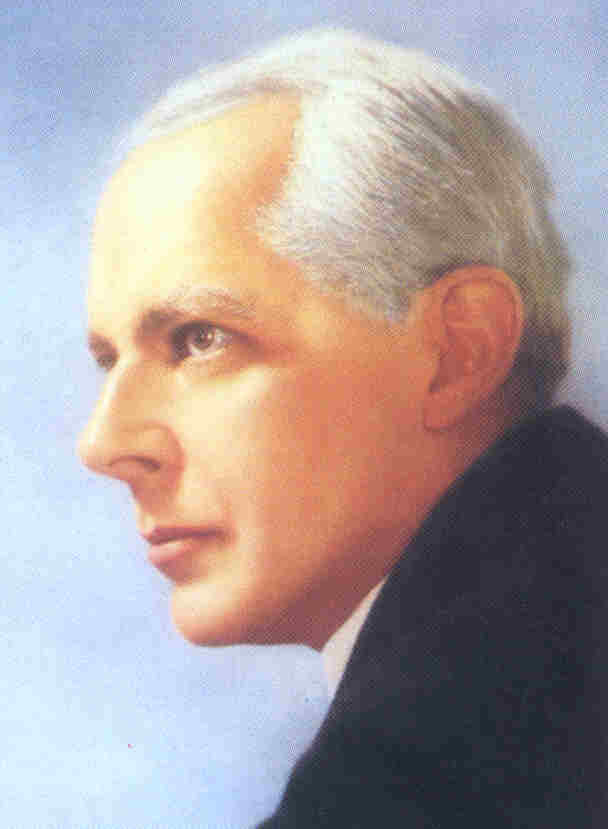
Bela Viktor Janos Bartok was a Hungarian composer, pianist and collector of Eastern European and Middle Eastern folk music. Bartok is considered one of the greatest composers of the 20th century. He was one of the founders of the field of ethnomusicology, the study and ethnography of folk music. Bela Bartok began lessons with his mother, who brought up the family after his father's death in 1888. In 1894 they settled in Bratislava, where he attended the Gymnasium (Dohnanyi was an elder schoolfellow), studied the piano with Laszlo Erkel and Anton Hyrtl, and composed sonatas and quartets. In 1898 he was accepted by the Vienna Conservatory, but following Dohnanyi he went to the Budapest Academy (1899-1903), where he studied the piano with Franz Liszt's pupil Istvan Thoman and composition with Janos Koessler. There he deepened his acquaintance with Wagner, though it was the music of Strauss, which he met at the Budapest premiere of Also sprach Zarathustra in 1902, that had most influence. He wrote a symphonic poem, Kossuth (1903), using Strauss's methods with Hungarian elements in F. Liszt's manner. |
Arrangements | Recordings
Songbooks, Arrangements and/or Media
Displaying 1-8 of 8 items.
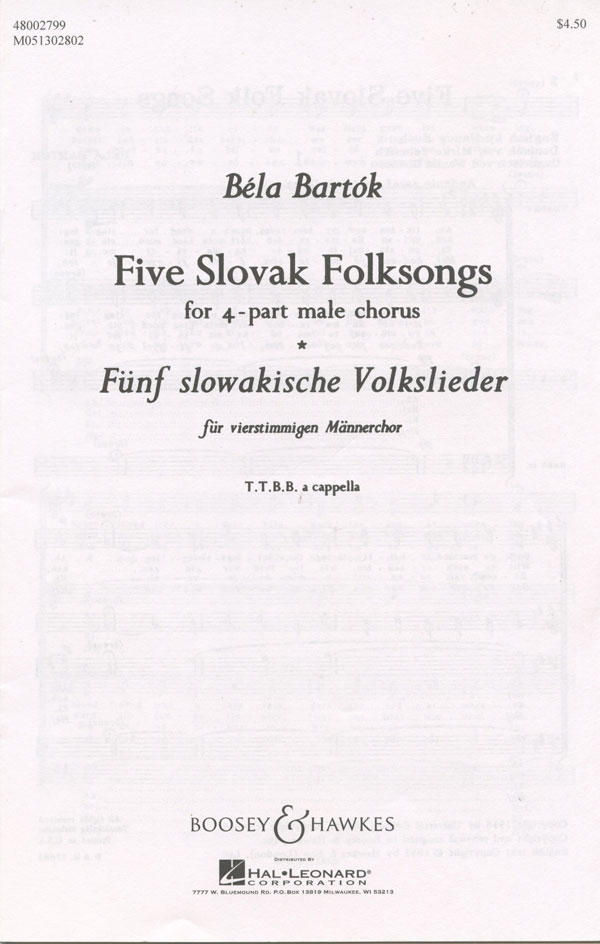
Bela Bartok : Five Slovak Folksongs "Many people think it is a comparatively easy task to write a composition on found folk tunes... This way of thinking is completely erroneous. To handle folk tunes is one of the most difficult tasks; equally difficult, if not more so, than to write a major original composition. If we keep in mind that borrowing a tune means being bound by its individual peculiarity, we shall understand one part of the difficulty. Another is created by the special character of folk tune. We must penetrate it, feel it, and bring out its sharp contours by the appropriate setting... It must be a work of inspiration just as much as any other composition." - Bela Bartok. Includes English text. 
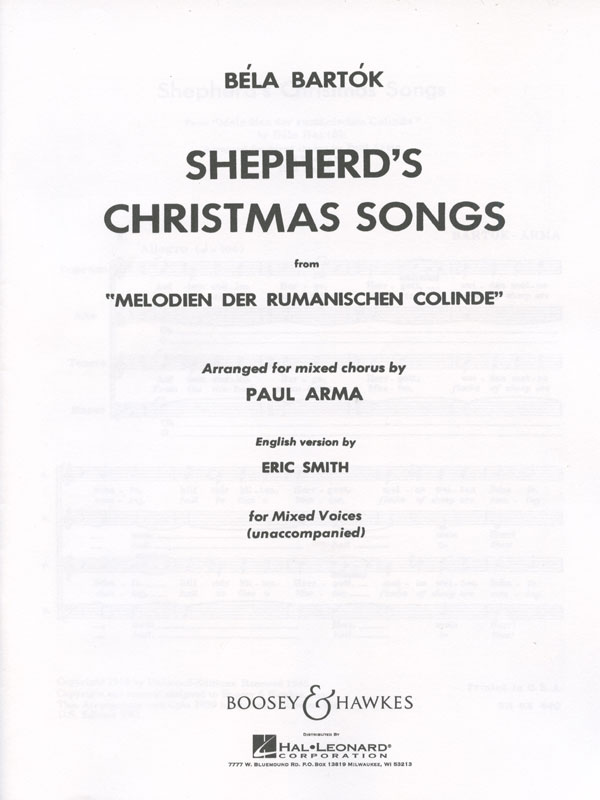
Bela Bartok : Shepherd's Christmas Songs Arranged for unaccompanied mixed voices by Paul Arma with English text by Eric Smith these pieces are from "Melodien der Rumanischen Colinda".
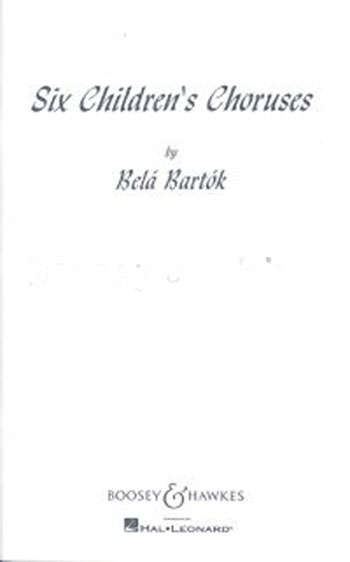
Bela Bartok : Six Songs for Children's Choruses The original version of these choruses was an a cappella version; later an orchestral accompaniment was added. The piano reduction of the latter has merely been added to the present edition for rehearsal purposes when preparing the choir for a performance with orchestra. it is the composer's intention that performances should talk place either a cappella or with orchestra, but not with piano. Songlist: Hussar, Only Tell Me, Loafer, Bread Baking, Don't Leave Me!, Teasing Song
Bela Bartok : Hungarian & Slovak Folksongs Text in English, German and Hungarian. Songlist: Four Old Hungarian Folksongs, Five Slovak Folksongs
Bela Bartok : Three Hungarian Folk Songs "Many people think it is a comparatively easy task to write a composition on found folk tunes... This way of thinking is completely erroneous. To handle folk tunes is one of the most difficult tasks; equally difficult, if not more so, than to write a major original composition. If we keep in mind that borrowing a tune means being bound by its individual peculiarity, we shall understand one part of the difficulty. Another is created by the special character of folk tune. We must penetrate it, feel it, and bring out its sharp contours by the appropriate setting... It must be a work of inspiration just as much as any other composition." - Bela Bartok Songlist: Mocking of Youth - from Four Women's Choruses, Spring, Enchanting Song
Bela Bartok : Choral Works for Children's and Female Voices Based on the Béla Bartók Complete Critical Edition (Z. 15009), this volume includes Bartók's complete works for children's and female voices. The lyrics in this Urtext edition are in the original languages, but literal English translations are provided in the appendix, which also includes English versions of those of the 27 Two- and Three-Part Choruses that were authorized by the composer. The edition is complete with an informative preface (in Hungarian, English, and German) and detailed Editorial Comments (in Hungarian and English). The Comments give an overview of the textual, folk-music, and compositional sources, and provide detailed information on the performance practice of Bartók's choral works. The edition has been printed on high-quality and environmentally-friendly paper. This volume is also available cloth-bound, along with the volumes for male voices and for mixed voices, in slipcase (HL50603804). Separate editions of each work included in this volume are also available.
Bela Bartok : Choral Works for Male Voices Based on the Béla Bartók Complete Critical Edition (Z. 15009), this volume includes Bartók's complete works for male voices. The lyrics in this Urtext edition are in the original languages and in the translations authorized by the composer. Literal English translations are provided in the appendix, which also includes the early version of Four Hungarian Folk Songs and the German version of movements 3 to 6 from Székely Folk Songs. The edition is complete with an informative preface (in Hungarian, English, and German) and detailed Editorial Comments (in Hungarian and English). The Comments give an overview of the textual, folk-music, and compositional sources, and provide detailed information on the performance practice of Bartók's choral works. The edition has been printed on high-quality and environmentally-friendly paper. This volume is also available cloth-bound, along with the volumes for children's and female voices and for mixed voices, in slipcase(HL50603804). Separate editions of each work included in this volume are also available.
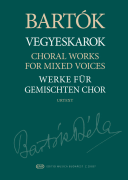
Bela Bartok : Choral Works for Mixed Voices Based on the Béla Bartók Complete Critical Edition (Z. 15009), this volume includes Bartók's complete works for mixed voices. The lyrics in this Urtext edition are in the original languages and in the translations authorized by the composer. Literal English translations are provided in the appendix. The edition is complete with an informative preface (in Hungarian, English, and German) and detailed Editorial Comments (in Hungarian and English). The Comments give an overview of the textual, folk-music, and compositional sources, and provide detailed information on the performance practice of Bartók's choral works. The edition has been printed on high-quality and environmentally-friendly paper. This volume is also available cloth-bound, along with the volumes for children's and female voices and for male voices, in slipcase (HL50603804). Separate editions of each work included in this volume are also available. |
 Vocal Harmony Arrangements - Home
Christian | Gospel | Standards | Musicals | Specialty | World | Barbershop | Contemporary | Vocal Jazz | Choral | Christmas
Mixed Voices | Female | Male | 8 Parts | 6 Parts | 5 Parts | 3 Parts | 2 Parts | Medleys | Solo | Folio Series | New Releases
Select a Category |
Want to Sing? - Find a Chorus Near You
List of Choruses by State | List of Choruses by City